
Official statement
Other statements from this video 10 ▾
- □ Pourquoi Google réduit-il le SEO à seulement deux domaines principaux ?
- □ Existe-t-il vraiment des secrets pour être classé premier sur Google ?
- □ Le SEO Starter Guide de Google contient-il vraiment toutes les techniques essentielles pour ranker ?
- □ Pourquoi Google recommande-t-il Search Console plutôt que Trends pour les exigences techniques SEO ?
- □ Faut-il vraiment courir après les tendances montantes pour ranker ?
- □ Google Trends est-il vraiment efficace pour identifier les bons mots-clés ?
- □ Google Trends peut-il vraiment révéler vos opportunités SEO manquées ?
- □ Faut-il vraiment publier son contenu avant les pics de recherche saisonniers ?
- □ Google Trends peut-il vraiment booster votre stratégie vidéo YouTube ?
- □ Pourquoi les tendances de recherche YouTube diffèrent-elles de celles du web Google ?
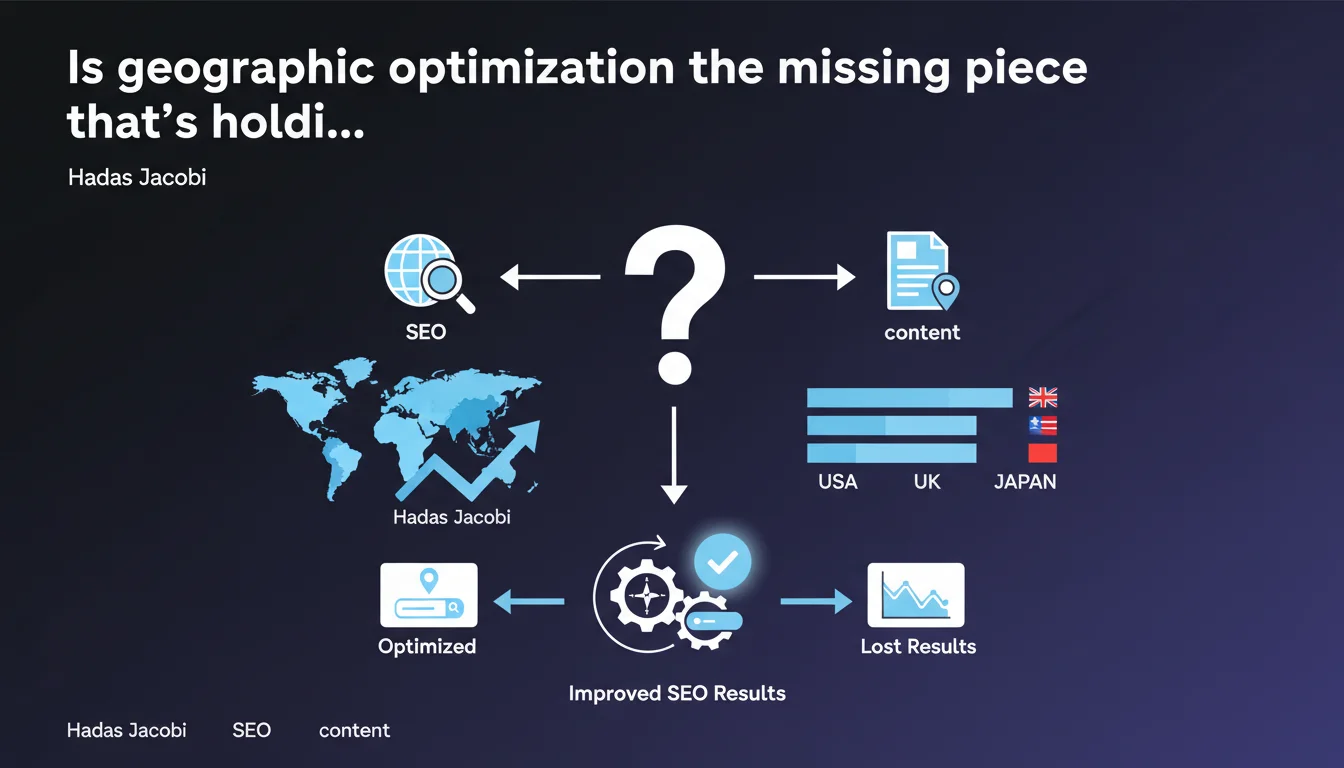
Google confirms that search trends vary significantly by country and region — so you must calibrate your content for the geographic audience you're actually targeting. Optimizing for the wrong territory dilutes your efforts and tanks your relevance. Local adaptation isn't optional: it's a prerequisite for winning.
What you need to understand
What does Google mean by "optimizing for the right geographic audience"?
Google is reminding us of an obvious truth that's often overlooked: search queries, user intent, and search volumes differ dramatically from one market to another. What works in France might be marginal in Belgium or Quebec. What ranks #1 in the United States could be completely off-topic in the UK.
Hadas Jacobi is talking about content prioritization here. In other words, stop creating generic content and hoping it resonates everywhere with everyone. Local signals — language, culture, semantic variations, seasonality — carry significant weight in Google's local relevance algorithm.
What are the risks of poor geographic calibration?
The first risk is producing invisible content because nobody is actually searching for those terms in that region. The second is triggering conflicting signals: backlinks from country A, hosting in country B, content written for country C. Google hates geographic ambiguity.
Concretely, if you're targeting French-speaking Switzerland with Paris-centric vocabulary, you're missing the target. If you're optimizing for the French market using a .com extension hosted in the USA without GSC geotargeting, you're unnecessarily complicating things for Google.
Are search trends really that different from one region to another?
Absolutely. Search volumes, seasonality, synonyms, and even user intent all change. "Location" doesn't mean the same thing in French and English. "Avocat" can mean a fruit or a legal professional depending on geographic context.
Google Trends by region makes this crystal clear: a term can be exploding in the Île-de-France region and virtually nonexistent in Occitania. Mobile searches vary based on urban density. Local queries spike in certain tourist areas at specific times of year.
- Prioritize content based on actual search volumes observed in your target area, not assumptions
- Adapt vocabulary to regional variations: Québécois vs. French vs. Belgian vs. Swiss
- Calibrate technical signals: hreflang, GSC geotargeting, hosting location, local backlinks
- Monitor seasonal trends specific to each region so you can anticipate traffic spikes
SEO Expert opinion
Is this statement consistent with real-world practices?
Yes, and it states the obvious for anyone who's been doing international or multi-regional SEO for years. Google's algorithms have long incorporated multiple geographic signals: server IP location, domain extension, local backlinks, Google Business Profile mentions, local user behavior.
What's interesting is that Google is stating this explicitly in the context of editorial prioritization. The subtext: stop creating random content and hoping it lands somewhere. Do proper keyword research by region first.
What nuances should we add to this recommendation?
The statement remains intentionally vague on the right geographic granularity. Are we talking countries, administrative regions, metropolitan areas, or neighborhoods? Google doesn't specify. [To verify]: how granular should segmentation be for national sites with dispersed audiences?
Another point: Hadas Jacobi doesn't address hybrid or multi-target content. What do you do when your audience is spread across multiple regions with similar but not identical expectations? Duplicate? Create a neutral version? Use dynamic content? No clear guidance.
When does this rule not really apply?
For purely international or multi-language sites with proper hreflang strategy, the problem is already framed. Each regional version has dedicated content, aligned technical signals, local backlinks. The recommendation becomes obvious.
However, for single-domain sites with mixed audiences (e.g., a .com targeting France + Belgium + Switzerland + French-speaking Canada), implementation becomes murky. Should you segment by subfolder? Subdomain? Google doesn't decide.
Practical impact and recommendations
What should you do concretely to optimize by geographic zone?
Start with region-segmented keyword research. Google Trends, Semrush with geographic filters, Google Keyword Planner with local targeting. Identify actual search volumes, lexical variations, queries specific to each market.
Next, align your technical signals. If you're targeting a specific market with a generic domain (.com, .net), use geographic targeting in Google Search Console. If you have multiple language or regional versions, implement hreflang properly — no circular chains, no missing self-references.
Finally, adapt the content itself: vocabulary, examples, currencies, units of measurement, cultural references. Content calibrated for Paris doesn't resonate in Montreal. Nuances matter.
What errors should you avoid in geographic optimization?
Classic mistake: duplicating identical content across multiple regional versions while changing just a few words. Google detects duplication and may ignore the variants. Either create genuinely differentiated content or canonicalize to one main version.
Another trap: mixing geographic signals. A .fr site hosted in the USA with mostly German backlinks, targeting France in GSC but with content in English. Google doesn't know where you're located, and your local relevance collapses.
Third error: ignoring local trends. Optimize for "hiking boots" in general without realizing that in certain mountainous regions, searches explode in May-June, while elsewhere it's September-October. You miss visibility windows.
How do you verify that your site is properly calibrated geographically?
Check Google Search Console: Performance tab, filter by country. You should see impressions and clicks concentrated on your target area. If you're supposed to target France but 40% of your impressions come from India, that's a red flag.
Analyze your backlinks by geographic origin. A link profile consistent with your target market strengthens local signals. Predominantly foreign backlinks dilute your local relevance.
Test your main queries with tools that simulate geolocation (VPNs, regional proxies, SE Ranking with local targeting). Compare actual SERPs across regions. If you're not appearing where you should be, your geographic signals are miscalibrated.
- Segment your keyword research by region and identify local lexical variations
- Configure geographic targeting in Google Search Console if using a generic domain
- Implement hreflang correctly if you have multiple language or regional versions
- Adapt content to local specifics: vocabulary, examples, currencies, cultural references
- Audit your backlinks: prioritize links from your target zone to strengthen local signals
- Verify in GSC Performance that impressions and clicks are concentrated on your target market
- Test your rankings with geolocation tools to spot inconsistencies across regions
- Monitor seasonal trends specific to each region to anticipate search peaks
❓ Frequently Asked Questions
Faut-il créer un domaine distinct pour chaque région ciblée ?
Hreflang est-il indispensable pour cibler plusieurs régions francophones ?
Comment Google détecte-t-il la zone géographique ciblée par un site ?
Peut-on cibler plusieurs régions avec un seul domaine .com ?
Les backlinks locaux impactent-ils vraiment le SEO géographique ?
🎥 From the same video 10
Other SEO insights extracted from this same Google Search Central video · published on 25/09/2024
🎥 Watch the full video on YouTube →
💬 Comments (0)
Be the first to comment.