
Official statement
What you need to understand
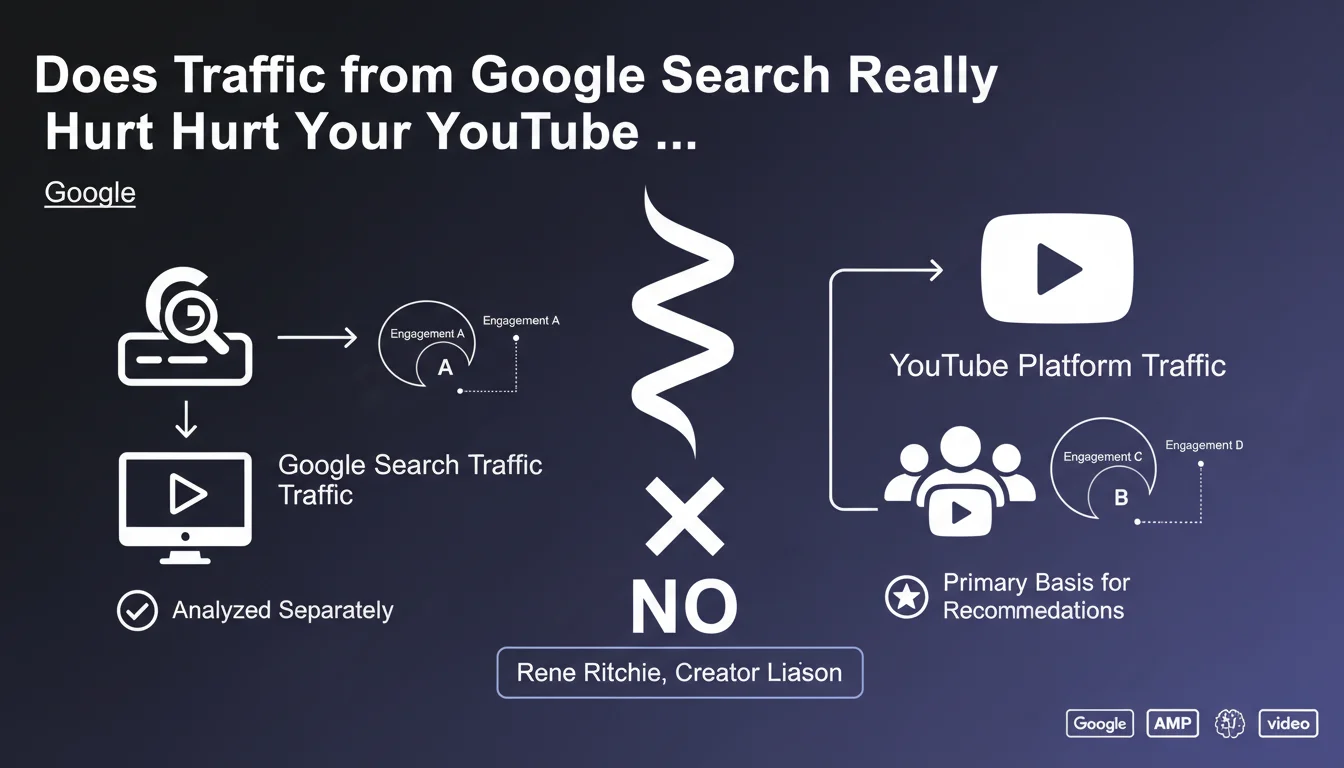
YouTube has just officially clarified a crucial point that worried many creators and SEO professionals: traffic coming from Google Search does not negatively impact video recommendations on the platform.
Concretely, this means that engagement metrics are analyzed separately according to each traffic source. A video that performs less well with an audience coming from Google Search will not be penalized in YouTube's general recommendation algorithm.
YouTube's recommendation system primarily focuses on interactions coming from its own platform. In other words, it's the users who discover your videos via the YouTube homepage, suggestions, or subscriptions that weigh most heavily in the algorithm.
- Each traffic source (Google Search, YouTube homepage, suggestions, etc.) is evaluated independently
- External traffic does not degrade the overall performance of your videos in recommendations
- The algorithm prioritizes engagement signals from the native YouTube ecosystem
- Retention and engagement metrics remain crucial, but are contextualized by source
SEO Expert opinion
This clarification from YouTube is consistent with what we've been observing for several years in our performance analyses. Videos that receive a lot of SEO traffic from Google do not indeed seem to suffer any algorithmic penalty on their internal recommendations.
However, an important nuance must be made: while Google Search traffic doesn't directly penalize, the quality of engagement remains decisive. A video optimized for an informational keyword that attracts visitors looking for a quick answer will naturally have a lower retention rate. This is not a penalty, but a logical consequence of the mismatch between search intent and content.
In practice, this confirms that a hybrid strategy remains optimal: optimize for Google Search for initial discovery, while creating content that encourages subscriptions and interactions to fuel the internal recommendation algorithm.
Practical impact and recommendations
- Continue optimizing your videos for Google Search without fear of penalizing your YouTube recommendations: SEO-friendly titles, descriptions, and tags remain relevant
- Segment your content strategy: some videos can specifically target Google traffic (tutorials, specific questions), others the YouTube algorithm (entertaining content, series)
- Analyze your metrics by traffic source in YouTube Analytics to understand which type of content performs better depending on visitor origin
- Work on native YouTube engagement: encourage subscriptions, notifications, comments, and additional video viewing to fuel the recommendation algorithm
- Optimize the first few seconds differently depending on your objective: quick hook for informational SEO traffic, storytelling for recommendation traffic
- Don't neglect native YouTube metadata: chapters, end screens, interactive cards that promote internal navigation
- Test hybrid formats: videos that answer an SEO question in the first 2 minutes, then develop the topic to retain the YouTube audience
💬 Comments (0)
Be the first to comment.