
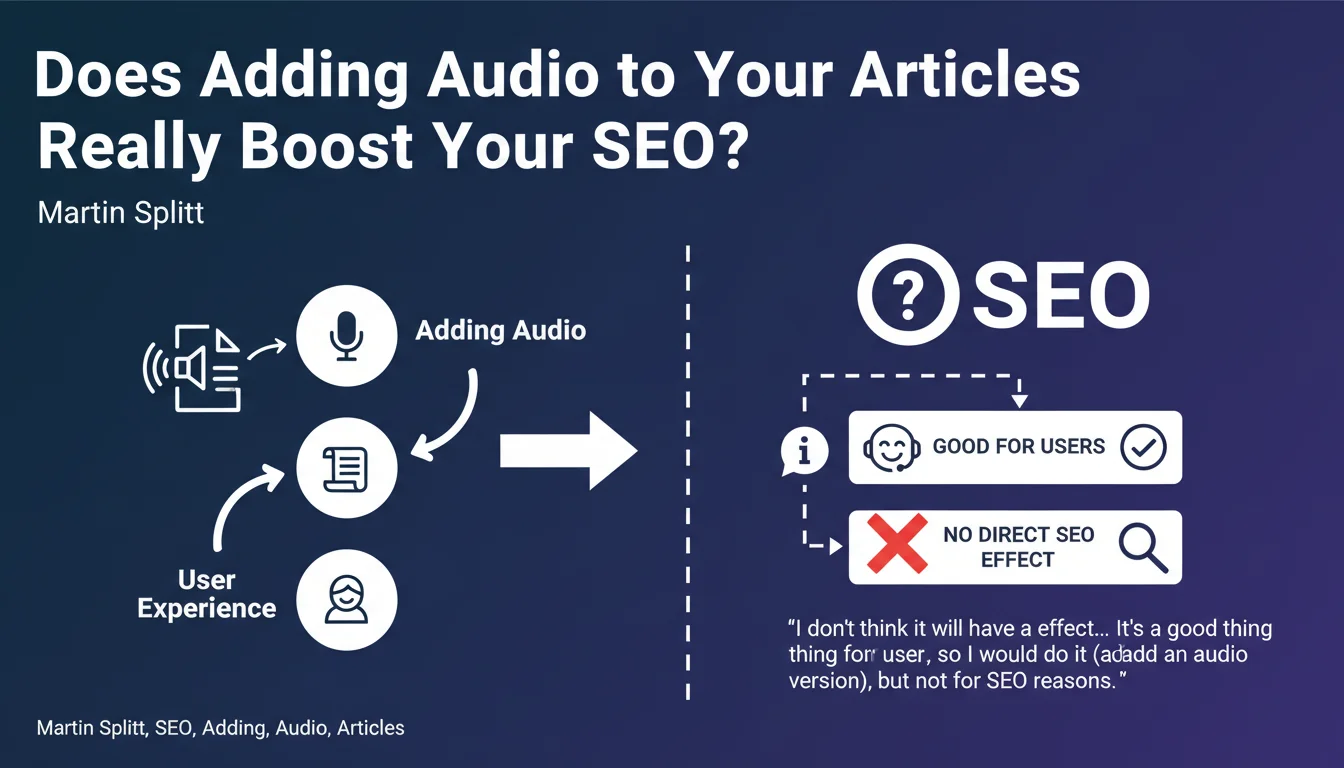
Official statement
What you need to understand
Martin Splitt, a developer at Google, recently provided an important clarification regarding the impact of audio versions integrated into blog articles. His position is unequivocal: adding an audio file to your text content has no direct effect on organic search rankings.
This statement may surprise some SEO practitioners who hoped that multimedia enrichment of pages would have a positive impact on rankings. Google does not consider adding audio as a direct ranking signal, unlike other on-page factors.
However, Martin Splitt specifies that it is a beneficial feature for user experience. Audio addresses accessibility needs and offers an alternative way to consume content, particularly appreciated for on-the-go consumption.
- No direct SEO boost: audio is not a ranking factor
- Confirmed UX value: improves accessibility and engagement
- UX motivation, not SEO: implement for users only
- Google does not crawl or index audio content in a significant way for ranking purposes
SEO Expert opinion
This position from Google is consistent with what we've been observing in the field for several years. Tests conducted on sites integrating audio versions have never shown direct improvement in organic positions. The search engine remains fundamentally oriented toward textual content for understanding and ranking pages.
However, there are potential indirect effects that should not be completely overlooked. If adding audio significantly improves time spent on page, reduces bounce rate, or increases social shares, these behavioral signals can positively influence SEO. This is an indirect and secondary impact, but real.
In summary, audio is not an SEO tactic per se, but rather a user experience enhancement that can contribute to the overall site performance if properly implemented.
Practical impact and recommendations
- Don't prioritize audio in your SEO roadmap if your resources are limited
- Focus your efforts on fundamentals: textual content quality, HTML structure, internal linking, technical performance
- Add audio only if you've identified a real user need (accessibility, mobile audience, long reads)
- Measure UX impact with behavioral metrics (time on page, scrolling, engagement) rather than SEO rankings
- Optimize audio file weight to avoid degrading Core Web Vitals, which would have a negative SEO impact
- Ensure that audio never replaces textual content, but complements it
- Invest in transcription if you create podcasts or native audio content
- Use appropriate schema.org markup (AudioObject) for primary audio content
Optimizing a balanced content strategy between SEO requirements, technical constraints, and user experience requires sharp expertise and a holistic vision. These strategic trade-offs, such as deciding whether to invest in audio or prioritize other more impactful levers, often prove complex to make without perspective and experience. Support from a specialized SEO agency can help you make the right investment choices and build a roadmap adapted to your actual resources and objectives.
💬 Comments (0)
Be the first to comment.