
Official statement
Other statements from this video 10 ▾
- □ Does Google really reduce SEO to just two main areas?
- □ Does Google's SEO Starter Guide really contain all the essential techniques you need to rank higher?
- □ Why does Google recommend Search Console over Trends for SEO technical requirements?
- □ Do you really need to chase every emerging trend to rank higher in Google?
- □ Is Google Trends really effective for identifying the right keywords?
- □ Can Google Trends really uncover your hidden SEO opportunities?
- □ Should you really publish your content before seasonal search peaks hit?
- □ Is geographic optimization the missing piece that's holding back your SEO results?
- □ Can Google Trends really accelerate your YouTube video strategy?
- □ Why do YouTube search trends differ so dramatically from traditional Google web search?
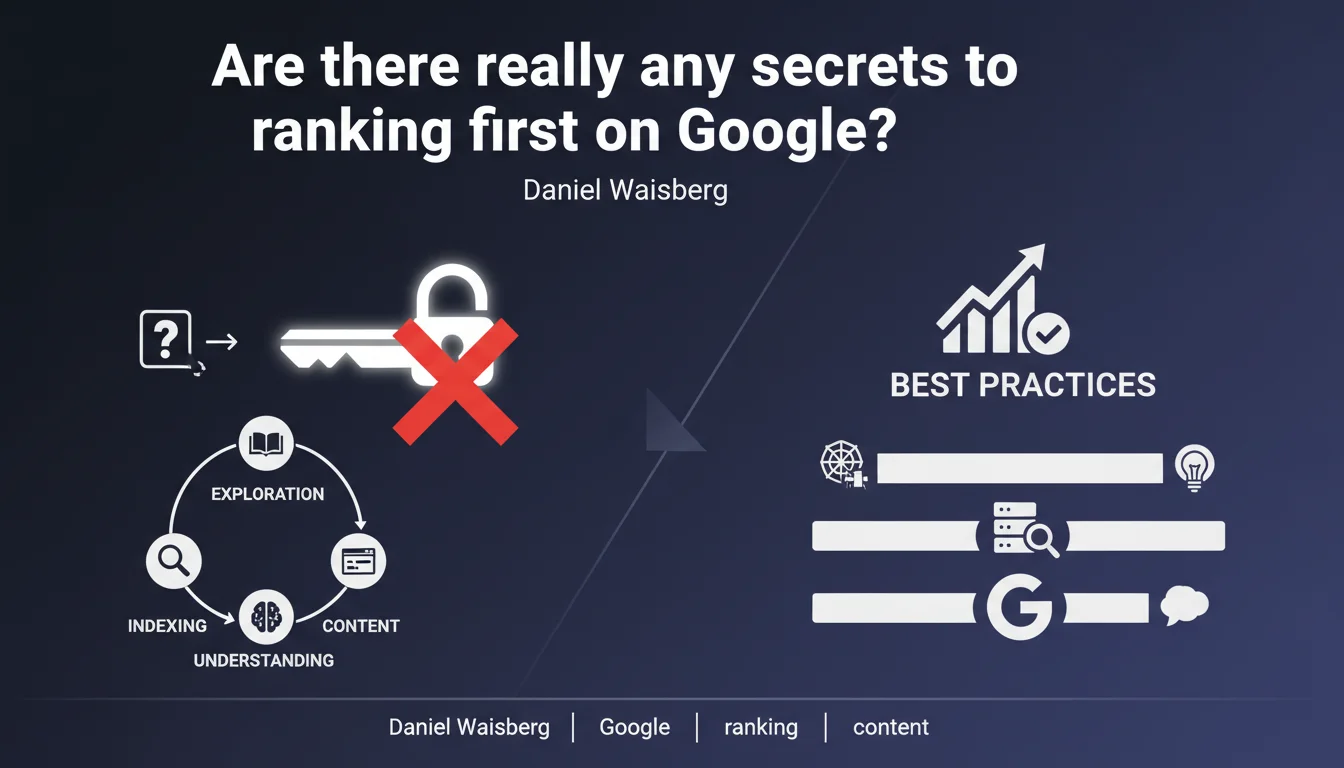
Google claims there are no secrets to achieving the top position, only solid exploration, indexing, and content understanding practices. This official statement reminds us that SEO relies on solid technical and editorial fundamentals, not hidden tricks.
What you need to understand
Why does Google insist there are no secrets?
This statement aims to discourage unrealistic expectations and the promises of miraculous results that some unscrupulous providers continue to sell. Google reminds us that ranking is based on complex algorithms that evaluate hundreds of signals.
By insisting on the absence of shortcuts, Google pushes professionals to focus on technical and editorial fundamentals. Exploration, indexing, and content understanding form the foundation of any viable SEO strategy.
What exactly does Google mean by "best practices"?
Google remains deliberately vague on this point. The best practices mentioned likely encompass: crawl budget optimization, site technical structure, content quality, user experience, and semantic relevance.
The problem? This evasive wording provides no concrete, actionable data. For an SEO professional, it's self-evident and brings nothing new to the table — but it deserves to be contextualized in real-world practice.
Is Google's position consistent with the reality of SEO?
Yes and no. Technically, Google is right: no isolated manipulation guarantees first place. But in practice, certain sectors display recurring ranking patterns that look very much like effective "recipes."
Sites that dominate competitive SERPs often share common characteristics: content depth, quality backlink volume, topical authority, freshness of updates.
- No magic formula, but SEO levers whose relative impact varies by sector
- Exploration and indexing remain absolute technical prerequisites before any optimization
- Content understanding comes through semantics, structure, and relevance signals
- Best practices evolve: what worked yesterday can be obsolete today
- Google values long-term consistency over short-term tactics
SEO Expert opinion
Is this statement actually useful for SEO professionals?
Honestly? It's stating the obvious. No serious practitioner has believed in "secrets" for years. What's missing here is the granularity of ranking criteria and their relative weighting based on different queries.
Google communicates constantly about best practices, but remains strategically vague about actual ranking factors. Result: SEO professionals continue to rely on field observation, A/B testing, and statistical correlations. [To verify]: the relative impact of each "best practice" varies enormously depending on the type of query, vertical, and search intent.
What field-based nuances should be applied to this claim?
First point: certain ultra-competitive sectors (finance, health, law) show that sites in the top position share very similar patterns. It's not a secret, but it's a solid empirical observation.
Second point: Google underestimates the importance of factors like domain age, historical consistency of your link profile, and topical authority built over years. These aren't "secrets," but durable competitive advantages that don't reduce to simple best practices.
Third point — and this is where it gets tricky: Google's algorithm is constantly evolving. Core updates, local adjustments, feature tests in certain regions… all of this creates chronic SERP instability. Result? Yesterday's best practices may become less effective tomorrow.
In what cases does this rule not fully apply?
On branded or ultra-specific queries, offline notoriety and perceived authority play a decisive role. A recent site backed by a recognized brand can bypass certain classic criteria.
Similarly, in low-competition niches, a few basic optimizations are enough to reach the first page. In these contexts, discussing complex "best practices" borders on overkill.
Practical impact and recommendations
What should you do concretely to maximize your ranking chances?
Start by auditing the exploration and indexing of your site. Verify that Googlebot can access all your strategic pages without friction. Identify blockages in robots.txt, recurring 4xx/5xx errors, and cascade redirects.
Next, optimize the semantic understanding of your content. Structure your pages with coherent heading tags, relevant Schema.org structured data, and logical internal linking that reinforces topicality.
Finally, work on the depth and freshness of your content. Google values pages that comprehensively answer search intents, with regular updates that signal active maintenance.
What errors should you absolutely avoid?
Don't fall into the over-optimization trap. Stuffing text with keywords, multiplying exact-match anchors in internal linking, or creating weakly differentiated satellite pages: all counter-productive practices.
Also avoid neglecting user experience signals. A slow site, poorly adapted to mobile, or with high bounce rates sends negative signals that weigh on ranking, even if the content is technically correct.
How can you verify your site respects the fundamentals?
Use Search Console to identify indexing errors, coverage issues, and crawl anomalies. Cross-check this data with a tool like Screaming Frog to map your site's actual architecture.
Measure technical health via PageSpeed Insights, Lighthouse, and Core Web Vitals. A technically performant site has a clear competitive advantage, especially on mobile.
- Audit your robots.txt file and XML sitemap to eliminate crawl blockages
- Fix all 4xx/5xx errors detected in Search Console
- Optimize loading time and Core Web Vitals
- Structure your content with coherent heading tags and structured data
- Strengthen internal linking to distribute PageRank and topicality
- Regularly update your strategic content to signal freshness
- Analyze competitor SERPs to identify observable ranking patterns
- Monitor algorithm evolution and adjust your strategy accordingly
❓ Frequently Asked Questions
Est-ce que Google partage vraiment tous les critères de classement ?
Les bonnes pratiques SEO suffisent-elles pour atteindre la première position ?
Pourquoi Google insiste-t-il autant sur l'exploration et l'indexation ?
Cette déclaration remet-elle en cause les stratégies SEO avancées ?
Faut-il encore investir dans le SEO si Google dit qu'il n'y a pas de secret ?
🎥 From the same video 10
Other SEO insights extracted from this same Google Search Central video · published on 25/09/2024
🎥 Watch the full video on YouTube →
💬 Comments (0)
Be the first to comment.