
Official statement
Other statements from this video 4 ▾
- □ Why Should You Use Topics Instead of Exact Search Terms in Google Trends?
- □ Should you monitor what your competitors' audiences are searching for to unlock hidden content opportunities?
- □ Can Google Trends really replace your dedicated SEO keyword research tools?
- □ Should you really be monitoring emerging topics in Google Trends to stay ahead of SEO opportunities?
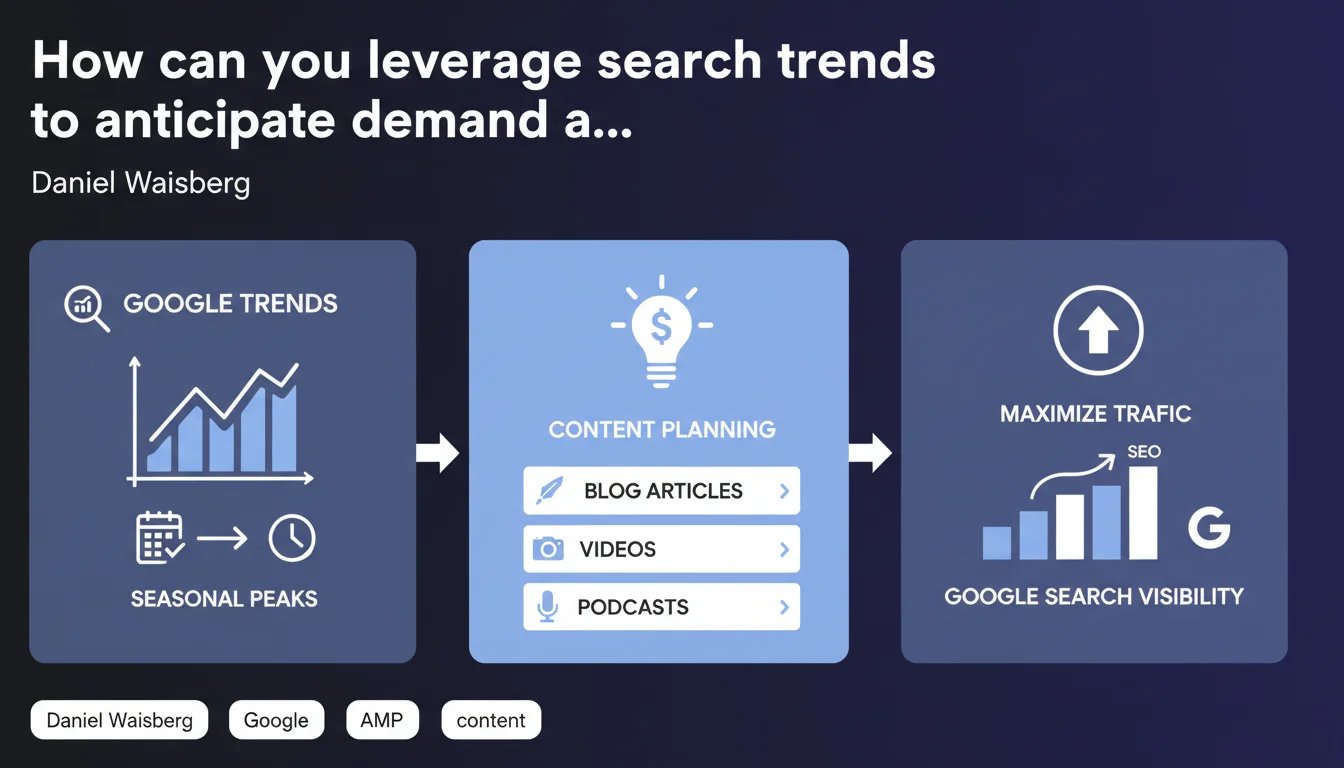
Google confirms that Google Trends data makes it possible to identify seasonal peaks in search interest for certain topics, and recommends preparing content in advance to capture this traffic. A proactive approach that relies on the ability to anticipate demand rather than react to it.
What you need to understand
What exactly does Google say in this statement?
Google states that using Google Trends helps identify periods when certain topics experience seasonal search peaks. The idea: publish content before these periods to already be positioned when demand explodes.
This is an official validation of a field practice that is well-known — but rarely formalized by Google with this level of clarity. The statement suggests that the timing of publication impacts your ability to capture traffic during peaks.
Why is this approach presented as effective?
Publishing in advance gives Google time to crawl, index and evaluate your content before demand rises. Practically speaking, this gives the search engine time to build trust in the page, rank it, and integrate it into its results before the competition wakes up.
Conversely, publishing during or after the peak means playing at a disadvantage. The content doesn't have time to mature in the index, and the competition is already saturated.
What are the key takeaways?
- Anticipation: publish before the seasonal peak, not during
- Actionable data: Google Trends provides clear indicators about search cycles
- Crawl and indexing timing: the engine needs time to evaluate new content
- Proactive strategy: positioning yourself before demand explodes limits direct competition
SEO Expert opinion
Is this statement consistent with field observations?
Yes, and it's one of the rare times when Google formally outlines an editorial strategy based on data. In the field, we've known for a long time that publishing seasonal content 4 to 8 weeks before the peak optimizes ranking chances.
What's interesting is that Google doesn't just say "create good content" — it provides a temporal action framework. That's rare, and it deserves to be taken seriously.
What nuances should be considered?
Google doesn't specify exactly how far in advance to publish. Is it 2 weeks? 2 months? It probably depends on domain freshness, authority, and topic competitiveness. An established site can afford to publish later than a new one.
Another limitation: Trends provides macro-level trends, not precise search volumes. You need to cross-reference with other tools (Search Console, third-party tools) to refine. [To verify]: Google doesn't clarify whether this approach works equally well for highly volatile topics or micro-niches.
In what cases does this rule not apply?
This logic works for cyclical and predictable topics (Christmas, back to school, taxes, etc.). It breaks down for unpredictable or breaking news topics, where reactivity trumps anticipation.
Similarly, in ultra-competitive markets where major players already publish in advance, arriving 6 weeks early isn't enough — you also need the authority to compete. Timing alone won't compensate for weak link strategies or poor site architecture.
Practical impact and recommendations
What should you do concretely to exploit this approach?
First, analyze Trends data for the last 2-3 years to identify cyclical topics in your sector. Spot periods of gradual increases and peaks — that's the timing you need to anticipate.
Next, build a reverse editorial calendar: if the peak is in December, plan publication for October. Also plan updates to existing content if you've already covered the topic in previous years.
What mistakes should you absolutely avoid?
Don't wait until the last minute. Publishing 1 week before the peak is already too late — Google won't have time to properly index and rank your page. Don't expect miracles.
Also avoid focusing solely on obvious big peaks. Sometimes slower but gradual increases with less competition offer better opportunities. Don't overlook adjacent sub-topics.
How do you verify this strategy is working on your site?
- Identify 3 to 5 seasonal topics relevant to your business via Google Trends
- Cross-reference with Search Console data to see if you're already capturing traffic during these periods
- Publish content 6 to 8 weeks before the next expected peak
- Track ranking and traffic evolution in Search Console during and after the peak
- Compare performance of pages published in advance vs those published during or after the peak
- Update existing content before each new seasonal cycle
❓ Frequently Asked Questions
Combien de temps à l'avance faut-il publier du contenu saisonnier ?
Google Trends suffit-il pour planifier une stratégie éditoriale SEO ?
Faut-il créer du nouveau contenu ou mettre à jour l'ancien avant un pic saisonnier ?
Cette approche fonctionne-t-elle pour tous les types de sites ?
Peut-on se baser uniquement sur les pics de Trends pour choisir ses sujets ?
🎥 From the same video 4
Other SEO insights extracted from this same Google Search Central video · published on 10/10/2024
🎥 Watch the full video on YouTube →
💬 Comments (0)
Be the first to comment.