
Official statement
Other statements from this video 4 ▾
- □ Comment exploiter les tendances de recherche pour anticiper la demande et maximiser son trafic SEO ?
- □ Pourquoi Google Trends recommande-t-il de privilégier les topics aux termes exacts ?
- □ Faut-il espionner les recherches sur vos concurrents pour booster votre stratégie de contenu ?
- □ Google Trends peut-il vraiment remplacer vos outils de recherche de mots-clés SEO ?
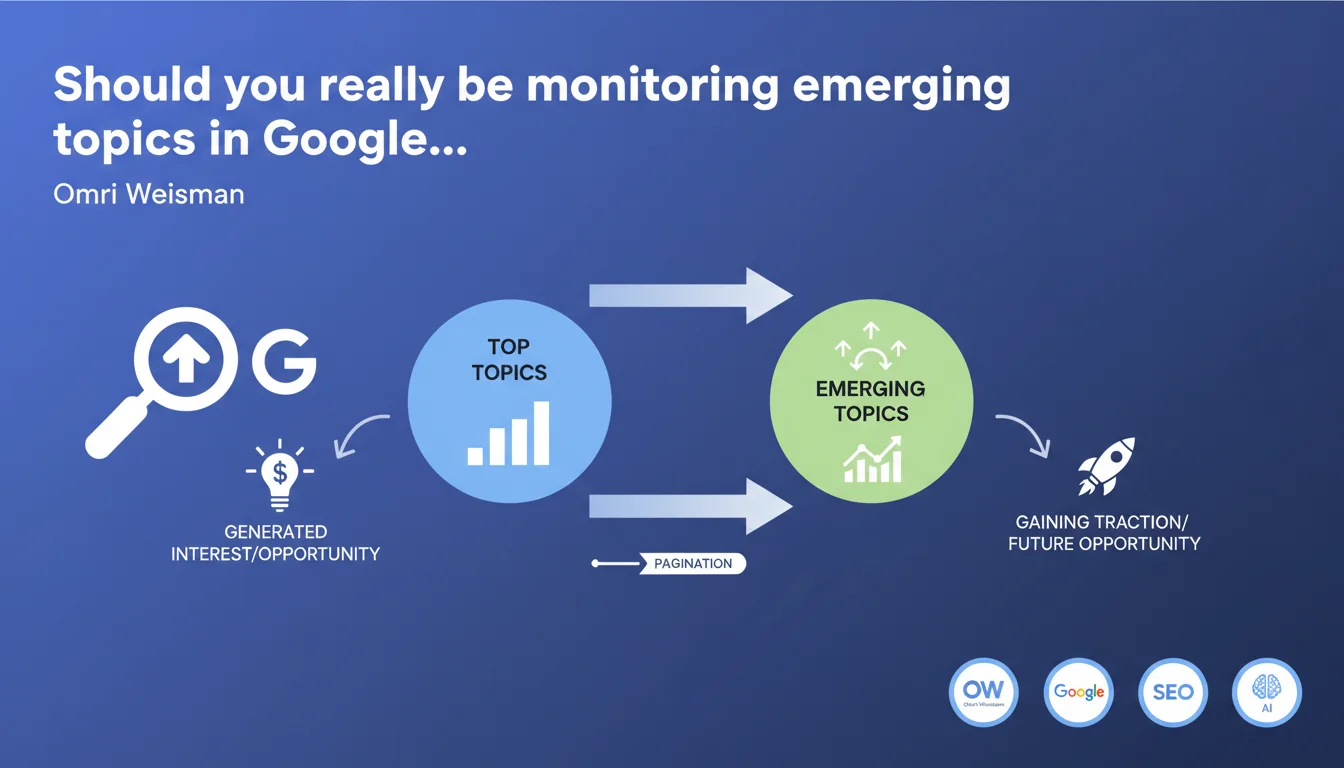
Google recommends leveraging Google Trends to identify both already popular topics (top topics) and those that are gaining momentum (rising topics). The pagination feature allows you to explore beyond the first results to uncover less obvious opportunities. In short, monitoring the emergence of new search queries can give you a competitive edge in content production.
What you need to understand
Why does Google emphasize emerging topics over raw search volume?
Because absolute volumes tell you nothing about dynamics. A topic that jumps from 100 to 1,000 monthly searches in three weeks is strategically far more interesting than a term stable at 10,000 searches.
Google Trends reveals these upward trends before they explode in traditional tools. You can produce content at the moment demand is forming, not six months later when everyone is already doing it.
What's the concrete difference between top topics and rising topics?
Top topics represent current volume — what people are searching for most right now. Rising topics show acceleration: what is gaining attention rapidly.
For example? A term might be absent from top topics but rank at the top of rising topics because it's experiencing explosive growth. That's where the opportunities hide to create content before saturation kicks in.
Why this insistence on pagination?
Because everyone looks at the first page. Results on page 2 or 3 of Trends often contain less competitive niches that are still growing.
Spending five minutes scrolling can help you spot an emerging topic that no competitor has invested in yet. That's time well spent.
- Monitoring rising topics lets you anticipate demand before your competition
- Top topics remain useful for understanding what's already working and assessing saturation
- Pagination reveals niche opportunities overlooked by others
- Google Trends complements traditional SEO tools by showing dynamics, not just static volume
SEO Expert opinion
Is this recommendation consistent with practices observed in the field?
Yes, and it's even one of the rare Google tips that has immediate practical value. Sites that use Trends to detect emerging topics can publish during the growth phase, when competition is low and Google is actively seeking fresh content on those queries.
That said — and here's where it gets tricky — Trends only provides relative signals. A topic can be "rising" simply because it went from 10 to 50 searches. Without cross-referencing with a tool showing actual volumes, you risk wasting time on niches that are too narrow.
What limitations should you keep in mind?
First, Google Trends doesn't show absolute volumes. You see a curve, not a number. It's impossible to know if "rising" means 500 or 50,000 monthly searches without checking elsewhere.
Second, some spikes are ephemeral: news cycles, temporary buzz, seasonal effects. Creating content on a topic that drops in three weeks is wasted effort. You need to distinguish real underlying trends from flash in the pan. [To verify]: Google doesn't specify how to filter this noise.
In what cases does this method not work?
If you're in an ultra-specialized niche with low search volume, Trends will be too imprecise. The data is anonymized and smoothed: you won't see anything shift.
Same for highly technical B2B markets where decision-makers don't search Google much but consume content via LinkedIn, newsletters, or word-of-mouth. Trends captures mainstream demand, not closed-loop channels.
Practical impact and recommendations
Concretely, how do you integrate Google Trends into your editorial strategy?
Start by setting up a monthly monitoring process. Choose 5-10 themes related to your sector and track associated rising topics. Note those showing continuous growth over several weeks, not just an isolated spike.
Then cross-reference with a volume tool (Semrush, Ahrefs, Google Keyword Planner) to validate the topic has real potential. If the volume is too low, move on. If the trend is solid and the volume worthwhile, produce content quickly.
What mistakes should you avoid when exploiting Google Trends?
Don't jump on every emerging topic without checking its longevity. A Twitter or TikTok buzz can artificially inflate searches for 48 hours. Look at history over at least 3-6 months.
Also avoid neglecting pagination thinking the top results are enough. The most interesting opportunities are often on page 2 or 3, where no one looks. Scroll systematically.
How do you verify your content is actually capturing these trends?
Track your rankings on targeted queries with a rank tracker. If you publish at the right time on an emerging topic, you should see a rapid climb in results — often within days.
Also analyze incoming traffic via Google Analytics or Search Console. If the topic really takes off, you'll see growth in organic traffic for these specific queries.
- Set up a monthly monitoring process on 5-10 strategic themes via Google Trends
- Filter rising topics by verifying their continuity over 3-6 months (not just an isolated spike)
- Cross-reference Trends data with a volume tool to validate real potential
- Browse through pagination up to page 3 to detect overlooked niches
- Produce content quickly once an emerging topic shows solid momentum
- Track rankings and organic traffic to measure the impact of your publications
❓ Frequently Asked Questions
Google Trends donne-t-il des volumes de recherche exacts ?
À quelle fréquence faut-il consulter Google Trends pour détecter des opportunités ?
Peut-on faire confiance aux rising topics pour bâtir une stratégie de contenu durable ?
Faut-il privilégier les top topics ou les rising topics ?
Peut-on utiliser Google Trends pour des marchés B2B ou très niches ?
🎥 From the same video 4
Other SEO insights extracted from this same Google Search Central video · published on 10/10/2024
🎥 Watch the full video on YouTube →
💬 Comments (0)
Be the first to comment.