
Official statement
Other statements from this video 4 ▾
- □ How can you leverage search trends to anticipate demand and maximize your SEO traffic?
- □ Should you monitor what your competitors' audiences are searching for to unlock hidden content opportunities?
- □ Can Google Trends really replace your dedicated SEO keyword research tools?
- □ Should you really be monitoring emerging topics in Google Trends to stay ahead of SEO opportunities?
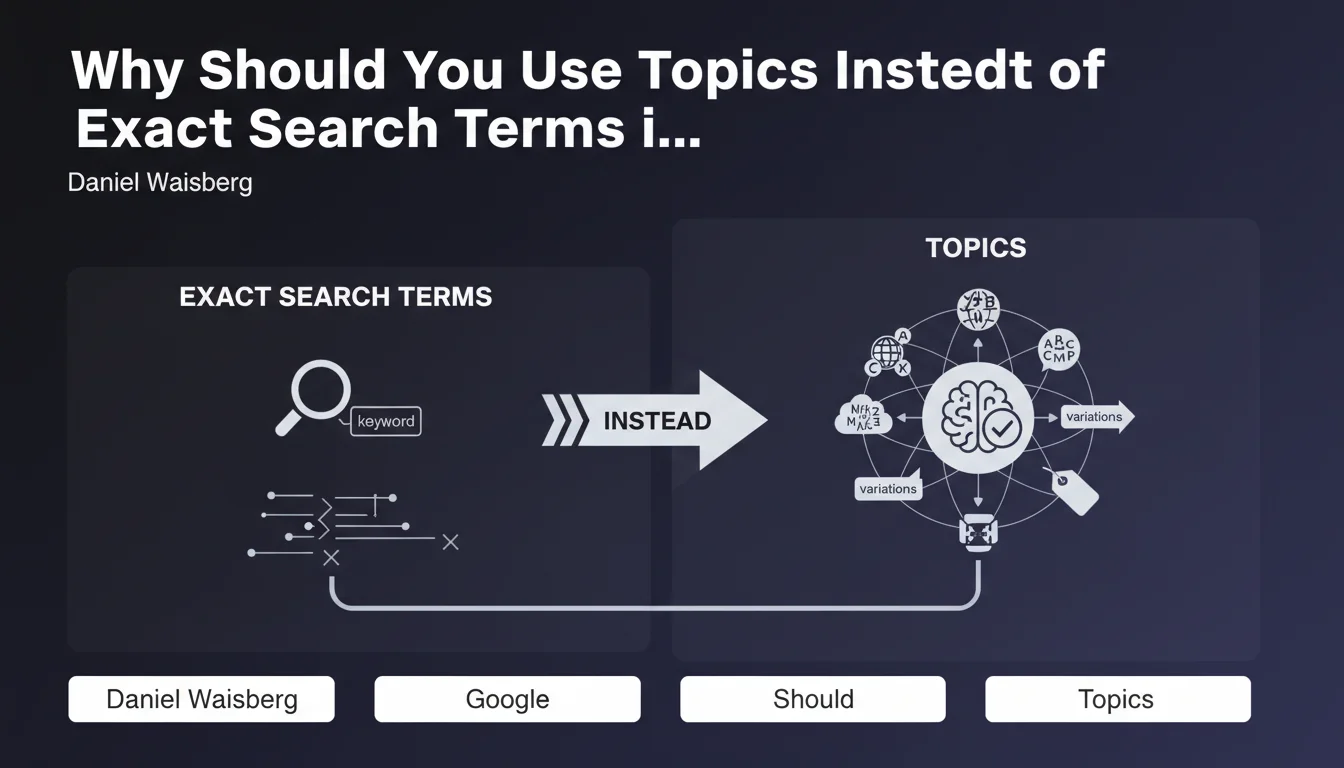
Google recommends using topics in Trends rather than raw search terms. Topics automatically aggregate multilingual data, misspellings, variations, and acronyms — giving you a more complete picture of search trends. For SEO professionals, this fundamentally changes how you leverage this tool during keyword research.
What you need to understand
What's the concrete difference between a topic and a search term in Trends?
A search term in Google Trends corresponds to an exact query typed by users. If you search for "SEO", you'll only get data for that specific string of characters.
A topic, by contrast, functions as semantic aggregation. It brings together all related linguistic forms: "SEO", "search engine optimization", "optimisation moteurs recherche", common misspellings, acronyms, and even equivalents in other languages if the search concept is global.
Why is Google pushing this distinction now?
Query fragmentation has accelerated with voice search and regional variations. The same concept can be searched 15 different ways depending on the country, expertise level, or device used.
By enforcing topic usage, Google enables SEO professionals to have a macro view of trends rather than a sum of fragmented curves. This is particularly useful for multilingual markets or niches where vocabulary varies dramatically.
In what scenarios does this approach really make a difference?
- International keyword research: a topic aggregates volumes from 10+ countries without needing to create 10 separate queries
- Emerging trend analysis: detect rising concepts before a dominant term becomes established
- Avoid volume bias: a frequent misspelling can skew the analysis of an isolated term
- Competitive benchmarking: compare concepts rather than brand-specific formulations
SEO Expert opinion
Is this recommendation truly new or just poorly understood?
Let's be honest: the topics/terms distinction has existed in Trends for years. What's changing is that Google now emphasizes it in a prescriptive manner. Waisberg doesn't say "you can", he says "it is recommended".
Many SEO professionals still use Trends in raw search mode, copy-paste keywords, and retrieve truncated curves. This official statement legitimizes a best practice that was already obvious to those who dig deep into the tool — but it remains ignored by most busy practitioners.
What limitations should you know about topics?
The problem is that Google alone decides what constitutes a topic. There's no precise documentation on aggregation criteria. Some topics merge adjacent concepts that, for an SEO, should remain separate.
[To verify]: the algorithm defining topic boundaries is not transparent. You sometimes observe questionable aggregations where commercial-intent terms are mixed with informational ones.
When should you still analyze raw search terms?
When working on a highly specific query with important nuances. For example, "buy iPhone 15" vs "iPhone 15 review" — the topic "iPhone 15" will mix everything and you lose intent granularity.
Same for brands: if you want to compare "Nike Air Max" and "Nike Dunk", the "Nike" topic will be useless. Exact terms remain essential for local SEO, technical niches, or long-tail analysis.
Practical impact and recommendations
What should you concretely change in your Google Trends usage?
When you open Trends, start by typing your query and check if Google suggests an associated topic. It appears in a dropdown menu below the search bar. Select it rather than the raw term.
If you're comparing multiple concepts (e.g. "SEO" vs "SEM"), make sure you're comparing topics to topics, not a topic to an exact term — otherwise your curves will be skewed.
How do you integrate this approach into keyword research?
Use topics to validate macro demand: is a concept growing or declining over 5 years? Are there seasonal spikes?
Then switch to exact terms to identify precise formulations that convert. Cross-reference with tools like Google Keyword Planner, Semrush, or Ahrefs to grab actual search volumes and CPCs.
Topics are also powerful for detecting emerging trends — a concept rising sharply before standard vocabulary crystallizes. This is where you can get ahead of the competition.
What pitfalls should you avoid?
- Never treat a Trends volume (0-100) as absolute search volume — these are relative indices
- Verify that Google's suggested topic actually matches your intent (some are too broad or too narrow)
- Don't ignore exact terms for editorial content or SEM campaigns: topics provide direction, not copy briefs
- Always cross-reference Trends with other sources (Search Console, third-party tools) to validate hypotheses
- Don't confuse topic popularity with SEO opportunity — a saturated topic may be less profitable than an underserved niche
❓ Frequently Asked Questions
Un topic Google Trends peut-il inclure des termes de plusieurs langues ?
Les topics remplacent-ils totalement l'analyse par termes exacts ?
Comment savoir si Google propose un topic pour ma requête ?
Les fautes d'orthographe comptent-elles vraiment dans un topic ?
Peut-on exporter les données d'un topic pour analyse externe ?
🎥 From the same video 4
Other SEO insights extracted from this same Google Search Central video · published on 10/10/2024
🎥 Watch the full video on YouTube →
💬 Comments (0)
Be the first to comment.