
Official statement
What you need to understand
What Was the Helpful Content Update Actually Supposed to Deliver?
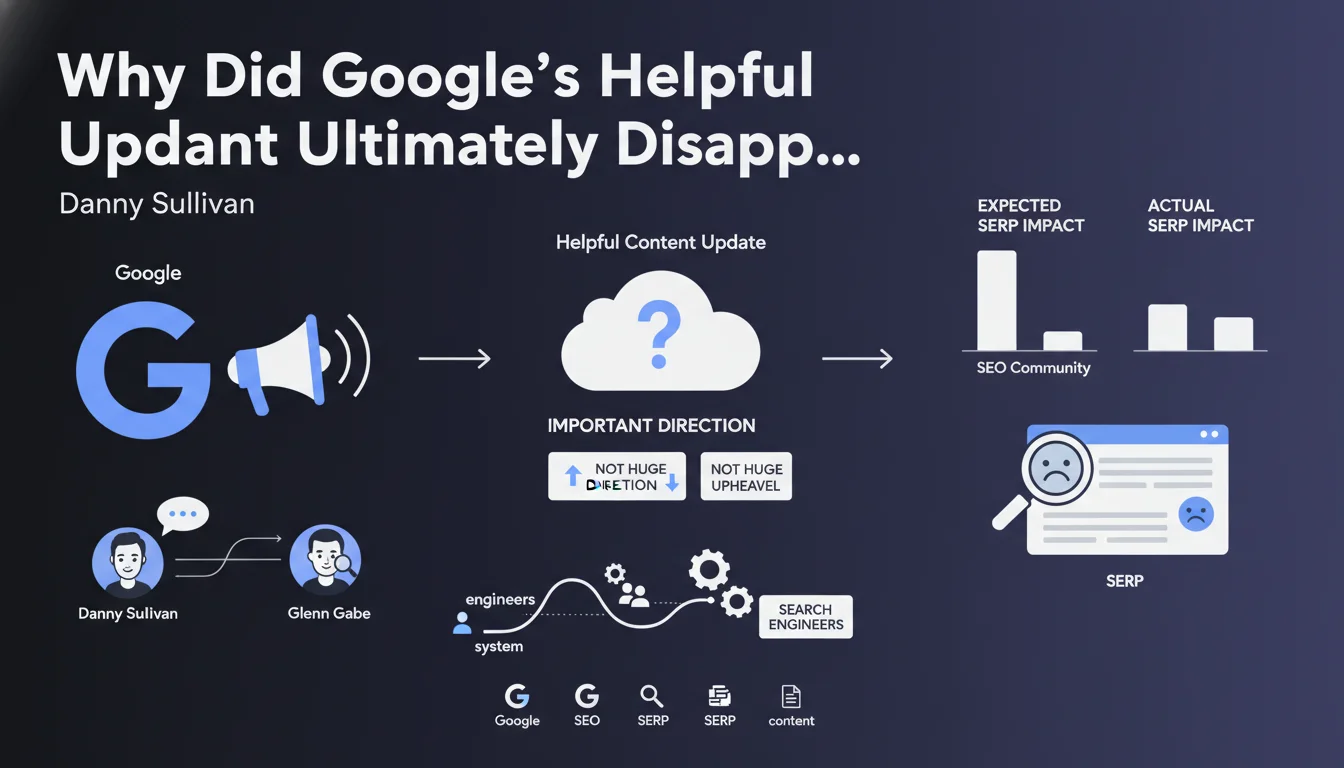
Google announced this update as a major direction for its algorithm, aiming to favor content genuinely useful to users. The announcement was accompanied by massive communication, suggesting a significant shake-up of search results.
Yet field observations showed an almost nonexistent impact on SERPs. Danny Sullivan had to clarify that "important" didn't mean "major upheaval," revealing a gap between the communication and the technical reality of the rollout.
How Does This Content Classifier Really Work?
The Helpful Content Update acts as an additional signal integrated into Google's overall algorithm. It doesn't function in isolation but in synergy with other signals that may not yet be deployed.
Engineers continue to refine the classifier progressively. Low-quality content not detected during the first wave could be caught during future updates, notably subsequent core updates.
Why Are People Talking About Another "Mobilegeddon"?
The reference to Mobilegeddon 2015 is revealing: this mobile-first update had been announced as apocalyptic but ultimately proved very moderate. The same pattern is repeating here.
This is more of a strategic communication effort than an immediate algorithmic revolution. Google is laying the groundwork for gradual evolution rather than abrupt change.
- Limited initial impact despite Google's massive communication
- The classifier will be progressively refined in upcoming updates
- Works in synergy with other signals not all deployed yet
- Gradual and iterative approach rather than immediate revolution
- Notable disappointment among experienced SEO practitioners
SEO Expert opinion
Does This Statement Reveal a Deliberate Communication Strategy?
Analysis of this situation clearly shows a preemptive communication strategy on Google's part. By massively announcing this update, Google sends a message to content creators without immediately deploying strong algorithmic penalties.
This approach allows Google to modify behaviors through the simple threat of a future penalty, while giving itself time to refine its algorithms. It's an effective tactic that has already proven successful with mobile-first indexing.
The risk for SEOs is overinvesting resources in optimizations whose impact remains uncertain in the short term. The right balance must be found between anticipation and pragmatism.
Should Practitioners Ignore This Update Given Its Low Impact?
Absolutely not. Even though the immediate impact is limited, Danny Sullivan explicitly confirms that the classifier will be strengthened progressively. Ignoring this trend would be a major strategic mistake.
Sites producing low-quality content not detected today could be penalized during upcoming core updates. The prudent approach is to consider this update as a warning signal and adjust your content strategy now.
What Are the Implications for Medium-Term SEO Strategies?
This situation perfectly illustrates the need to adopt a long-term vision in SEO. Google's updates now work in successive layers, each signal adding to previous ones to create a cumulative effect.
SEOs must accept a new reality: spectacular upheavals are being replaced by gradual but deep evolutions. Content quality becomes a foundational investment, not a one-time tactical optimization.
Sites waiting to see measurable impact before acting place themselves in a reactive position rather than proactive, which can generate visibility losses difficult to recover once penalties are applied.
Practical impact and recommendations
What Should You Concretely Implement on Your Site?
The priority is to audit your existing content with an analysis framework centered on real usefulness to the user. Identify pages created primarily for search engines rather than to meet an authentic need.
Implement a reinforced editorial process that systematically validates the added value of each new piece of content. Favor depth and expertise over publication volume.
Document your authors' expertise and ensure each piece of content clearly demonstrates in-depth knowledge of the subject matter. Google increasingly seeks to identify signals of genuine authority.
What Mistakes Must Absolutely Be Avoided?
Don't fall into the trap of defensive over-optimization. Some sites have massively deleted content out of fear of this update, even though their content was perfectly legitimate. The analysis must be nuanced and qualitative.
Also avoid the opposite error: completely ignoring this evolution on the grounds that current impact is low. Sites waiting to be penalized before reacting find themselves in a weak position difficult to recover from.
Don't consider helpful content as a simple technical optimization checklist. This is a change in editorial philosophy that requires a cultural transformation within content production teams.
How Can You Ensure Your Strategy Is Aligned with These Evolutions?
Implement a quality measurement system that goes beyond traditional SEO metrics. Analyze real engagement time, qualified bounce rates, and especially user satisfaction indicators.
Conduct regular user testing to validate that your content effectively meets your target audience's expectations and questions. Behavioral signals are becoming increasingly determinant in Google's algorithm.
- Audit all existing content with a user-centered framework
- Identify and improve or remove low-value content
- Document the expertise and authority of content creators
- Implement an editorial process validating real relevance
- Favor depth and quality over volume
- Measure behavioral signals beyond classic SEO metrics
- Perform regular user testing to validate content usefulness
- Anticipate future evolutions rather than waiting to be impacted
💬 Comments (0)
Be the first to comment.