
Official statement
Other statements from this video 18 ▾
- □ Are images really slowing down your site's SEO performance?
- □ How can you actually boost your website's performance by selecting the right image format?
- □ Is your website really serving the right image size to each device?
- □ Does Google really index all your responsive image variations with picture and srcset?
- □ Should you systematically use lazy-loading for all images below the fold?
- □ Should you really avoid lazy-loading for all your images?
- □ Should you really use the HTML loading attribute to optimize lazy-loading?
- □ Are images really the main bottleneck killing your site's performance?
- □ Are poorly configured images really harming your SEO through layout shifts?
- □ Does image quality really need to adapt by screen size for SEO success?
- □ Do you really need picture and srcset to optimize responsive images for SEO?
- □ Should you declare alternative image versions using structured data to boost Google's indexing?
- □ Should you really enable lazy-loading on every single below-the-fold image?
- □ Is lazy-loading all your images actually hurting your SEO performance?
- □ Should you really be using the HTML loading attribute for lazy-loading in 2024?
- 1:22 Do you really need to migrate your images to WebP and AVIF to boost your SEO?
- 1:57 Should you really automate image compression for SEO success?
- 1:57 Should you really manually verify automatic image compression results for your website?
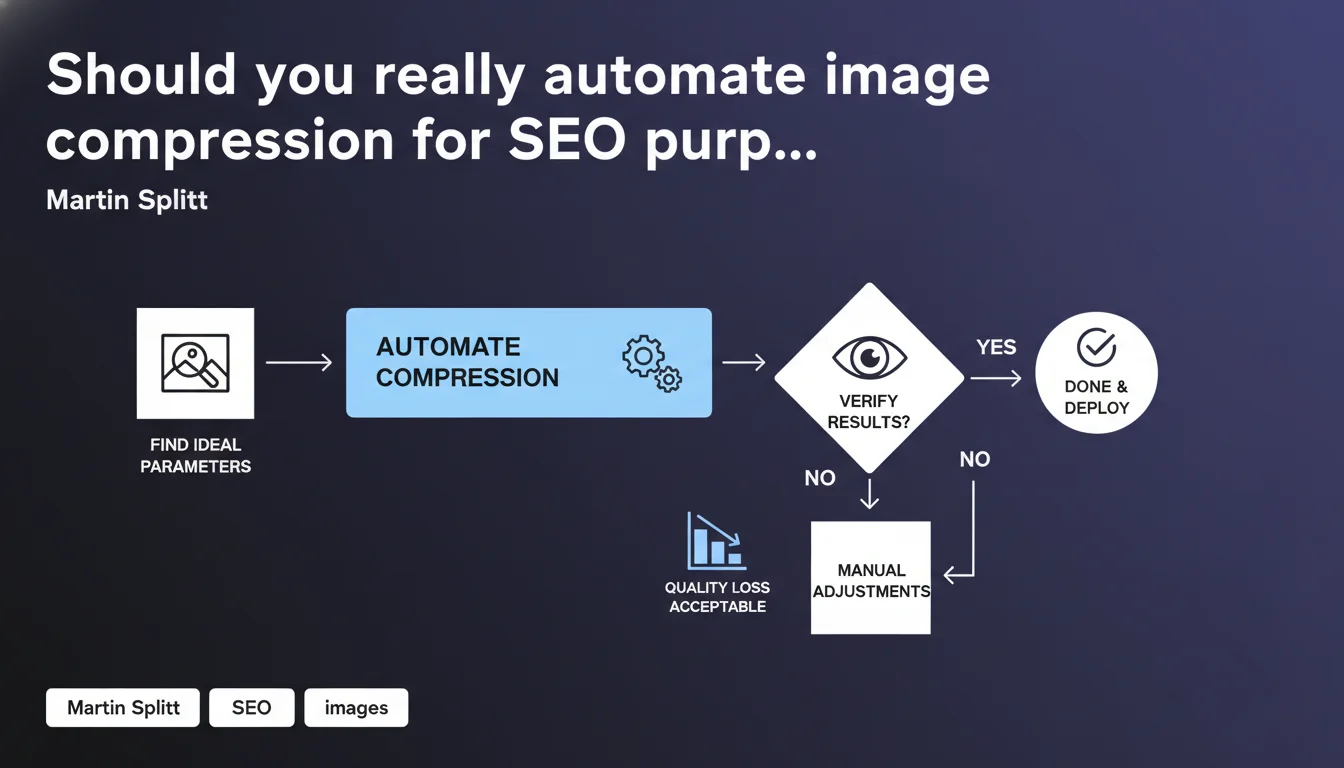
Google recommends compressing images to the maximum without visible quality loss, then automating the process once optimal parameters are found. However, some images will require manual adjustments — full automation is not a magic solution.
What you need to understand
Why does Google insist so much on image compression?
Images represent on average 50 to 70% of the total weight of a web page. Inadequate compression directly impacts the Largest Contentful Paint (LCP), one of the three Core Web Vitals metrics scrutinized by Google since the Page Experience Update.
Martin Splitt doesn't talk about a target size in kilobytes, but rather a balance: compress "as much as possible" without unacceptable visual degradation. The tolerance threshold varies depending on the type of image and context — an e-commerce product photo tolerates less compression than a decorative illustration.
What does "acceptable quality" concretely mean?
Google remains intentionally vague on this point. Acceptable quality depends on business context, device of viewing, and image type. A high-resolution photo for an architecture firm's website doesn't have the same requirements as a blog visual.
The recommended approach: test multiple compression levels (70%, 80%, 90%) and compare visually on different screens. The balance point is where quality loss becomes noticeable for your target audience.
Is automation really reliable?
Splitt implicitly acknowledges the limitations of automation by specifying that "some images may require manual adjustments". Automatic compression algorithms struggle with certain cases: subtle gradients, embedded text, images with complex transparency.
The hybrid approach is therefore the norm: automate the majority of images (products, thumbnails, standard editorial images), but maintain human quality control over strategic visuals.
- Maximum compression without visible quality loss is the objective — not a universal compression rate
- Automation works for 80-90% of cases, but requires systematic verification of results
- The threshold for "acceptable quality" varies depending on business context and image usage
- Compression directly impacts LCP and therefore ranking via Core Web Vitals
- Modern formats (WebP, AVIF) offer better compression/quality ratios than JPEG/PNG
SEO Expert opinion
Is this recommendation consistent with real-world observations?
Absolutely. Performance audits consistently show that poorly optimized images are the primary bottleneck for good LCP. Google practices what it preaches: a faster web means less bandwidth consumed on Google's infrastructure side.
What's missing from this statement? Quantified benchmarks. Splitt provides no compression thresholds, no preferred format, no metrics to measure "acceptable quality". [To verify]: Does Google have internal compression thresholds beyond which an image is considered too heavy? Nothing in public documentation.
In what cases does this approach show its limitations?
Automation works poorly with three types of images: visuals with embedded text (JPEG compression degrades readability), images with high added value (photography portfolios, luxury sites where visual quality is a selling point), and complex graphics with subtle gradients.
Another point: the recommendation ignores the question of lazy loading and responsive design. Compressing an image is good — but serving the right size according to the viewport is better. Optimal compression on 4K can be catastrophic on mobile if the image remains 3000px wide.
What's the real priority: compression or format?
Splitt talks about compression, not format. Yet migrating from JPEG to WebP (average gain: 25-35%) or AVIF (gain: 40-50%) often delivers more benefits than fine-tuning JPEG compression. The unspoken point here is revealing: Google has been pushing these formats for years, but avoids officially imposing them.
In practice, the winning combination is: modern format + adapted compression + responsive images. Isolating compression as Splitt does here is somewhat reductive — but probably more digestible for a broad audience.
Practical impact and recommendations
What should you concretely do to optimize image compression?
First step: audit your existing assets. Use PageSpeed Insights or Lighthouse to identify images that are too heavy. The report precisely indicates potential savings per image — start with those that provide the most gain.
Next, define your compression parameters by image type. Example: e-commerce products in WebP quality 85%, editorial visuals in WebP quality 75%, icons and logos in SVG or optimized PNG. Test each configuration on multiple devices before validating.
How do you automate without losing quality control?
Integrate compression into your publishing workflow. If you're on WordPress, plugins like ShortPixel or Imagify handle conversion + compression at upload. On custom stacks, tools like Squoosh (Google), ImageOptim or services like Cloudinary automate the process.
Critical: implement systematic quality control on a random sample. Regularly verify that automation isn't degrading certain image types — especially those with text or fine details.
What mistakes should you avoid at all costs?
Never compress an already compressed image — you lose quality without significant gain. Don't rely on automatic previews: always verify on real device, not only on your 27-inch developer screen.
Another classic pitfall: forgetting responsive design. A perfectly compressed image but served at 2000px on mobile unnecessarily consumes bandwidth. Use srcset and sizes to serve the right dimension according to viewport.
- Audit images with PageSpeed Insights and prioritize those with high LCP impact
- Define compression profiles by image type (products, editorial, decorative)
- Visually test each configuration on mobile, tablet and desktop
- Automate compression via CMS plugin or CDN with on-the-fly transformation
- Implement regular quality control on random samples
- Prefer WebP or AVIF over JPEG/PNG when compatible
- Implement srcset and sizes to serve the right image size according to device
- Regularly monitor Core Web Vitals via Search Console
❓ Frequently Asked Questions
Quel taux de compression appliquer par défaut sur les images JPEG ?
Faut-il migrer toutes les images en WebP ou AVIF ?
Les outils de compression automatique dégradent-ils vraiment la qualité ?
La compression d'images améliore-t-elle directement le ranking Google ?
Comment vérifier que mes images ne sont pas surcompressées ?
🎥 From the same video 18
Other SEO insights extracted from this same Google Search Central video · published on 02/07/2024
🎥 Watch the full video on YouTube →
💬 Comments (0)
Be the first to comment.