
Official statement
Other statements from this video 16 ▾
- □ Do you really need to notify Google when redesigning your website?
- □ Does Google really detect WEBP format through the HTTP header rather than the file extension?
- □ What does Google really consider a prominent video, and why does it matter for your search rankings?
- □ Does multilingual duplicate content really hurt your international SEO rankings?
- □ Should you choose a ccTLD over .com to target a local market?
- □ Why does Google insist on isolating site migrations from any other redesign work?
- □ Is AdsBot skewing your Search Console crawl data without you knowing?
- □ Should you consolidate all hreflang annotations in one sitemap or split them by language?
- □ Does Google offer a button to force massive reindexing of a website after a redesign?
- □ Strong vs Bold: Does Google really make a difference between these two tags?
- □ Does LCP really only measure what's visible in your viewport at load time?
- □ Is an XML sitemap really essential for Google to index your website?
- □ Should you use hreflang 'de' or 'de-de' to target German speakers?
- □ Does Google really retry indexing your pages after a 401 error or server downtime?
- □ Should you really prioritize alt text over OCR for extracting text from images?
- □ Is infinite scroll killing your e-commerce indexation on Google?
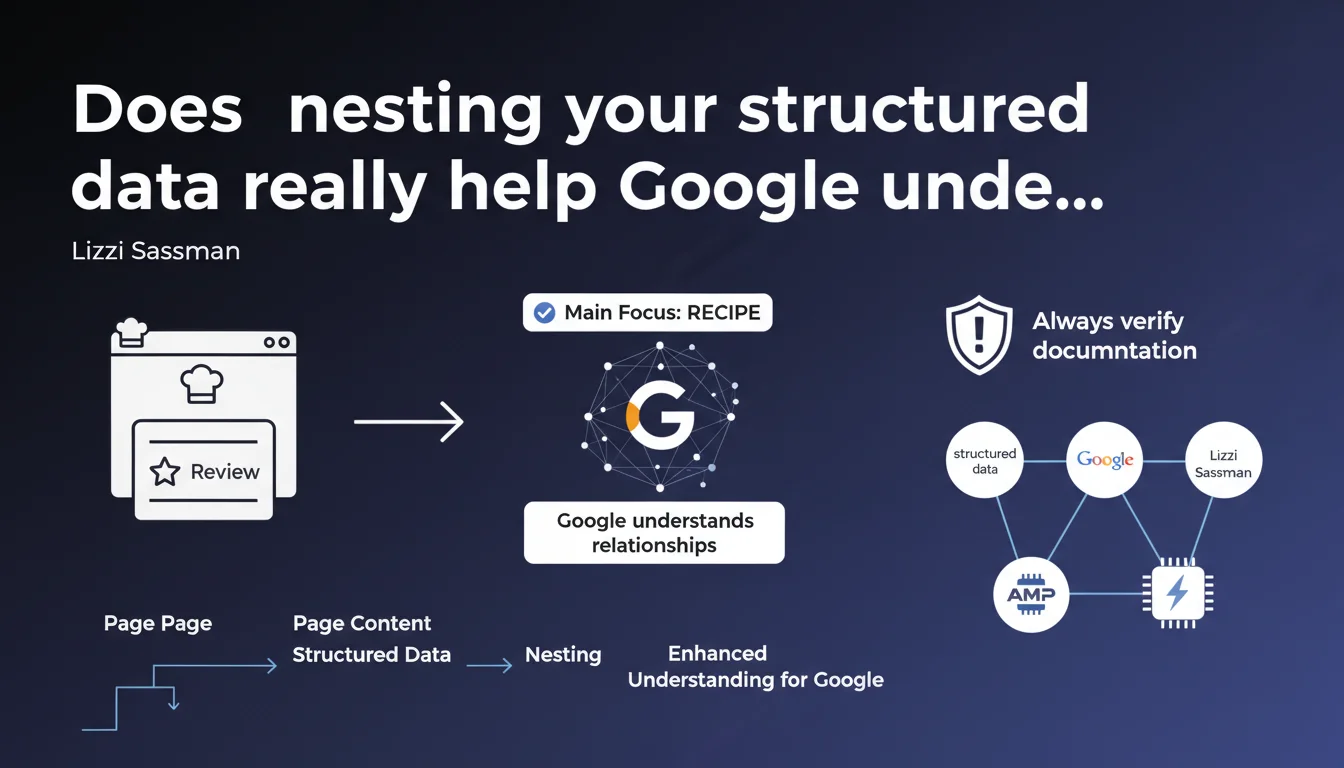
Google uses nested structured data to identify the main subject of a page. Concretely: a review nested within a recipe signals that the page is primarily a recipe, not a review article. This hierarchy helps the algorithm display the correct rich snippet.
What you need to understand
Why does Google need this hierarchy in structured data?
The problem is straightforward: a single page can contain multiple types of content. A lasagna recipe might include user reviews, a demonstration video, and author information. Without a clear hierarchy, Google has to guess what the main subject actually is.
Nesting structured data solves this ambiguity. By placing a Review object inside a Recipe object, you explicitly signal that the recipe is the main content and the review is merely a supporting element. This directly influences which rich snippet will be displayed in the SERPs.
How does this nesting work technically?
In JSON-LD, certain properties accept nested objects. For example, the Recipe type has an "aggregateRating" property that can contain an AggregateRating object. Similarly, "review" can contain an array of Review objects.
This architecture is not arbitrary — it follows the logic of the Schema.org vocabulary, which defines parent-child relationships between content types. Google exploits this structure to understand the semantic relationship between different page elements.
Can all types of structured data be nested?
No, and that's where complications arise. Each Schema.org type defines which properties it accepts and what types of objects can be nested within it. The Google documentation for each search feature (recipes, events, products, etc.) specifies these rules.
Some nesting is mandatory for rich snippet eligibility. Other nesting is optional but recommended. And some combinations, while technically valid according to Schema.org, are not recognized by Google to trigger specific features.
- Nesting signals hierarchy: the parent type is the main content, nested types are supplementary
- Direct influence on rich snippets: Google chooses the display format based on the identified primary type
- No universal nesting rule: each type has specific rules defined in Google documentation
- Technical validation required: use the Rich Results Test to verify compatibility
SEO Expert opinion
Does Google consistently respect this nesting logic?
In theory, it's coherent. In practice? Field observations show that Google often identifies the main content correctly even without strict nesting, largely thanks to semantic processing of the textual content itself.
Multiple cases observed where pages with "flat" structured data (multiple types at the same level) still get the correct rich snippet. The algorithm seems to cross-reference structured data with other signals: position in the DOM, content volume, semantic HTML tags. [Needs verification] on how much nesting is a determining factor versus one signal among many.
What are the risks of incorrect nesting?
The main risk: loss of rich snippet eligibility. If Google fails to determine the primary content type, it may simply not display an enhanced result. Worse, it could display the wrong type of snippet — imagine a product page displaying as a blog article.
Also watch out for validation errors. Certain required properties for a given type become mandatory only if that type is declared as primary. Incorrect nesting can generate warnings in Search Console that, while not blocking, signal a suboptimal implementation.
When is nesting not the best approach?
Let's be honest: when a page truly covers multiple topics of equal importance, nesting forces an artificial hierarchy. Typical example: an event page that includes both venue information (LocalBusiness) and the event itself (Event).
In these cases, using separate blocks of structured data at the same level may be more appropriate. Google will have to choose which rich snippet to display, but at least you won't have distorted the actual semantics of your content. The tradeoff to accept: you let Google decide rather than control explicitly.
Practical impact and recommendations
What should you audit first on your existing pages?
Start by identifying pages that combine multiple content types: product pages with reviews, articles with embedded videos, author pages with article lists, etc. These are the candidates for restructuring your structured data.
Use Google's Rich Results Test for each page type. Check not only technical validation, but also the primary content type detected. If the tool identifies a different type than what you're targeting, that's a red flag.
How do you implement nesting without breaking everything?
For JSON-LD (the recommended format), refactoring is relatively clean. Identify the primary type, then integrate secondary types as values of appropriate properties. For example, for a recipe with reviews:
The Recipe type becomes the root object. Individual reviews integrate into the "review" property as an array of Review objects. The aggregate rating goes into "aggregateRating". This structure replaces the multiple separate JSON-LD blocks you may have had initially.
- Map all page types that combine multiple content types
- Consult Google documentation specific to each feature you're targeting (recipes, products, events, etc.)
- Identify which properties accept nested objects according to Schema.org
- Refactor the JSON-LD by placing the main content as the root type
- Test each page with Google's Rich Results Test
- Check Search Console for any new errors after deployment
- Monitor the evolution of rich snippet impressions in the weeks following
What technical errors must you absolutely avoid?
First common mistake: nesting in the wrong direction. If your page is primarily a product review (Review type), the product must be nested inside the review via the "itemReviewed" property, not the other way around. The hierarchy must reflect the actual content of your page.
Second pitfall: omitting fields that become required. When you change the primary type, the mandatory fields change too. A Product requires "name" and "image", but if you nest it within a Review, the latter has its own requirements ("author", "reviewRating", etc.).
❓ Frequently Asked Questions
Peut-on utiliser plusieurs blocs JSON-LD séparés plutôt qu'imbriquer les données ?
L'imbrication fonctionne-t-elle de la même manière en microdata ou RDFa ?
Si je change ma structure de données, vais-je perdre temporairement mes rich snippets ?
Faut-il imbriquer même si la documentation Google ne le mentionne pas explicitement ?
Les données structurées imbriquées influencent-elles le classement au-delà des rich snippets ?
🎥 From the same video 16
Other SEO insights extracted from this same Google Search Central video · published on 09/03/2023
🎥 Watch the full video on YouTube →
💬 Comments (0)
Be the first to comment.