
Official statement
Other statements from this video 16 ▾
- □ Faut-il vraiment prévenir Google lors d'une refonte de site ?
- □ Google détecte-t-il vraiment le format WEBP par l'en-tête HTTP plutôt que par l'extension du fichier ?
- □ Comment Google évalue-t-il vraiment la proéminence d'une vidéo sur une page ?
- □ Le contenu dupliqué multilingue pénalise-t-il vraiment votre référencement international ?
- □ Faut-il préférer un ccTLD au .com pour cibler un marché local ?
- □ Pourquoi Google insiste-t-il pour isoler les migrations de site de toute autre refonte ?
- □ Pourquoi AdsBot fausse-t-il vos statistiques de crawl dans Search Console ?
- □ Hreflang : faut-il regrouper toutes les annotations dans un seul sitemap ou les séparer par langue ?
- □ Google propose-t-il un bouton pour réindexer massivement un site après refonte ?
- □ Strong vs Bold : Google fait-il vraiment la différence entre ces deux balises ?
- □ Le LCP ne mesure-t-il vraiment que le viewport visible au chargement ?
- □ Faut-il utiliser hreflang 'de' ou 'de-de' pour cibler les germanophones ?
- □ Google réessaie-t-il vraiment d'indexer vos pages après une erreur 401 ou serveur down ?
- □ Faut-il vraiment imbriquer ses données structurées pour indiquer le focus principal d'une page ?
- □ Faut-il vraiment privilégier l'attribut alt plutôt que l'OCR pour le texte dans les images ?
- □ Pourquoi le scroll infini pénalise-t-il l'indexation de vos pages e-commerce ?
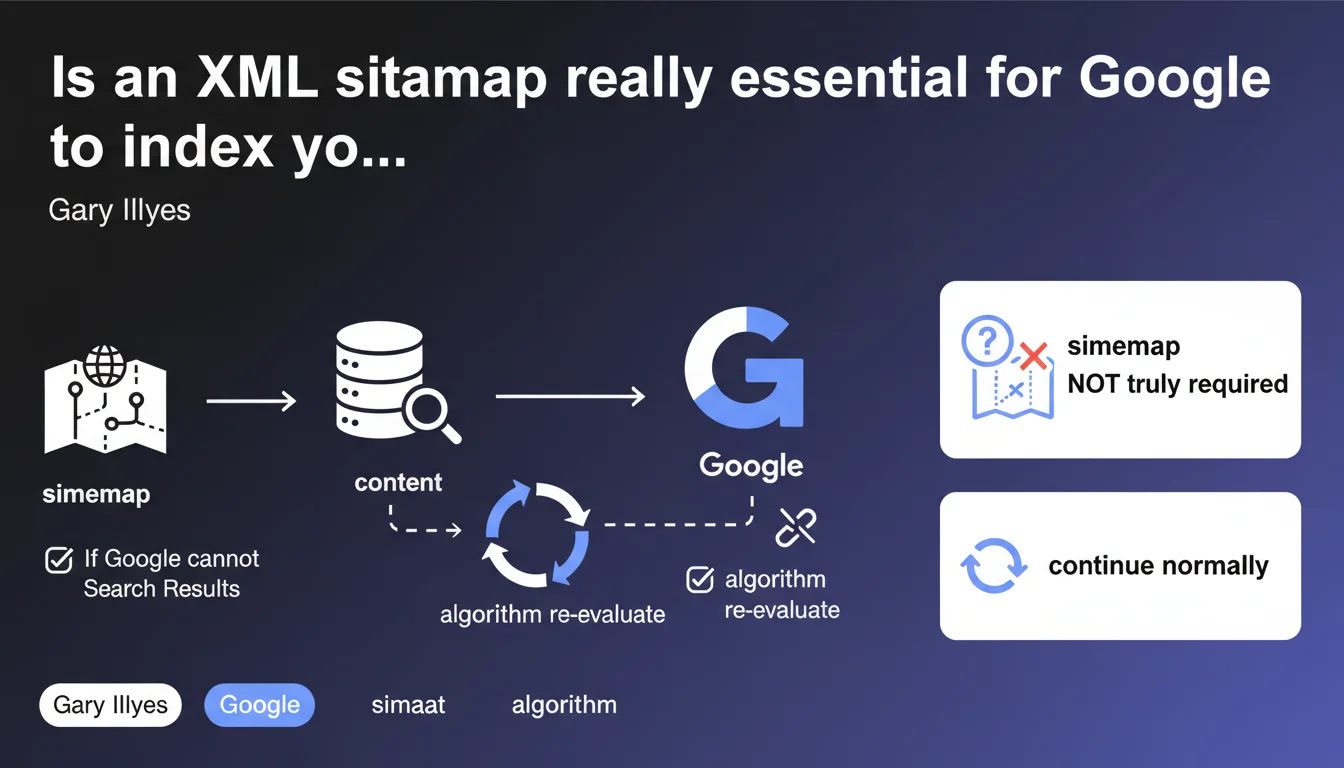
Google confirms that an XML sitemap is not mandatory to appear in search results. If the crawler cannot retrieve your sitemap, don't panic: continue normally, the issue may resolve itself automatically during the next algorithmic re-evaluations of your site.
What you need to understand
Can Google index a site without a sitemap?
Yes, absolutely. The XML sitemap is a facilitator, not a prerequisite. Google discovers and indexes billions of pages every day through natural crawling: internal links, backlinks, standard navigation.
The sitemap acts as an accelerator. It signals to Google which pages exist, their relative priority, their update frequency. But if your internal linking structure is solid and your site receives external links, Googlebot will find your content without assistance.
Why does Gary Illyes emphasize this point?
Because too many webmasters panic as soon as an error appears in Search Console concerning the sitemap. Gary reminds everyone of a ground truth: a temporary technical problem does not block indexation.
Google's algorithms regularly re-evaluate sites. A sitemap that is inaccessible today may be retrieved tomorrow. And in the meantime, organic crawling continues its work.
In what cases does the sitemap remain truly useful?
On large sites (several thousand pages), sites with complex architecture, or those that frequently publish new content. The sitemap helps prioritize the crawl budget.
Also crucial for sites with many orphaned pages or poorly linked content. Without a sitemap, these URLs risk remaining invisible for a long time.
- The sitemap is not mandatory to appear in Google's index
- Google crawls via internal links, backlinks, and natural exploration
- A temporarily inaccessible sitemap does not prevent indexation
- Algorithms re-evaluate regularly — the problem may resolve itself
- Remains useful for large sites, complex architectures, or frequently updated content
SEO Expert opinion
Does this statement match what we observe in the field?
Yes — but with nuances. We indeed see sites that are perfectly indexed without a sitemap. A small well-linked WordPress blog, a standard business website: no issues.
However, on an e-commerce with 50,000 product references with filters and pagination, the absence of a sitemap significantly slows down the discovery of new pages. Google eventually indexes everything, certainly, but it takes weeks instead of days.
What does "algorithms re-evaluate content" really mean?
Gary remains deliberately vague here. [To verify]: what is the exact frequency of these re-evaluations? Are we talking days, weeks, months?
On high-traffic sites or those with strong backlinks, we observe frequent recrawls — sometimes several times per week. On dormant sites, it can drag on. Gary's phrasing suggests you shouldn't be overly alarmed, but it lacks numerical precision.
When does this logic become risky?
On sites with complex JavaScript architecture, particularly client-side (React, Vue without SSR). If Google cannot properly crawl your links AND you don't have a sitemap, you're playing with fire.
Same applies to sites with lots of short-lived content: news, events, flash offers. Waiting for Google to "re-evaluate" in two weeks means losing most of the potential traffic.
Practical impact and recommendations
Should you delete your sitemap to reduce technical overhead?
No. Seriously, keep your sitemap. The maintenance cost is negligible (automatically generated by most CMS platforms), and the benefits remain real.
This statement primarily aims to reassure those encountering temporary errors in Search Console. It does not constitute an invitation to abandon best practices.
How should you react if Google reports it cannot retrieve your sitemap?
First, verify the basics: sitemap.xml file accessible at the declared URL, no 404 errors, no robots.txt blocking. If everything looks OK on the server side, wait a few days.
Concretely? Monitor your strategic pages using Search Console's URL inspection tool. If they continue to be indexed normally, the sitemap error is likely inconsequential.
What actions should you prioritize to guarantee optimal indexation?
The sitemap is just one tool among many. Solid internal linking comes first: every important page should be accessible within 3 clicks maximum from the homepage.
Next, obtain quality backlinks — even modest ones — to signal to Google that your site deserves attention. Finally, structure your architecture logically: clear hierarchy, clean URLs, no orphaned content.
- Maintain your XML sitemap, even if Gary says it's not mandatory
- If error in Search Console, verify accessibility and format, then wait
- Prioritize a robust internal linking structure — it's the foundation
- Ensure your strategic pages are linked from frequently crawled pages
- Monitor actual indexation via URL inspection, not just sitemap status
- For large sites, segment your sitemaps (products, categories, blog…)
- Don't panic if the sitemap is temporarily inaccessible — continue publishing normally
❓ Frequently Asked Questions
Mon sitemap affiche une erreur 500 depuis 3 jours, dois-je m'inquiéter ?
Un site de 10 pages a-t-il besoin d'un sitemap ?
Google peut-il pénaliser un site sans sitemap ?
Combien de temps Google met-il à ré-crawler un site après une erreur sitemap ?
Vaut-il mieux plusieurs sitemaps ciblés ou un seul gros fichier ?
🎥 From the same video 16
Other SEO insights extracted from this same Google Search Central video · published on 09/03/2023
🎥 Watch the full video on YouTube →
💬 Comments (0)
Be the first to comment.