
Official statement
Other statements from this video 16 ▾
- □ Faut-il vraiment prévenir Google lors d'une refonte de site ?
- □ Google détecte-t-il vraiment le format WEBP par l'en-tête HTTP plutôt que par l'extension du fichier ?
- □ Comment Google évalue-t-il vraiment la proéminence d'une vidéo sur une page ?
- □ Faut-il préférer un ccTLD au .com pour cibler un marché local ?
- □ Pourquoi Google insiste-t-il pour isoler les migrations de site de toute autre refonte ?
- □ Pourquoi AdsBot fausse-t-il vos statistiques de crawl dans Search Console ?
- □ Hreflang : faut-il regrouper toutes les annotations dans un seul sitemap ou les séparer par langue ?
- □ Google propose-t-il un bouton pour réindexer massivement un site après refonte ?
- □ Strong vs Bold : Google fait-il vraiment la différence entre ces deux balises ?
- □ Le LCP ne mesure-t-il vraiment que le viewport visible au chargement ?
- □ Le sitemap XML est-il vraiment indispensable pour être indexé par Google ?
- □ Faut-il utiliser hreflang 'de' ou 'de-de' pour cibler les germanophones ?
- □ Google réessaie-t-il vraiment d'indexer vos pages après une erreur 401 ou serveur down ?
- □ Faut-il vraiment imbriquer ses données structurées pour indiquer le focus principal d'une page ?
- □ Faut-il vraiment privilégier l'attribut alt plutôt que l'OCR pour le texte dans les images ?
- □ Pourquoi le scroll infini pénalise-t-il l'indexation de vos pages e-commerce ?
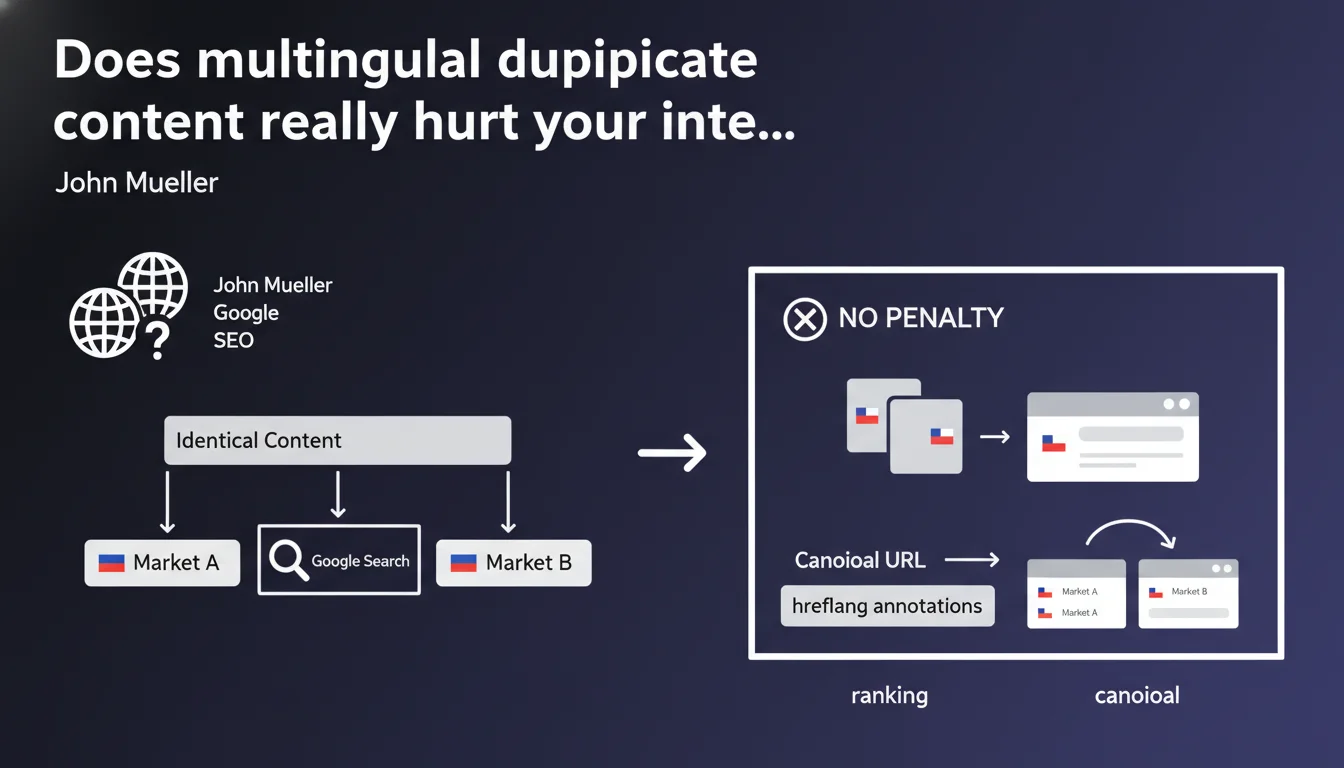
Google does not penalize duplicate content when the same linguistic version exists across multiple geographic domains. The search engine will choose a canonical URL by default, but hreflang tags allow you to control which version appears based on user location. In other words: duplicating your French content across .fr and .be domains won't cost you any visibility.
What you need to understand
Why this precision about multilingual duplicate content?
Many international sites hesitate to deploy the same content across multiple markets out of fear of the infamous "duplicate content penalty". Let's take a classic example: you sell your products in France and Belgium with two separate sites (.fr and .be), but the French content is strictly identical.
Mueller confirms what some observers were already noticing in the field — Google does not penalize this practice. The search engine may certainly consolidate signals on a URL it deems canonical, but no punishment is applied.
How does Google concretely handle these identical pages?
Without explicit direction, Google selects a reference canonical URL from among the duplicate versions. This consolidation means that only one version appears in the SERPs by default, with others being considered redundant.
This is where hreflang annotations come in: they tell Google which version to serve based on the user's language and geolocation. In other words, hreflang allows you to dynamically swap URLs in search results without creating a duplication conflict.
What's the difference between consolidation and penalty?
The nuance is critical. A canonical consolidation does not negatively affect your domain — Google simply groups signals (backlinks, authority) on the URL it deems primary.
A duplicate content penalty would imply active ranking degradation, or even deindexing. Nothing of the sort here: your pages remain indexable, your signals preserved, only default visibility is arbitrated by the algorithm or your hreflang tags.
- No algorithmic sanction for identical content across multiple linguistic markets
- Google selects a canonical URL by default if no directive is provided
- Hreflang tags allow you to control which version appears based on user context
- Canonical consolidation preserves SEO signals, it does not destroy them
- This rule applies to content in the same language deployed across multiple geographic domains
SEO Expert opinion
Is this statement consistent with real-world observations?
Absolutely. Multinational sites with identical linguistic versions (French-speaking Switzerland / France, English-speaking Canada / UK) do not experience traffic collapse due to duplicate content. What we observe instead is rather a geographic cannibalization: without hreflang, Google often displays the dominant .com or .fr version everywhere.
The real problem is therefore not a penalty, but a poor distribution of traffic. A Belgian user who lands on the French version may encounter friction (currency, shipping, legal notices), which degrades the experience and conversions.
What limitations must be placed on this statement?
Mueller explicitly speaks of "identical content in the same language across multiple markets". This tolerance does not extend to the following cases:
— Scraped or republished content from external sources without added value
— Intra-domain duplication on a massive scale (thousands of nearly-identical URLs on a single site)
— Syndication without canonical or clear attribution to the original source
— Low-quality machine translation deployed at scale
In these contexts, Google effectively applies filters or penalties. Mueller's statement specifically concerns legitimate international expansion of a business that sells across multiple markets with identical linguistic content. [To verify] whether this tolerance applies to content aggregators or business models based on content republication.
Does hreflang really solve all problems?
In theory yes, in practice it's trickier. Hreflang implementation remains one of the most fragile in technical SEO: malformed tags, non-canonical URLs referenced, redirect loops, incorrect language codes.
Even when properly implemented, hreflang is only a signal to Google, not an absolute directive. The search engine may ignore your annotations if it judges another version more suitable (IP geolocation vs. browser preferences, user history, contradictory quality signals).
Practical impact and recommendations
What should you do concretely to secure your multilingual SEO?
Implement hreflang properly. Use the full language-region syntax (fr-FR, fr-BE, fr-CH) rather than language alone. Each page must reference all its variants, including itself. Test with Search Console and tools like Screaming Frog or Oncrawl.
Define an x-default version. This tag indicates which page to serve by default to users whose language/region doesn't match any declared variant. Often, it's your international landing page or your main .com site.
Avoid cross canonical links. If your .fr page points a canonical to .be, you sabotage your hreflang strategy. Each linguistic version should be self-canonical unless you intentionally want to consolidate on a single URL (in which case, no need for hreflang).
What mistakes should you absolutely avoid?
Don't assume hreflang compensates for identical content everywhere. Even without penalty, non-localized content (currency, cultural references, testimonials, examples) converts worse. Google may also favor better-adapted competitors locally via user quality signals.
Don't blindly duplicate thousands of pages. Mueller's tolerance concerns legitimate multi-market expansion scenarios. If you artificially create 50 site versions to capture traffic without real local business activity, you risk other types of filters (thin content, doorway pages).
Don't neglect complementary geographic signals. Hreflang alone is not enough: local server or CDN, geographic TLD (.fr, .de) or consistent subdomains/subdirectories, local legal notices, currencies and hours, local backlinks — all these elements reinforce geographic relevance.
How do you verify your implementation is working?
- Complete hreflang audit with Screaming Frog or Sitebulb (verify bidirectionality, code consistency)
- Validation in Google Search Console > International Targeting (hreflang errors reported)
- Simulated geolocation testing (VPN) to verify which version appears in SERPs by country
- Server log analysis to detect redirects or 4xx/5xx errors on linguistic variants
- Organic traffic monitoring by country/language in Analytics to identify cannibalizations
- Verification of canonical tags (must point to themselves, not to another variant)
- Control of XML sitemap consistency (each linguistic version in its dedicated sitemap or distinct section)
❓ Frequently Asked Questions
Puis-je dupliquer mon contenu français sur .fr, .be et .ch sans risque ?
Hreflang est-il obligatoire si je n'ai qu'une seule langue sur plusieurs domaines ?
Le contenu dupliqué entre domaines différents (scraping) est-il toléré de la même manière ?
Dois-je utiliser des sous-domaines, sous-répertoires ou TLD géographiques pour éviter le duplicate ?
Google peut-il ignorer mes balises hreflang et afficher quand même la mauvaise version ?
🎥 From the same video 16
Other SEO insights extracted from this same Google Search Central video · published on 09/03/2023
🎥 Watch the full video on YouTube →
💬 Comments (0)
Be the first to comment.