
Official statement
Other statements from this video 16 ▾
- □ Faut-il vraiment prévenir Google lors d'une refonte de site ?
- □ Google détecte-t-il vraiment le format WEBP par l'en-tête HTTP plutôt que par l'extension du fichier ?
- □ Comment Google évalue-t-il vraiment la proéminence d'une vidéo sur une page ?
- □ Le contenu dupliqué multilingue pénalise-t-il vraiment votre référencement international ?
- □ Faut-il préférer un ccTLD au .com pour cibler un marché local ?
- □ Pourquoi Google insiste-t-il pour isoler les migrations de site de toute autre refonte ?
- □ Pourquoi AdsBot fausse-t-il vos statistiques de crawl dans Search Console ?
- □ Hreflang : faut-il regrouper toutes les annotations dans un seul sitemap ou les séparer par langue ?
- □ Google propose-t-il un bouton pour réindexer massivement un site après refonte ?
- □ Strong vs Bold : Google fait-il vraiment la différence entre ces deux balises ?
- □ Le LCP ne mesure-t-il vraiment que le viewport visible au chargement ?
- □ Le sitemap XML est-il vraiment indispensable pour être indexé par Google ?
- □ Faut-il utiliser hreflang 'de' ou 'de-de' pour cibler les germanophones ?
- □ Google réessaie-t-il vraiment d'indexer vos pages après une erreur 401 ou serveur down ?
- □ Faut-il vraiment imbriquer ses données structurées pour indiquer le focus principal d'une page ?
- □ Pourquoi le scroll infini pénalise-t-il l'indexation de vos pages e-commerce ?
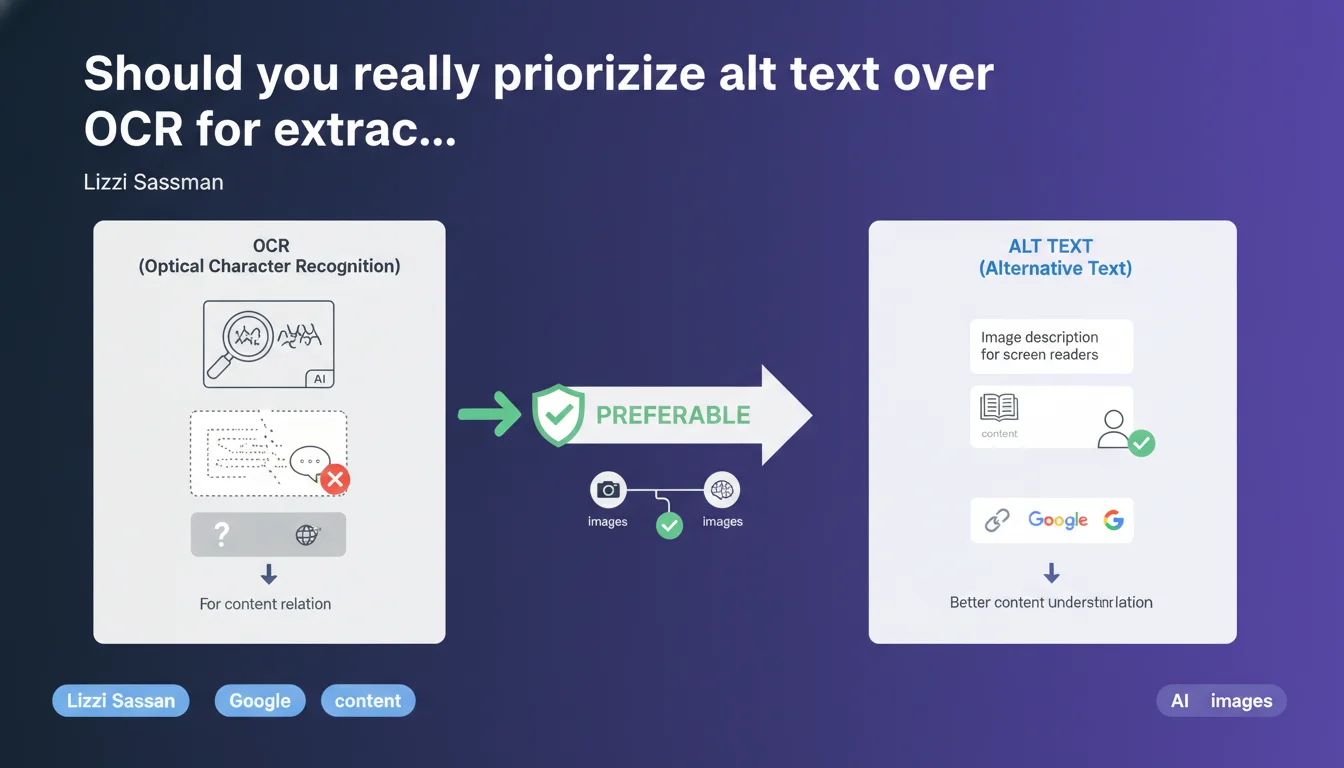
Google confirms it can extract text from images via OCR, but recommends using the alt attribute instead. The reason: better accessibility for screen readers and explicit context about how the image relates to the content. For SEOs, this means you cannot rely solely on OCR to convey important information.
What you need to understand
Does Google really read text embedded in images?
Yes, and Google confirms it explicitly. OCR (Optical Character Recognition) technology is indeed used by the search engine to extract text present in images. It's a technical capability they've deployed for several years now.
But — and this is where it gets interesting — Google specifies that it prefers you to provide this information via the alt attribute. Not out of technical default, but by strategic choice. Important distinction.
Why does Google insist on the alt attribute when it can read the image?
Two main reasons. First, accessibility: screen readers used by visually impaired people rely on the alt attribute, not on OCR. If you count solely on Google's ability to read your image, you exclude this audience.
Second, semantic context. OCR extracts plain text, period. The alt attribute allows you to explain how this image relates to the rest of the page content. It's this contextual relationship that really matters to Google in understanding relevance.
What does this concretely change for SEO?
It confirms that the alt attribute remains an active relevance signal and recommended by Google. Failing to fill it in means missing an opportunity to clarify the intent behind the image.
- Google can technically extract text from images via OCR
- The alt attribute remains the preferred method to convey this information
- Alt text provides semantic context that OCR alone cannot deliver
- Accessibility is an explicit criterion in this recommendation
- Do not rely solely on OCR to index important textual content
SEO Expert opinion
Is this statement truly consistent with practices observed in the field?
Yes and no. Across thousands of audits, we observe that Google does indeed index text present in images, even without an alt attribute. Case studies show that text embedded in infographics can appear in search results.
But — and this is less encouraging — the reliability of this indexation remains unpredictable. It's impossible to predict with certainty which text will be extracted, how it will be weighted, and whether it will actually be used for ranking. [To verify]: Google provides no guarantee on the weight given to OCR text versus alt text.
What are the practical limitations of this recommendation?
First point: Google doesn't clarify whether OCR and alt are cumulative or redundant in its analysis. If you have text in the image AND in the alt, does that strengthen the signal or create unnecessary duplication? Radio silence.
Second concern: the recommendation remains very generic. No guidance on optimal alt length, on whether to duplicate the image text exactly or rephrase it, on how decorative versus informative images are treated. We're left in the dark.
In what cases might this rule not fully apply?
For decorative images, the standard recommendation remains to leave the alt empty (alt=""). So the rule does not apply systematically to all images.
Next, for highly technical content (mathematical formulas, code, complex diagrams), alt alone is often insufficient. In these cases, a complete text description outside the image remains necessary, regardless of OCR or alt.
Practical impact and recommendations
What should you concretely do with your alt attributes?
Prioritize contextual description over simple transcription. If your image contains the text "45% increase in conversions," your alt should be "Chart showing a 45% increase in conversions after SEO optimization," not just "45% conversions."
Avoid over-optimization keyword stuffing in alts. Google explicitly states elsewhere: alt must serve accessibility first. If it sounds artificial to a screen reader, it's probably bad for SEO too.
What mistakes must you absolutely avoid?
Never rely on OCR as the sole indexation vector for important textual content. If the information is critical for page comprehension, it must exist in standard HTML text, not only in images.
Don't leave informative images without alt telling yourself "Google will read the text anyway." That's betting on a technical capability that Google explicitly says isn't a priority.
How do you efficiently audit and fix your images?
Use Screaming Frog or equivalent crawler to list all images without alt. Then prioritize by type: editorial content images > infographics > screenshots > product visuals.
For each image, ask yourself: "If this image didn't display, would the user lose essential information?" If yes, alt is essential. If no, empty alt or pure decoration.
- Audit all images on the site to identify those without alt attribute
- Write descriptive and contextual alts, not mere transcriptions
- Avoid keyword stuffing in alt attributes
- Never rely solely on OCR to index strategic textual content
- Distinguish between informative images (mandatory alt) and decorative ones (empty alt acceptable)
- Check consistency between image text and its alt description
- Test with a screen reader to validate the relevance of descriptions
❓ Frequently Asked Questions
Google utilise-t-il vraiment l'OCR pour toutes les images d'un site ?
Si mon image contient déjà du texte, dois-je le répéter exactement dans l'alt ?
Les images décoratives doivent-elles avoir un attribut alt vide ou absent ?
Le texte extrait par OCR a-t-il le même poids SEO que le texte alt ?
Faut-il optimiser les alts avec des mots-clés SEO ?
🎥 From the same video 16
Other SEO insights extracted from this same Google Search Central video · published on 09/03/2023
🎥 Watch the full video on YouTube →
💬 Comments (0)
Be the first to comment.