
Official statement
Other statements from this video 16 ▾
- □ Faut-il vraiment prévenir Google lors d'une refonte de site ?
- □ Google détecte-t-il vraiment le format WEBP par l'en-tête HTTP plutôt que par l'extension du fichier ?
- □ Comment Google évalue-t-il vraiment la proéminence d'une vidéo sur une page ?
- □ Le contenu dupliqué multilingue pénalise-t-il vraiment votre référencement international ?
- □ Faut-il préférer un ccTLD au .com pour cibler un marché local ?
- □ Pourquoi Google insiste-t-il pour isoler les migrations de site de toute autre refonte ?
- □ Pourquoi AdsBot fausse-t-il vos statistiques de crawl dans Search Console ?
- □ Hreflang : faut-il regrouper toutes les annotations dans un seul sitemap ou les séparer par langue ?
- □ Google propose-t-il un bouton pour réindexer massivement un site après refonte ?
- □ Le LCP ne mesure-t-il vraiment que le viewport visible au chargement ?
- □ Le sitemap XML est-il vraiment indispensable pour être indexé par Google ?
- □ Faut-il utiliser hreflang 'de' ou 'de-de' pour cibler les germanophones ?
- □ Google réessaie-t-il vraiment d'indexer vos pages après une erreur 401 ou serveur down ?
- □ Faut-il vraiment imbriquer ses données structurées pour indiquer le focus principal d'une page ?
- □ Faut-il vraiment privilégier l'attribut alt plutôt que l'OCR pour le texte dans les images ?
- □ Pourquoi le scroll infini pénalise-t-il l'indexation de vos pages e-commerce ?
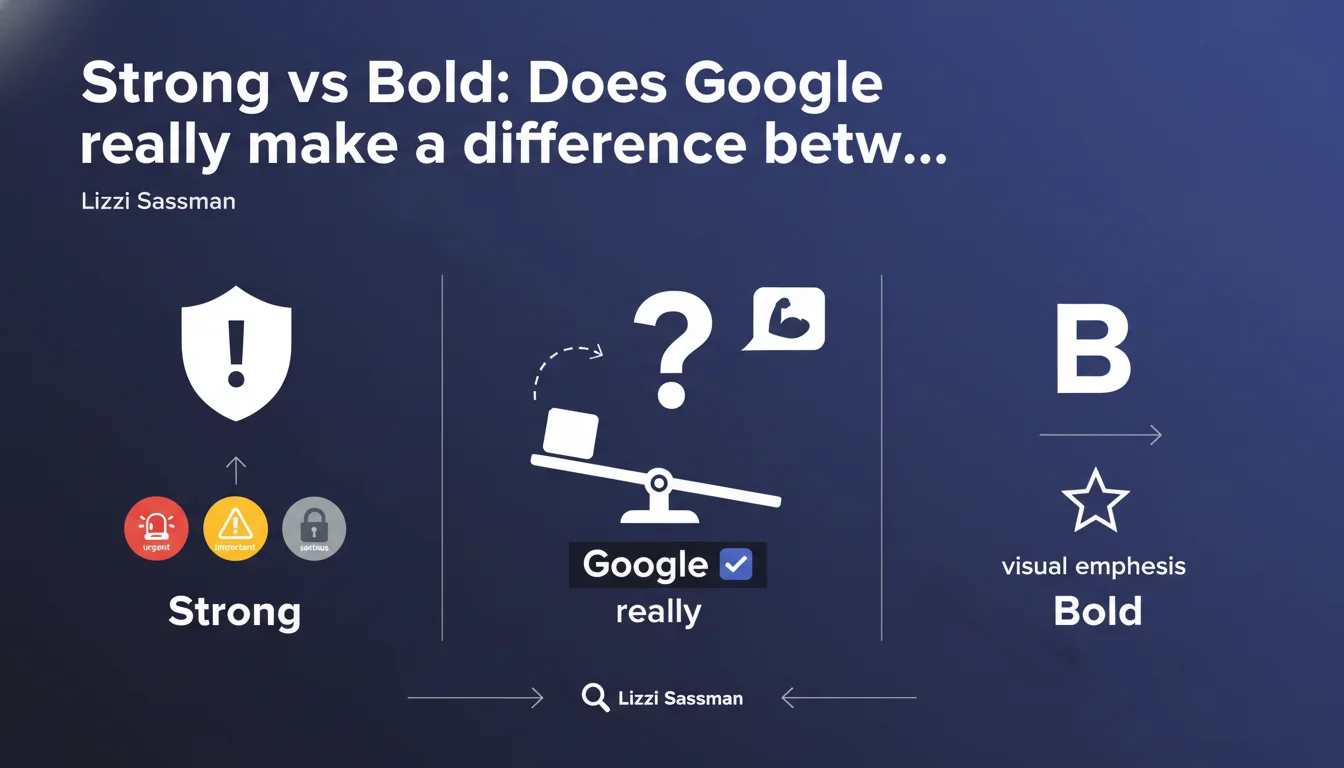
Google distinguishes between <strong> and <b> tags based on their level of semantic importance. The strong tag signals content that is "intensely important, urgent or serious," while bold applies to formatting without strong semantic value. This nuance potentially impacts how algorithms interpret content emphasis.
What you need to understand
What is the technical distinction between strong and b?
Both tags produce the same visual result: bold text. But their semantic meaning diverges. The <b> tag simply indicates typographic formatting, without particular connotation.
The <strong> tag, on the other hand, conveys a value of importance to the tagged content. Google specifies that it should be used for elements that are "intensely important, urgent or serious." The example given — a warning — illustrates this use case.
Does Google really use this distinction for ranking?
Lizzie Sassman does not detail whether this difference directly impacts ranking. She merely indicates that strong is a stronger form than bold. Concretely? No metrics provided, no numerical examples.
So we're navigating in murky waters. Google recommends a good semantic practice, but guarantees nothing about its algorithmic weight. This is consistent with their doctrine: "write for users, not for robots."
- The
<strong>and<b>tags differ in their semantic value, not in their visual rendering - Google defines strong as "intensely important, urgent or serious"
- No explicit confirmation of a direct impact on ranking
- The statement remains in a "best practice" approach without quantitative data
SEO Expert opinion
Does this distinction carry real weight in algorithms?
Let's be honest: no one can say with certainty that Google assigns different weight to these two tags in its ranking algorithms. Large-scale A/B tests have never isolated a measurable effect of strong vs b on positions. [To be verified]
What is certain is that semantic HTML plays a role in the contextual understanding of content. Entities, heading hierarchy, structure — all of that matters. But the specific weight of strong compared to b? Google releases no figures.
Should you modify all your texts accordingly?
No. Frankly, going through every occurrence of <b> to replace it with <strong> would be a monumental waste of time. Unless you have already exhausted all critical optimizations — internal linking, title structure, crawl depth, page speed.
On the other hand, on new content, adopting the correct tag from the outset costs nothing. And it contributes to overall semantic hygiene that, over time, improves the algorithmic readability of your pages.
<strong> tags everywhere dilutes their value. Reserve them for truly essential passages.Practical impact and recommendations
When should you use strong rather than b in your content?
Reserve <strong> for critical information: warnings, cautions, key points in an argument. If you're uncertain, ask yourself this question: "does this passage deserve to catch the eye of a reader in a hurry?"
Use <b> for purely visual formatting: a keyword in a list, a technical term in a glossary, a product name. No urgency, no gravity — just typographic emphasis.
How do you audit the use of these tags on an existing site?
Extract all your <b> and <strong> tags via a Screaming Frog or Oncrawl crawl. Filter strategic pages — landing pages, flagship editorial content. Verify that usage is consistent with the importance hierarchy of your message.
If you observe a chaotic mix, standardize gradually. Priority should go to high-traffic pages or YMYL content where semantic clarity matters more.
- On new content, systematically adopt
<strong>for critical points - Avoid multiplying
<strong>tags — 2 to 3 occurrences maximum per 500-word section - Audit your strategic pages to identify inconsistent uses of
<b> - Don't launch a massive overhaul to fix existing content, unless you have time and resources
- Train your writers on this distinction to build editorial consistency
❓ Frequently Asked Questions
La balise strong a-t-elle un impact direct sur le classement Google ?
Dois-je remplacer tous mes <b> par des <strong> ?
Combien de balises strong maximum par page ?
La balise <em> est-elle équivalente à <i> pour l'emphase ?
🎥 From the same video 16
Other SEO insights extracted from this same Google Search Central video · published on 09/03/2023
🎥 Watch the full video on YouTube →
💬 Comments (0)
Be the first to comment.