
Official statement
Other statements from this video 16 ▾
- □ Do you really need to notify Google when redesigning your website?
- □ Does Google really detect WEBP format through the HTTP header rather than the file extension?
- □ What does Google really consider a prominent video, and why does it matter for your search rankings?
- □ Does multilingual duplicate content really hurt your international SEO rankings?
- □ Should you choose a ccTLD over .com to target a local market?
- □ Why does Google insist on isolating site migrations from any other redesign work?
- □ Is AdsBot skewing your Search Console crawl data without you knowing?
- □ Should you consolidate all hreflang annotations in one sitemap or split them by language?
- □ Does Google offer a button to force massive reindexing of a website after a redesign?
- □ Strong vs Bold: Does Google really make a difference between these two tags?
- □ Does LCP really only measure what's visible in your viewport at load time?
- □ Is an XML sitemap really essential for Google to index your website?
- □ Does Google really retry indexing your pages after a 401 error or server downtime?
- □ Does nesting your structured data really help Google understand what your page is actually about?
- □ Should you really prioritize alt text over OCR for extracting text from images?
- □ Is infinite scroll killing your e-commerce indexation on Google?
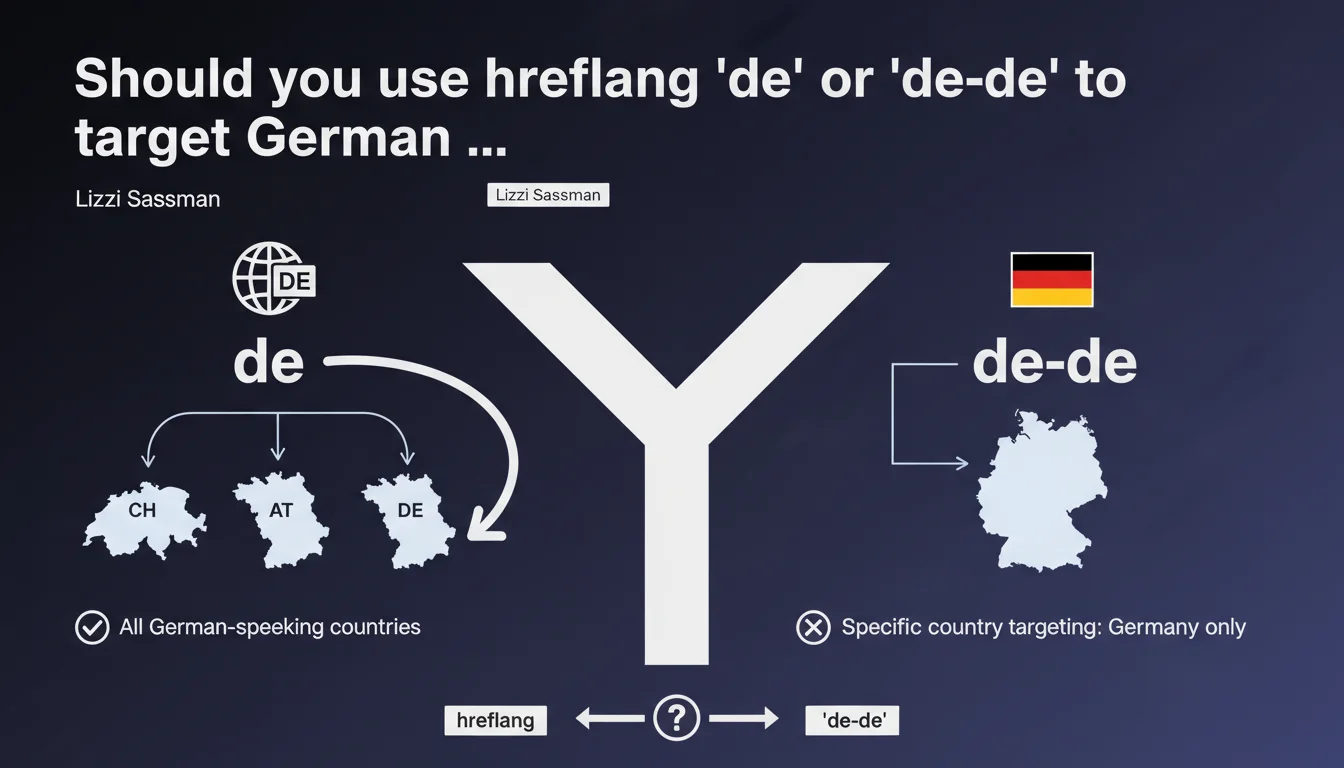
Google confirms that hreflang 'de' (without country code) is appropriate if your content targets German speakers indiscriminately (Germany, Austria, Switzerland). The choice between 'de' and 'de-de' depends solely on your geographic and linguistic targeting strategy.
What you need to understand
What's the difference between 'de' and 'de-de' in hreflang?
The annotation hreflang="de" targets the German language without country distinction. It tells Google that this content is intended for all German speakers, regardless of their location.
Conversely, hreflang="de-de" specifically targets German speakers located in Germany. It's a combined geographic and linguistic targeting.
Why is this distinction important in practice?
Cultural, regulatory, and commercial differences between Germany, Switzerland, and Austria often justify distinct versions. Prices in euros vs Swiss francs, different legal conditions, local expressions — all reasons to create country-specific variants.
But if your content is universal (technical blog, generic product documentation), a single hreflang="de" avoids unnecessary duplication and simplifies maintenance.
In what cases is it acceptable for all German speakers to access the same site?
This approach works when your offering doesn't vary by country: 100% digital services, informational content, SaaS tools with unified pricing. No point creating /de-de/, /de-at/, /de-ch/ if everything is identical.
However, as soon as local specifics come into play — currencies, VAT, shipping, legal notices — country-level targeting becomes essential.
- hreflang="de" = language alone, pan-regional German-speaking targeting
- hreflang="de-de" = language + country, Germany-only targeting
- The choice depends on your commercial and editorial strategy, not on an absolute technical rule
- Google respects this logic: no penalty for using 'de' if it's consistent with your intent
SEO Expert opinion
Does this statement really clarify hreflang's gray areas?
Yes and no. Google confirms what the ISO 639-1 / ISO 3166 spec has always implied: you can omit the country code if geographic targeting doesn't matter. That's reassuring, but not new.
What's missing — and Google remains vague on this — is what happens in case of conflict. If you have both hreflang="de" AND hreflang="de-de" coexisting, which does Google prioritize for a Swiss user? The official documentation stays fuzzy. [To verify] with real cases in Search Console.
Does practice contradict this theoretical approach?
In reality, the vast majority of multi-market e-commerce sites use combined language-country codes (de-de, de-at, de-ch) even when content is nearly identical. Why? Because it allows precise control over traffic distribution and progressive customization.
Using only 'de' works, but you lose granularity. If tomorrow you want to differentiate Switzerland and Germany, you'll need to overhaul your entire hreflang structure. Starting with country codes from the beginning offers more strategic flexibility.
What common mistake does this statement help avoid?
Many sites use hreflang="de-de" by default without thinking, when their content actually targets all German speakers. Result: Austrian or Swiss users land on an English or French version because Google finds no exact match.
Lizzi Sassman's statement reminds you that you must align hreflang with your actual targeting, not copy-paste a standard implementation. It's common sense, but applied rigorously, it prevents traffic loss.
Practical impact and recommendations
What should you actually do on your multilingual site?
First, audit your targeting intent by language. Ask yourself: does my German content vary depending on whether the user is in Germany, Austria, or Switzerland? Prices, currencies, T&Cs, vocabulary?
If yes, implement distinct hreflang by country (de-de, de-at, de-ch). If no, a single hreflang="de" is sufficient. Don't overcomplicate your architecture unnecessarily.
How do you verify that hreflang implementation is consistent?
Use Google Search Console > Experience > International Targeting. Google flags matching errors, orphaned tags, conflicts. Fix them systematically.
Also test with VPNs or tools like hreflang Tags Testing Tool to simulate requests from different countries. Verify that the correct version displays for each language-country combination.
- Clearly define your targeting strategy (language only vs language+country) before implementing hreflang
- Use 'de' if content is identical for all German speakers, 'de-de' if specific to Germany
- Never mix 'de' and 'de-de' in the same hreflang cluster without a clear fallback logic
- Verify in Search Console that Google interprets your annotations correctly
- Document your hreflang logic in a mapping table to ease maintenance
❓ Frequently Asked Questions
Peut-on utiliser hreflang='de' ET hreflang='de-de' sur le même site ?
Si j'utilise hreflang='de' sans pays, Google peut-il quand même afficher ma page aux Allemands ?
Faut-il un hreflang distinct pour le suisse-allemand (gsw) ?
Que se passe-t-il si je ne mets aucun hreflang sur mes versions allemandes ?
🎥 From the same video 16
Other SEO insights extracted from this same Google Search Central video · published on 09/03/2023
🎥 Watch the full video on YouTube →
💬 Comments (0)
Be the first to comment.