
Official statement
Other statements from this video 16 ▾
- □ Do you really need to notify Google when redesigning your website?
- □ Does Google really detect WEBP format through the HTTP header rather than the file extension?
- □ What does Google really consider a prominent video, and why does it matter for your search rankings?
- □ Does multilingual duplicate content really hurt your international SEO rankings?
- □ Why does Google insist on isolating site migrations from any other redesign work?
- □ Is AdsBot skewing your Search Console crawl data without you knowing?
- □ Should you consolidate all hreflang annotations in one sitemap or split them by language?
- □ Does Google offer a button to force massive reindexing of a website after a redesign?
- □ Strong vs Bold: Does Google really make a difference between these two tags?
- □ Does LCP really only measure what's visible in your viewport at load time?
- □ Is an XML sitemap really essential for Google to index your website?
- □ Should you use hreflang 'de' or 'de-de' to target German speakers?
- □ Does Google really retry indexing your pages after a 401 error or server downtime?
- □ Does nesting your structured data really help Google understand what your page is actually about?
- □ Should you really prioritize alt text over OCR for extracting text from images?
- □ Is infinite scroll killing your e-commerce indexation on Google?
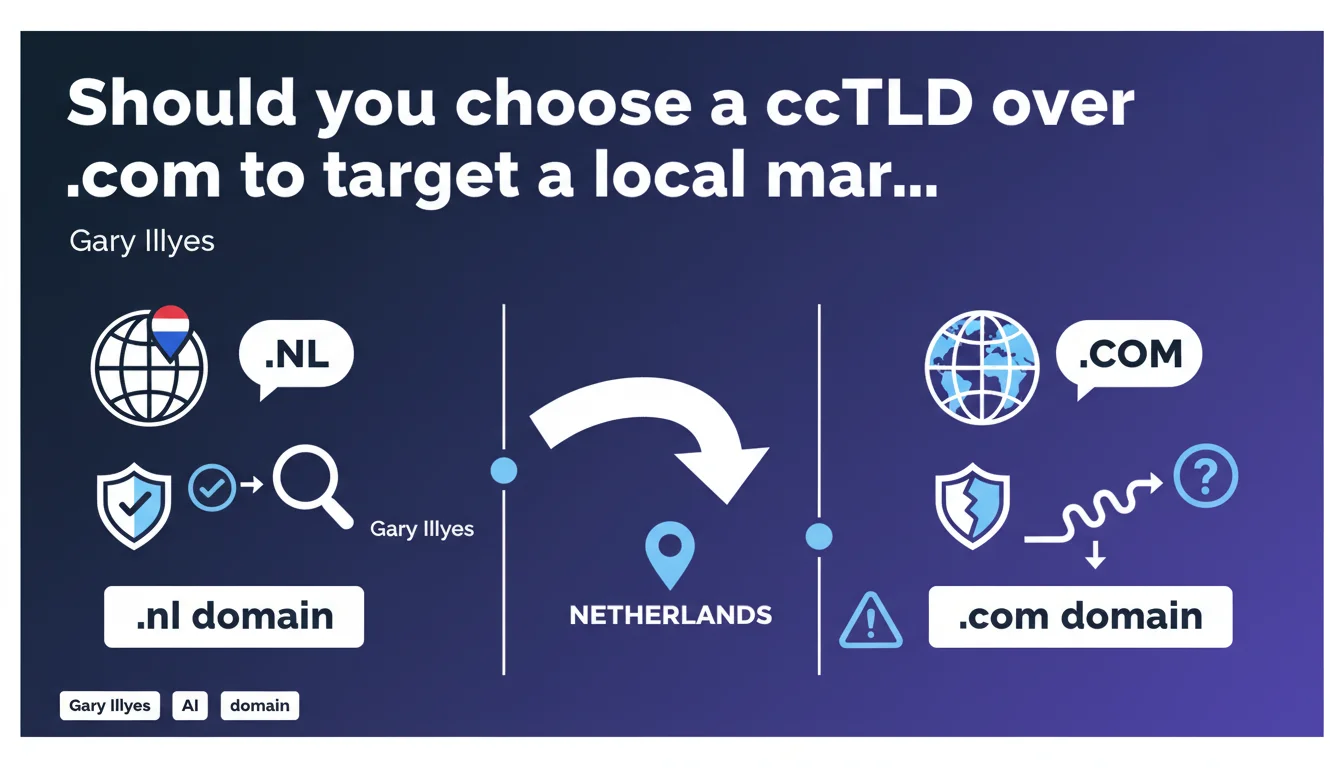
Gary Illyes recommends keeping a .nl domain for a Dutch website rather than migrating to a .com. The ccTLD .nl sends a clear geographical signal to all search engines, while a migration carries non-negligible technical and SEO risks. This statement raises the question of the trade-off between local extension and generic extension depending on the site's objectives.
What you need to understand
Why does Google insist on maintaining a local ccTLD?
The ccTLD (Country Code Top-Level Domain) such as .nl for the Netherlands constitutes an explicit geographical signal for search engines. Unlike a .com which requires manual configuration via Google Search Console to indicate geographical targeting, .nl indicates it natively.
This signal works universally — not only on Google, but also on Bing, Yandex or any other search engine. It's a structural advantage that simplifies geographic targeting and strengthens local relevance in Dutch SERPs.
What are the concrete risks of migrating to a .com?
Any domain migration carries risks: temporary loss of rankings, poorly configured 301 redirects, PageRank dilution, crawl disruption. Gary Illyes doesn't detail these risks, but they are well documented in practice.
Switching from a .nl to a .com adds an extra layer of complexity: loss of the native geographical signal. You'll need to compensate via Search Console (international targeting), hreflang if multilingual, and reinforced on-page signals (local address, phone number, geographical mentions). Nothing prohibitive, but it's a step backward on the automatic geographic targeting front.
In what context does this statement apply?
The recommendation clearly targets sites with local or national scope without immediate international expansion ambitions. If your business is limited to the Netherlands, .nl is optimal.
This logic applies to all ccTLDs: .fr for France, .de for Germany, .es for Spain. The principle remains identical: strong geographical signal, immediate recognition by local users, increased trust.
- The ccTLD sends a native geographical signal to all search engines
- A domain migration always carries technical and SEO risks
- Moving from .nl to .com requires compensation via Search Console and on-page signals
- This recommendation applies to sites with exclusive local/national scope
- Local users trust a ccTLD more than a generic .com
SEO Expert opinion
Is this recommendation absolute or nuanced?
Let's be honest: Gary Illyes simplifies for a specific use case. His statement is relevant for a single-country site without internationalization strategy. But it doesn't account for contexts where .com becomes superior.
If you're targeting multiple European or international markets, .com with a multilingual hreflang architecture becomes more coherent. Migrating from a .nl to .com and then deploying versions for .fr, .de, .es via subfolders (/fr/, /de/, /es/) can make sense — provided the migration is perfectly controlled.
.com also benefits from stronger perceived authority in certain sectors (tech, SaaS, international e-commerce). It's not a direct ranking factor, but it influences click-through rate and user trust outside a purely local context. [To verify]: Google does not communicate quantified data on the comparative impact of ccTLD vs .com in local SERPs with equivalent Search Console targeting.
Are migration risks always deal-breakers?
No. A well-executed domain migration — complete 301 redirects, priority backlink updates, crawl monitoring, ranking surveillance — can proceed without major drama. Temporary fluctuations are inevitable, but a solid site typically recovers within 3-6 months.
The real problem is that many migrations are botched: incomplete redirects, redirect chains, unmanaged UTM parameters, unmaintained sitemaps. And there, yes, it can hurt. Gary Illyes doesn't say it's impossible, he says the game isn't worth the candle unless you have a strong strategic reason.
Does the ccTLD impact backlinks and authority?
A rarely addressed but relevant question: backlinks acquired on a .nl often come from Dutch sites, which reinforces the geographical signal. Migrating to .com potentially dilutes this geographical coherence of your link profile.
Moreover, an established .nl domain from years past has accumulated historical authority — domain age, trust, user signals. All of this transfers via 301, but with estimated losses (not officially quantified by Google, but observed in practice around 10-15% temporary loss of 'SEO juice'). Again, [To verify] due to lack of precise official data.
Practical impact and recommendations
What should you do if you already have a .nl and are hesitating about migrating?
Gary Illyes' answer is clear: don't move if your target is exclusively Dutch. Instead, consolidate your .nl: improve your content, strengthen your internal linking, optimize your Core Web Vitals, develop your local backlink profile.
If you have international ambitions, two options: either keep the .nl and create subdomains or subfolders for other countries (de.yoursite.nl, fr.yoursite.nl — less optimal), or you actually consider migrating to .com with multilingual architecture. In the latter case, don't do it lightly.
How to manage a .nl to .com migration if it's strategically justified?
If you decide to migrate anyway, here are the non-negotiable fundamentals:
- Map all URLs from the .nl and create a comprehensive redirect matrix (no orphaned 404s)
- Set up Netherlands geographical targeting in Google Search Console for the new .com
- Update all editable backlinks (partners, directories, social profiles)
- Deploy tight monitoring of rankings and organic traffic for at least 6 months
- Keep the .nl active with redirects for at least 12 months (some recommend indefinitely)
- Strengthen local on-page signals on the .com: address, phone, LocalBusiness schema.org
- If multilingual, deploy hreflang from day one to avoid any targeting confusion
What errors must you absolutely avoid in this context?
First common mistake: migrating due to fashion or marketing pressure without solid strategic reason. .com seems more 'international', but if you're only targeting the Dutch market, it's SEO nonsense.
Second mistake: underestimating the technical complexity of a domain migration. It's not just a DNS change. It's a surgical operation requiring rigorous planning, specialized technical skills and intense post-migration monitoring.
For a single-country Dutch site, .nl remains the optimal option — strong geographical signal, local recognition, zero migration risk. Migrating to .com only makes sense if you're targeting structured international expansion. In that case, the migration must be impeccably prepared and executed.
These strategic trade-offs and technical migrations can prove complex to orchestrate alone, especially if your site generates significant traffic. Calling on a specialized SEO agency for a preliminary audit and personalized support can avoid costly mistakes and secure the transition.
❓ Frequently Asked Questions
Un .com avec ciblage Search Console équivaut-il à un ccTLD pour le référencement local ?
Puis-je garder mon .nl et ajouter un .com pour l'international ?
Combien de temps faut-il pour récupérer d'une migration de domaine ?
Le .nl est-il un handicap pour vendre à l'international ?
Google favorise-t-il les ccTLD dans les résultats locaux par rapport aux .com ?
🎥 From the same video 16
Other SEO insights extracted from this same Google Search Central video · published on 09/03/2023
🎥 Watch the full video on YouTube →
💬 Comments (0)
Be the first to comment.