
Official statement
Other statements from this video 16 ▾
- □ Do you really need to notify Google when redesigning your website?
- □ Does Google really detect WEBP format through the HTTP header rather than the file extension?
- □ What does Google really consider a prominent video, and why does it matter for your search rankings?
- □ Does multilingual duplicate content really hurt your international SEO rankings?
- □ Should you choose a ccTLD over .com to target a local market?
- □ Why does Google insist on isolating site migrations from any other redesign work?
- □ Is AdsBot skewing your Search Console crawl data without you knowing?
- □ Does Google offer a button to force massive reindexing of a website after a redesign?
- □ Strong vs Bold: Does Google really make a difference between these two tags?
- □ Does LCP really only measure what's visible in your viewport at load time?
- □ Is an XML sitemap really essential for Google to index your website?
- □ Should you use hreflang 'de' or 'de-de' to target German speakers?
- □ Does Google really retry indexing your pages after a 401 error or server downtime?
- □ Does nesting your structured data really help Google understand what your page is actually about?
- □ Should you really prioritize alt text over OCR for extracting text from images?
- □ Is infinite scroll killing your e-commerce indexation on Google?
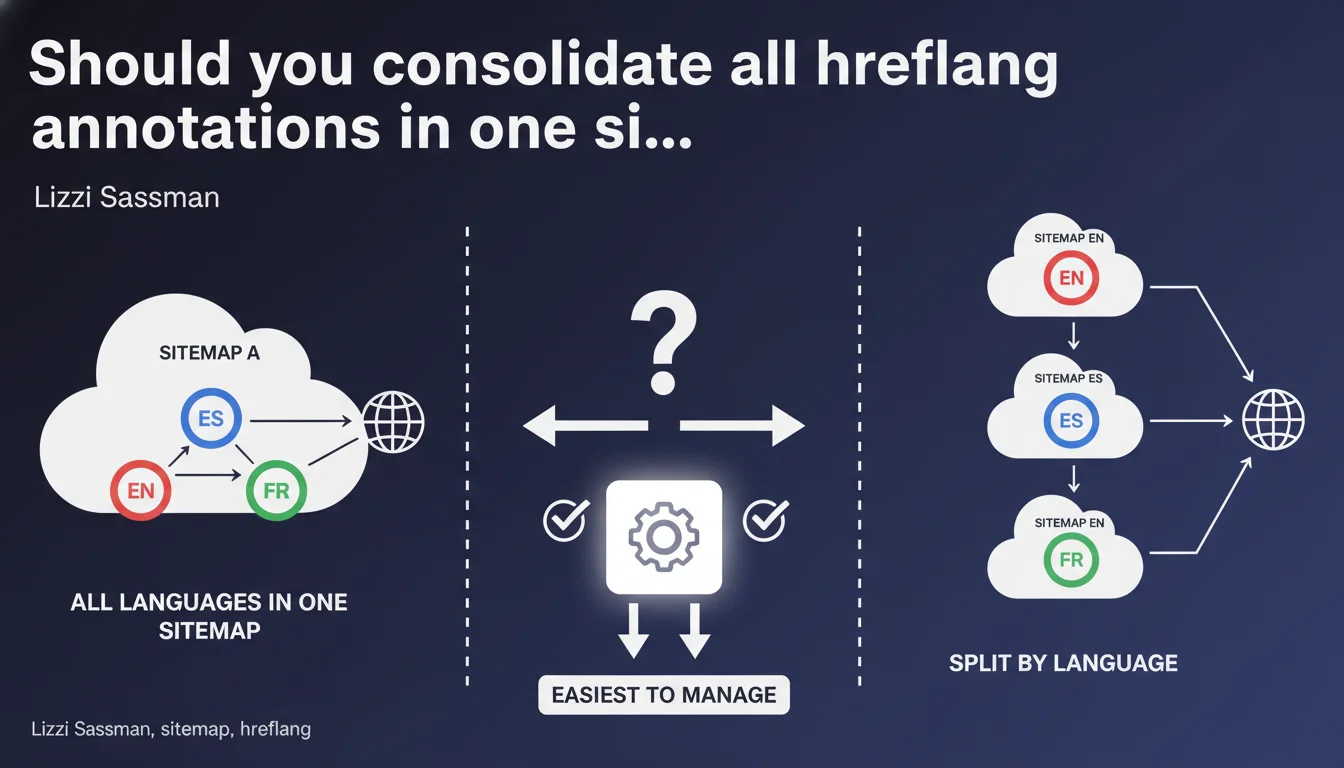
Google reads and understands hreflang annotations whether they're spread across multiple sitemaps or consolidated in a single file. Choosing between the two approaches is purely operational — go with whichever simplifies your management and integrates best with your submission workflow.
What you need to understand
Does Google mandate a specific structure for hreflang annotations in sitemaps?
No. Google prescribes no mandatory organization. You can centralize all your hreflang annotations in a single global sitemap, or split them by language across separate files. Both approaches are technically equivalent for Googlebot.
This statement dispels a persistent myth: some practitioners believed a single sitemap facilitated Google's processing. Others swore that language-based separation improved consistency. Sassman settles it — neither has an inherent technical advantage.
What logic should guide your structural choice?
Practical considerations take priority. If your CMS automatically generates a sitemap per language, stick with that logic. If you manually manage your sitemaps and a single file simplifies your workflow, do that. Maintenance ease is the only relevant criterion.
Your submission method also plays a role: if you use multiple Search Console properties separated by language, distinct sitemaps facilitate tracking. Conversely, a single property works perfectly fine with a global sitemap.
What are the essential takeaways for implementation?
- Google processes hreflang annotations spread across multiple sitemaps or consolidated in one identically
- Your choice should be guided by your organizational logic and generation tools
- No direct SEO impact — only maintainability matters
- Internal consistency remains crucial: regardless of your structure, every annotation must be bidirectional and complete
- Verify your sitemap respects technical limits (50,000 URLs, 50 MB uncompressed)
SEO Expert opinion
Does this flexibility hide operational pitfalls?
Yes, and the main pitfall lies in annotation consistency. When you spread your hreflang across multiple sitemaps, you multiply failure points. A missed update in one file creates orphaned annotations — Google detects the inconsistency and may ignore the entire cluster.
I've seen sites split their sitemaps by language without documenting the logic. Six months later, nobody knows which file contains what. The risk of human error skyrockets. Apparent simplicity masks real technical debt.
Does a single sitemap truly guarantee better consistency?
Not necessarily. A centralized sitemap can become an unmanageable monster if your site has 30 language versions. You end up with a multi-megabyte file that's difficult to audit and slow to generate. Errors get lost in the noise.
Conversely, if your CMS properly automates generation — whether as one file or multiple — structure matters little. It's automation that counts. [To verify] Google states both approaches work, but doesn't specify whether one facilitates crawling or speeds up change detection.
In which cases should you favor a specific architecture?
Sites with fewer than 10 languages and manual or semi-automated management? A single sitemap simplifies auditing and reduces files to maintain. Complex multilingual sites with automatic CMS generation? Language-specific sitemaps cleanly segment responsibilities and facilitate debugging.
Practical impact and recommendations
How do you concretely choose between a single sitemap and multiple ones?
Start by auditing your current generation process. Does your CMS naturally produce separate sitemaps? Forcing consolidation would be counterproductive. Conversely, if you manually assemble your files, unifying simplifies things.
Next, evaluate your Search Console structure. Single property for your entire site? A coherent global sitemap works. Separate properties by language or region? Segmented sitemaps aligned with that logic. Error traceability becomes clearer.
What errors should you avoid during implementation?
Don't fragment without valid reason. Creating 40 sitemaps for 40 languages when one suffices unnecessarily complicates maintenance. Conversely, don't force consolidation if your infrastructure naturally generates separate files.
Another classic pitfall: forgetting to reference all sitemaps in robots.txt or your sitemap index. If Google can't find a file, the annotations it contains are invisible. Verify that every sitemap is properly declared.
How do you verify hreflang annotation consistency?
- Crawl your entire site with Screaming Frog or equivalent, activating hreflang annotation extraction
- Verify that each URL declares all language variants of the cluster (including itself with x-default if relevant)
- Check for bidirectionality: if A points to B, B must point back to A with the correct hreflang
- Ensure no URL redirects to a 404 page, redirect, or canonicalized page
- Validate that language codes use the correct ISO format (fr, en-GB, es-MX…)
- Monitor hreflang errors in Search Console — Coverage tab and Enhancements report
❓ Frequently Asked Questions
Puis-je mélanger annotations hreflang dans le sitemap et dans le HTML ?
Dois-je soumettre mes sitemaps hreflang dans toutes mes propriétés Search Console ?
Un sitemap séparé par langue accélère-t-il le crawl des nouvelles pages ?
Que se passe-t-il si j'oublie de déclarer un sitemap hreflang dans le robots.txt ?
Dois-je inclure les URLs canonicalisées dans mes annotations hreflang ?
🎥 From the same video 16
Other SEO insights extracted from this same Google Search Central video · published on 09/03/2023
🎥 Watch the full video on YouTube →
💬 Comments (0)
Be the first to comment.