
Official statement
Other statements from this video 14 ▾
- □ Un code 403 sur mobile bloque-t-il réellement toute indexation de votre site ?
- □ Les erreurs 404 et redirections 301 nuisent-elles vraiment au référencement ?
- □ Pourquoi Google voit-il majoritairement vos prix en dollars américains ?
- □ Hreflang et canonical : pourquoi Google les traite-t-il comme deux concepts distincts ?
- □ L'outil de désaveu supprime-t-il vraiment les backlinks toxiques de Google ?
- □ Comment différencier des pages produits identiques sans tomber dans le duplicate content ?
- □ Faut-il vraiment vérifier séparément chaque sous-domaine dans Search Console ?
- □ Faut-il vraiment s'inquiéter d'un volume important de 404 sur son site ?
- □ Faut-il vraiment marquer tous les liens d'affiliation avec rel=nofollow ou rel=sponsored ?
- □ Les quality raters impactent-ils vraiment le classement de votre site ?
- □ Combien de temps Google mémorise-t-il les anciennes URL après une migration ?
- □ L'indexation mobile-first est-elle vraiment généralisée à tous les sites ?
- □ Le domaine .ai est-il vraiment traité comme un gTLD par Google ?
- □ Faut-il vraiment réduire le nombre de pages indexées pour améliorer son SEO ?
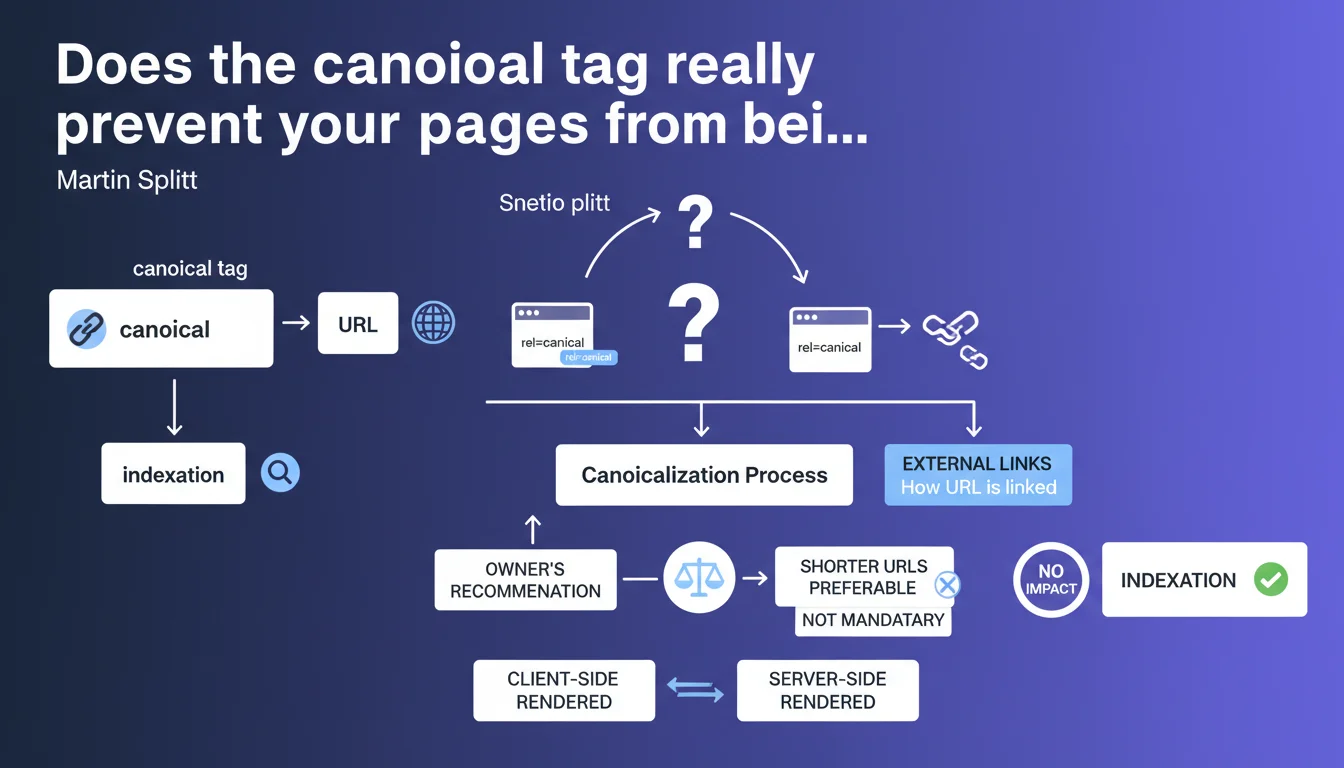
Google affirms that canonicalization has no impact on indexation. The canonical tag is solely meant to indicate which version of a page you prefer to see appear in search results, but it does not determine whether a URL will be indexed or not. Shorter URLs remain preferable without being mandatory, and the rendering mode (client-side vs server-side) is not a factor.
What you need to understand
What's the difference between canonicalization and indexation?
This is the central point of this statement: canonicalization and indexation are two distinct processes. Indexation determines whether a page enters Google's index. Canonicalization comes after, to choose which version to display when multiple URLs present similar or identical content.
Concretely — a page can be indexed even if you mark it as canonical to another URL. Google keeps both versions in its index, but only displays one in the SERPs. The canonical tag is a recommendation, not a blocking instruction.
How does Google select the canonical URL?
Martin Splitt clarifies that Google examines two main elements: your recommendation via the canonical tag, and how URLs are linked elsewhere on the web. If your backlinks point massively to URL A while you declare B as canonical, Google may ignore your preference.
Shorter URLs are preferable but not mandatory. This is a weak signal among others — not a decisive criterion. If your URL is 150 characters long but receives all the links, it can become the de facto canonical.
Does rendering mode influence this process?
No. Whether your site uses server-side rendering or client-side rendering, the canonicalization logic remains identical. Google treats the canonical tag the same way regardless of the HTML generation method.
This clarification likely addresses a recurring confusion: some believed that JavaScript applications risked having their canonicals ignored or misinterpreted. This is not the case.
- Canonicalization does not block indexation — the two processes are independent
- Google combines your canonical tag with external signals (links, mentions) to choose the displayed version
- Shorter URLs are a weak signal, not an eliminating criterion
- Server-side and client-side rendering: no difference in canonical treatment
SEO Expert opinion
Does this statement match what we observe in the field?
Yes and no. In principle, it's correct: we regularly see URLs indexed despite a canonical tag pointing elsewhere. But Splitt's wording masks an inconvenient reality — many SEO professionals still confuse canonical with noindex because Google itself has long maintained this confusion.
For years, we've observed cases where Google de facto disindexed pages marked canonical to another URL. Not systematically, but often enough to create confusion. This statement finally clarifies the theoretical model, but guarantees nothing about the algorithm's actual behavior in edge cases.
What gray areas remain in this assertion?
Splitt says Google "examines the owner's recommendation via the canonical tag and how the URL is linked elsewhere on the web." Fine. But what is the relative weight of each signal? [To verify] — we don't know if a backlink accounts for 10%, 50%, or 80% of the decision.
Second gray area: "shorter URLs are preferable but not mandatory." Preferable to what extent? If two URLs are strictly equivalent on all other criteria, does the shorter URL win every time? And if so, what difference in length triggers a switch? [To verify] — no numerical data.
In what cases does this rule not apply?
If you massively canonicalize pages to a URL that has no thematic relationship, Google may outright ignore your tags. Same if you create chains of canonicals (A → B → C) — Google hates this and will choose arbitrarily.
Another problematic case: sites with infinite pagination in JavaScript. Technically, client-side rendering changes nothing according to Splitt. In practice, if Google doesn't crawl your paginated pages correctly, your canonicals may point to nothing. Theory and reality don't always align.
Practical impact and recommendations
What should you do concretely with your canonical tags?
First, audit your existing canonicals. Verify that they always point to accessible, indexable, and relevant URLs. A canonical pointing to a 404 or a page blocked by robots.txt is a contradictory signal that Google may ignore.
Next, align your internal linking with your canonicalization choices. If you declare A as canonical, have your internal links point to A, not B. Google considers overall consistency — if you say one thing and do the opposite, you weaken your recommendation.
What mistakes should you absolutely avoid?
Never create chains of canonicals. Each URL should point directly to the final canonical version, with no intermediary. Google follows one or two jumps maximum, after which it abandons or chooses arbitrarily.
Also avoid canonicalizing pages with substantially different content. The tag is meant to manage duplicates or near-duplicates, not to merge distinct pages. If you force canonicalization between two different contents, Google may ignore your directive and index both versions anyway.
- Verify that all your canonicals point to 200 OK and indexable URLs
- Align your internal linking: links should point to the declared canonical version
- Remove canonical chains — each URL should point directly to the final one
- Reserve canonicals for actual duplicates, not pages with distinct content
- If you want to block indexation, use noindex, never canonical alone
- Audit regularly: Google may ignore your canonicals if external signals (backlinks) contradict your choice
How can you ensure Google respects your preferences?
Use Search Console to check which URL Google has actually chosen as canonical. In the URL inspection tool, the "Coverage" section indicates the canonical URL selected by Google. If it differs from your declaration, that's a warning sign.
Strengthen your canonicals with 301 redirects when possible. If you have no reason to keep multiple versions accessible, redirect the variants to the canonical. This is the strongest signal — far better than an HTML tag.
Canonicalization is a subtle optimization lever that requires global consistency between your technical declarations, your internal linking, and your external signals. Configuration errors can dilute your authority and create inconsistencies in the index.
For complex sites with many URL variants, multi-language architectures, or advanced technical setups, it may be wise to bring in a specialized SEO agency to audit your canonicalization strategy and guide you through rigorous implementation. Expert review often detects invisible internal errors and optimizes authority transmission between your pages.
❓ Frequently Asked Questions
Si je mets une balise canonical, la page sera-t-elle quand même indexée ?
Google respecte-t-il toujours ma balise canonical ?
Les URLs courtes sont-elles vraiment mieux pour la canonicalisation ?
Le JavaScript côté client pose-t-il problème pour les canonicals ?
Puis-je utiliser canonical pour bloquer l'indexation d'une page ?
🎥 From the same video 14
Other SEO insights extracted from this same Google Search Central video · published on 11/07/2023
🎥 Watch the full video on YouTube →
💬 Comments (0)
Be the first to comment.