
Official statement
Other statements from this video 14 ▾
- □ Un code 403 sur mobile bloque-t-il réellement toute indexation de votre site ?
- □ Les erreurs 404 et redirections 301 nuisent-elles vraiment au référencement ?
- □ La balise canonical bloque-t-elle vraiment l'indexation de vos pages ?
- □ Pourquoi Google voit-il majoritairement vos prix en dollars américains ?
- □ Hreflang et canonical : pourquoi Google les traite-t-il comme deux concepts distincts ?
- □ L'outil de désaveu supprime-t-il vraiment les backlinks toxiques de Google ?
- □ Faut-il vraiment vérifier séparément chaque sous-domaine dans Search Console ?
- □ Faut-il vraiment s'inquiéter d'un volume important de 404 sur son site ?
- □ Faut-il vraiment marquer tous les liens d'affiliation avec rel=nofollow ou rel=sponsored ?
- □ Les quality raters impactent-ils vraiment le classement de votre site ?
- □ Combien de temps Google mémorise-t-il les anciennes URL après une migration ?
- □ L'indexation mobile-first est-elle vraiment généralisée à tous les sites ?
- □ Le domaine .ai est-il vraiment traité comme un gTLD par Google ?
- □ Faut-il vraiment réduire le nombre de pages indexées pour améliorer son SEO ?
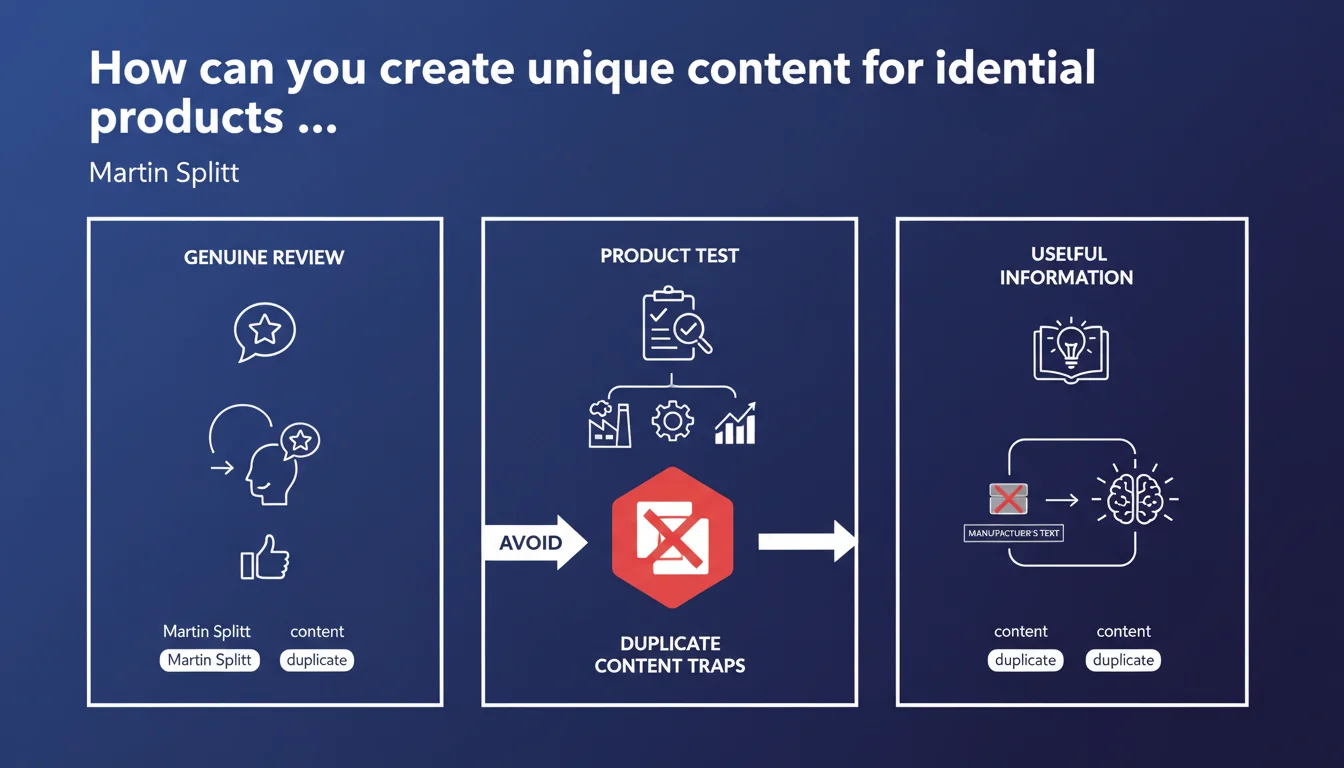
Martin Splitt is clear: to avoid duplicate content on product pages sold by multiple merchants, you need to add real value. No copy-pasting manufacturer specs. Google expects authentic reviews, real-world testing, useful information that goes beyond simple product datasheets.
What you need to understand
Why does Google demand unique content for identical products?
Marketplaces and e-commerce sites often sell the same products with the same manufacturer descriptions. Result: hundreds of nearly identical pages competing for the same rankings.
Google seeks to rank content that delivers the most value. If you just copy the manufacturer's text, you're adding nothing more than your competitors — and the engine will arbitrarily choose who to rank.
What counts as a "genuine perspective" according to Google?
Splitt mentions three concrete approaches: an authentic review, a product test, or useful information beyond specs. Not filler content, but perceptible value for the user.
This could be a usage guide, detailed comparisons, customer experience feedback, or even maintenance tips. The idea: move beyond basic catalog listings.
- Simply copying manufacturer specs with no additions = duplicate content
- Adding a genuine review, test, or guide = differentiated content
- Google favors pages that bring a unique perspective
- Content must be useful, not just different for the sake of it
SEO Expert opinion
Does this statement align with real-world practices?
Yes, and it's consistent with the Product Reviews Updates Google has deployed. Sites that stick to generic product sheets are getting hit hard in e-commerce SERPs.
However — and this is where it gets tricky — the line between "unique useful content" and "manufactured differentiation" is blurry. Some sites add hollow paragraphs just to avoid being identical. Google doesn't explain how it distinguishes between the two. [Needs verification]
What nuances should we consider?
Splitt doesn't clarify whether an aggregated user review alone is enough or if a full editorial review is required. Sites displaying hundreds of user reviews without proprietary content often perform well — proof that Google also values authentic UGC.
Another point: technical specifications remain necessary. The idea isn't to remove them, but to complement them. Differentiated text without basic specs would backfire.
In which cases does this rule not apply?
On ultra-technical products where specs suffice (industrial components, spare parts), it's difficult to add a "perspective." In that case, focus on site architecture, advanced filters, and user experience rather than forcing content.
Sites dominating these niches don't win through unique content, but via domain authority, technical structure, and trust signals (reviews, customer service, availability).
Practical impact and recommendations
What should you do concretely?
For each product, ask yourself: what can I bring that the manufacturer's sheet doesn't? If the answer is "nothing," you're in duplicate territory.
Prioritize products with high search volume and high margins. No point writing tests for 10,000 SKUs — focus on bestsellers and strategic products.
What mistakes should you avoid?
Don't fall into content spinning or automatic rewriting of manufacturer descriptions. Google detects these practices through language models and behavioral signals.
Also avoid duplicating your own content across product variants (colors, sizes). If pages are too similar, use canonical tags pointing to a main version instead.
- Identify priority products (volume + margin)
- Write authentic tests or reviews where possible
- Add usage guides, comparisons, maintenance tips
- Integrate authentic, structured customer reviews
- Use canonical tags on minor variants
- Monitor behavioral signals (time on page, bounce rate)
- Don't duplicate your own content across similar SKUs
How do you verify your pages are compliant?
Test your descriptions in Google: if multiple competitors show exactly the same text, you're in duplicate territory. Use tools like Copyscape or Siteliner to identify overly similar content.
Also analyze Core Web Vitals and average time on page: if your unique product sheets underperform competitors' duplicate content, it means your content isn't delivering perceptible value.
❓ Frequently Asked Questions
Est-ce que les avis clients suffisent pour différencier une page produit ?
Faut-il réécrire toutes les fiches produits d'un coup ?
Comment gérer les variantes (couleurs, tailles) sans duplicate ?
Le duplicate content interne est-il aussi pénalisant que l'externe ?
Peut-on automatiser la création de contenu unique pour des milliers de produits ?
🎥 From the same video 14
Other SEO insights extracted from this same Google Search Central video · published on 11/07/2023
🎥 Watch the full video on YouTube →
💬 Comments (0)
Be the first to comment.