
Official statement
Other statements from this video 14 ▾
- □ Un code 403 sur mobile bloque-t-il réellement toute indexation de votre site ?
- □ Les erreurs 404 et redirections 301 nuisent-elles vraiment au référencement ?
- □ La balise canonical bloque-t-elle vraiment l'indexation de vos pages ?
- □ Pourquoi Google voit-il majoritairement vos prix en dollars américains ?
- □ Hreflang et canonical : pourquoi Google les traite-t-il comme deux concepts distincts ?
- □ Comment différencier des pages produits identiques sans tomber dans le duplicate content ?
- □ Faut-il vraiment vérifier séparément chaque sous-domaine dans Search Console ?
- □ Faut-il vraiment s'inquiéter d'un volume important de 404 sur son site ?
- □ Faut-il vraiment marquer tous les liens d'affiliation avec rel=nofollow ou rel=sponsored ?
- □ Les quality raters impactent-ils vraiment le classement de votre site ?
- □ Combien de temps Google mémorise-t-il les anciennes URL après une migration ?
- □ L'indexation mobile-first est-elle vraiment généralisée à tous les sites ?
- □ Le domaine .ai est-il vraiment traité comme un gTLD par Google ?
- □ Faut-il vraiment réduire le nombre de pages indexées pour améliorer son SEO ?
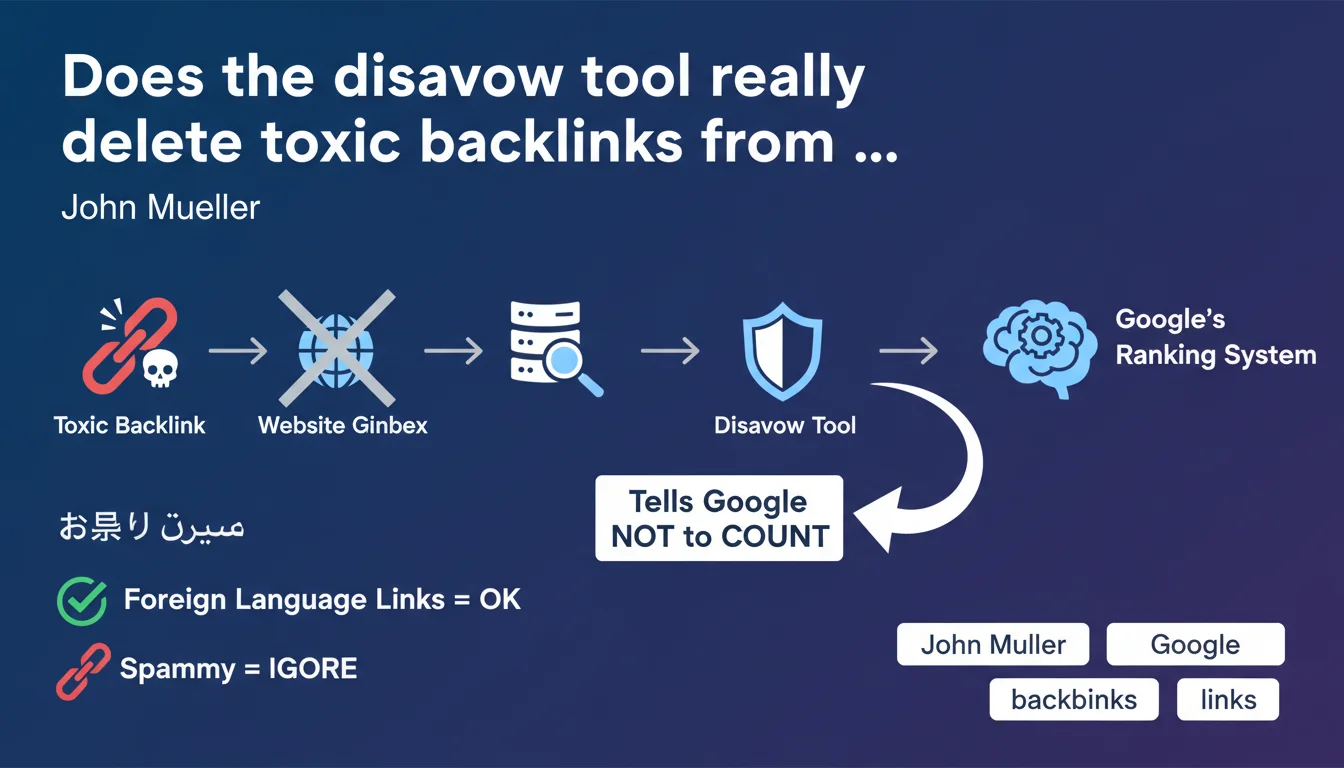
The disavow tool doesn't erase links from the web or from Google's systems — it simply instructs the search engine to ignore them for ranking purposes. Links from websites in foreign languages pose no inherent problem and can be disavowed if they're spammy, with no negative consequences.
What you need to understand
What does the disavow tool actually do?
The disavow tool destroys nothing. It functions as a processing filter: the links remain indexed in Google's databases, they still appear in Search Console, but the engine neutralizes them when calculating PageRank.
In concrete terms? Disavowed URLs continue to exist within Google's link graph. They simply are no longer counted as positive or negative signals anymore. It's a processing instruction, not a technical deletion.
Why do some SEOs worry about foreign language links?
Many professionals panic when they see Russian, Chinese, or Arabic backlinks flooding in — often from automated spam networks. The misconception: Google would penalize a site for having links from non-English domains.
The reality? The language of a source site is never a toxicity criterion in itself. A natural link from a legitimate Russian blog is worth as much as a French link. Only the spammy nature of the link matters — and language plays no role in that.
Do these links remain visible in Search Console after disavowal?
Yes, and this is where many make a mistake. Disavowed links continue to appear in the "Links to your site" report. Google doesn't hide them, doesn't remove them from its index — it simply ignores them during algorithmic calculation.
This visual permanence creates confusion: some people think the tool didn't work. Wrong. The lack of visual disappearance doesn't mean there's no effect on rankings.
- The disavow tool is an algorithmic processing instruction, not a physical deletion
- Disavowed links remain in Google's systems and in Search Console
- The language of a source site is never an indicator of toxicity — only the spammy nature matters
- Disavowing a legitimate foreign link has no negative impact on your SEO
SEO Expert opinion
Does this statement match real-world observations?
Yes, absolutely. Post-disavowal audits systematically show that links remain detectable via third-party tools (Ahrefs, Majestic) and in Search Console. If the tool physically deleted links from Google's databases, we would see a rapid divergence between GSC and external crawlers — which never happens.
However, effects on rankings are real but difficult to measure in isolation. [To verify]: Google has never communicated a precise timeline for disavow implementation — some people report a few days, others several weeks. This lack of transparency prevents rigorous validation.
Should you systematically disavow foreign language links?
Absolutely not. It's even a frequent mistake that can dilute your backlink profile. An e-commerce site with naturally occurring links from German, Italian, or Polish blogs — because its products appeal internationally — should definitely not disavow them.
The disavowal criterion is never language, but editorial and contextual quality: over-optimized anchors, auto-generated content, link farms, detectable PBNs. A Russian link from a legitimate academic site is worth more than a French link from a poor-quality directory.
Why does Google maintain links in its systems after disavowal?
Two likely reasons. First, technical architecture: selectively deleting entries in a link graph at web scale would be resource-intensive and introduce inconsistency risks.
Second, reversibility. If you mistakenly disavow a valuable link, Google can immediately reintegrate it into the calculation as soon as you remove it from your disavow file — without waiting for a recrawl. This is a non-negligible architectural advantage for webmasters.
Practical impact and recommendations
When should you really use the disavow tool?
Let's be honest: in 90% of cases, you don't need it. Google has significantly improved its ability to automatically ignore toxic links since Penguin 4.0. The tool remains relevant in three specific scenarios.
First: you've been the victim of a massive and documented negative SEO attack, with thousands of spammy links appearing suddenly. Second: you're cleaning up the aftermath of an inherited black hat netlinking strategy (site acquisition, post-penalty redesign). Third: you've received a manual action for artificial links — there, disavowal becomes mandatory for your reconsideration request.
How do you audit backlinks before disavowing?
Never disavow hastily. Export your backlinks from Search Console and cross-reference with a third-party tool (Ahrefs, SEMrush, Majestic). Identify suspicious patterns: over-represented exact match anchors, domains with no editorial content, networks of sites with the same technical fingerprint (IP, CMS, templates).
Prioritize links with real impact on your profile: a spam link from a DR 5 domain without traffic is probably already being ignored by Google. Focus on toxic links from domains that still hold residual authority — those can actually pollute your signal.
- Only use the disavow tool in cases of massive spam, inherited black hat, or Google manual action
- Never disavow a link simply because it comes from a foreign language site
- Cross-reference Search Console data with a third-party crawler to avoid false positives
- Document each disavowal with the precise reason (screenshot, analysis) in case of reconsideration request
- Re-evaluate your disavow.txt file every 6 months — links toxic yesterday may be deindexed today
- Test impact by disavowing progressively in small batches, never in bulk at once
❓ Frequently Asked Questions
Si je désavoue un lien, disparaîtra-t-il de Search Console ?
Dois-je désavouer tous les backlinks russes ou chinois que je reçois ?
Combien de temps faut-il pour qu'un désaveu soit pris en compte par Google ?
Puis-je annuler un désaveu si je me rends compte que j'ai désavoué un bon lien ?
L'outil de désaveu peut-il nuire à mon SEO si je l'utilise mal ?
🎥 From the same video 14
Other SEO insights extracted from this same Google Search Central video · published on 11/07/2023
🎥 Watch the full video on YouTube →
💬 Comments (0)
Be the first to comment.