
Official statement
What you need to understand
What exactly is the #nosearch feature announced by Bing?
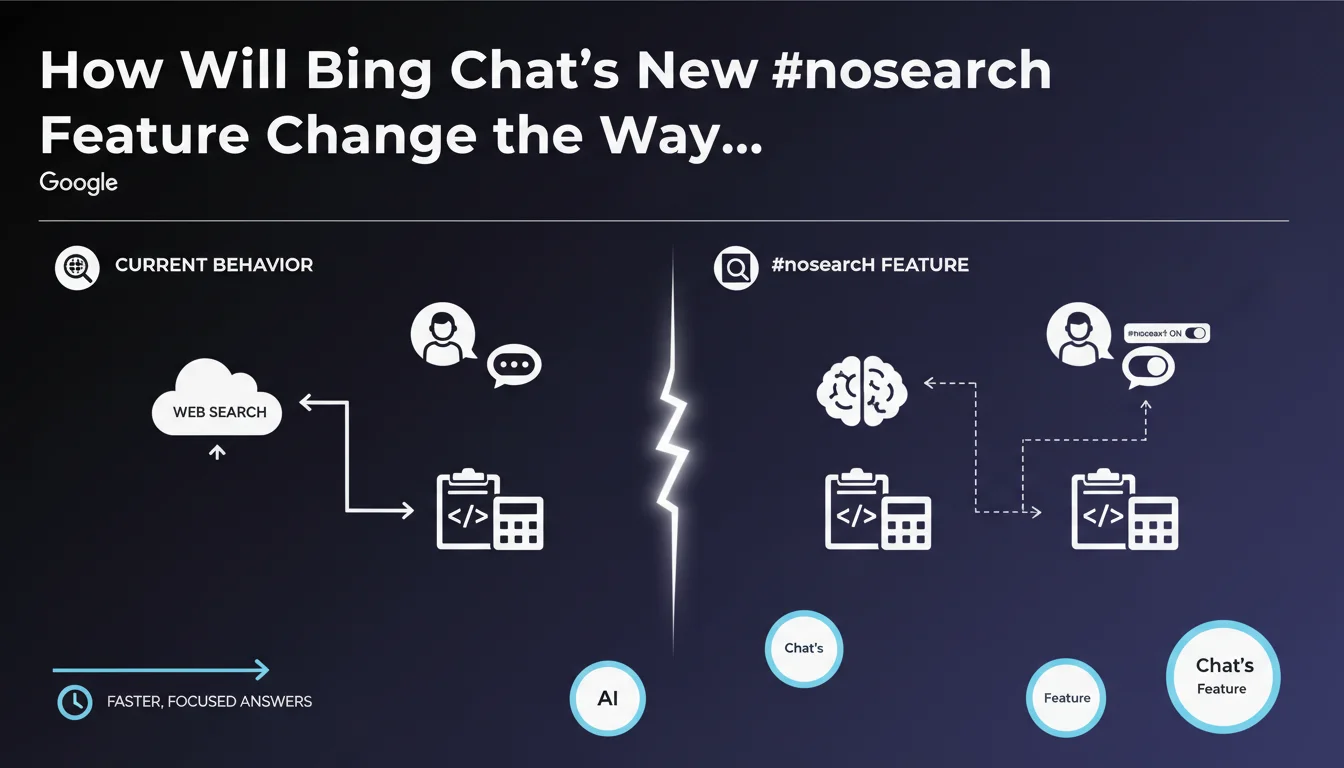
Microsoft has announced the development of a new #nosearch command for Bing Chat. This feature will allow users to voluntarily disable web searches during their interactions with the artificial intelligence.
Specifically, when a user asks a programming question or a math problem, they can request that Bing Chat rely solely on its language model, without consulting indexed web content. This option responds to criticism from users who found the tool too dependent on external sources.
Why should SEO professionals care about this announcement?
This evolution directly impacts the visibility of web content in AI-generated responses. If users massively choose to exclude web searches, organic traffic from Bing Chat could decrease significantly.
For SEO practitioners, this raises a strategic question: how do we maintain the value of optimized content if AIs can answer without consulting our sites? Differentiation through quality and unique expertise becomes even more critical.
What are the underlying implications of this modification?
This feature reveals a fundamental tension between the native capabilities of LLMs (Large Language Models) and the need to access current information. Microsoft implicitly acknowledges that its AI sometimes performs unnecessary searches.
- Users want quick answers without superfluous web navigation
- AIs tend to overconsume web content even for simple tasks
- This option could reduce the credit and visibility given to content creators
- The boundary between autonomous AI and search engine becomes more blurred
- Natural search rankings will need to adapt to these new user behaviors
SEO Expert opinion
Does this evolution align with trends observed in the AI ecosystem?
Absolutely. This announcement fits into a specialization logic for conversational AI tools. Google is also developing different modes for Gemini, some prioritizing speed and others accuracy with web verification.
We're observing a market maturation where users become more aware of the limitations and strengths of each approach. AIs can excellently handle logical or coding queries without external sources, but remain vulnerable to hallucinations on recent or specialized facts.
What nuances should we consider regarding this announcement?
We shouldn't overestimate the immediate impact of this feature. The majority of users will probably not know about the existence of #nosearch or won't think to use it systematically.
Moreover, this option will only concern certain types of queries. For questions about current events, recent factual data, or product comparisons, web searches will remain essential. SEO maintains its full relevance for this informational and commercial content.
In which cases will this modification have limited impact?
For sites offering in-depth expert content, original analysis, or exclusive data, the impact will be minimal. AIs cannot replace unique human expertise or access proprietary information.
High-quality E-E-A-T (Experience, Expertise, Authoritativeness, Trustworthiness) content will continue to attract traffic because it meets needs that language models alone cannot satisfy. This is additional validation of the importance of producing truly differentiating content.
Practical impact and recommendations
What concrete steps should you take to adapt to this evolution?
Strengthen the unique value proposition of your content. Focus on practical expertise, real case studies, and proprietary data that AIs cannot generate alone.
Develop content that necessarily requires external source consultation: detailed comparisons, customer testimonials, recent data analysis, tutorials with updated screenshots. These formats better resist web search exclusion.
Also optimize for featured snippets and rich answers, because even if #nosearch is activated, Bing might offer a verification option that will point to the best structured sources.
What mistakes should you avoid in response to this trend?
Don't fall into the trap of over-optimizing for AIs at the expense of human user experience. Your content must first serve your real visitors, not conversational bots.
Also avoid neglecting other traffic sources. This feature only concerns Bing Chat, which represents a limited share of overall traffic. Google Search, social networks, and direct traffic remain priorities.
- Don't panic: the immediate impact will likely be limited
- Don't abandon technical SEO: the fundamentals remain essential
- Don't create generic content easily reproducible by an AI
- Don't ignore diversification of acquisition channels
How can you verify that your strategy remains relevant?
Regularly analyze your traffic sources to identify variations coming from conversational tools. Segment your Analytics data to distinguish Bing Chat traffic from other Bing sources.
Test yourself how your content is used by Bing Chat, with and without the #nosearch function. Identify which types of queries still generate citations of your pages.
Audit your content to identify high-value pages that deserve additional investment, and those that might be obsolete given the native capabilities of AIs.
💬 Comments (0)
Be the first to comment.