
Official statement
What you need to understand
What Does the Notion of Relevance Really Mean According to Google?
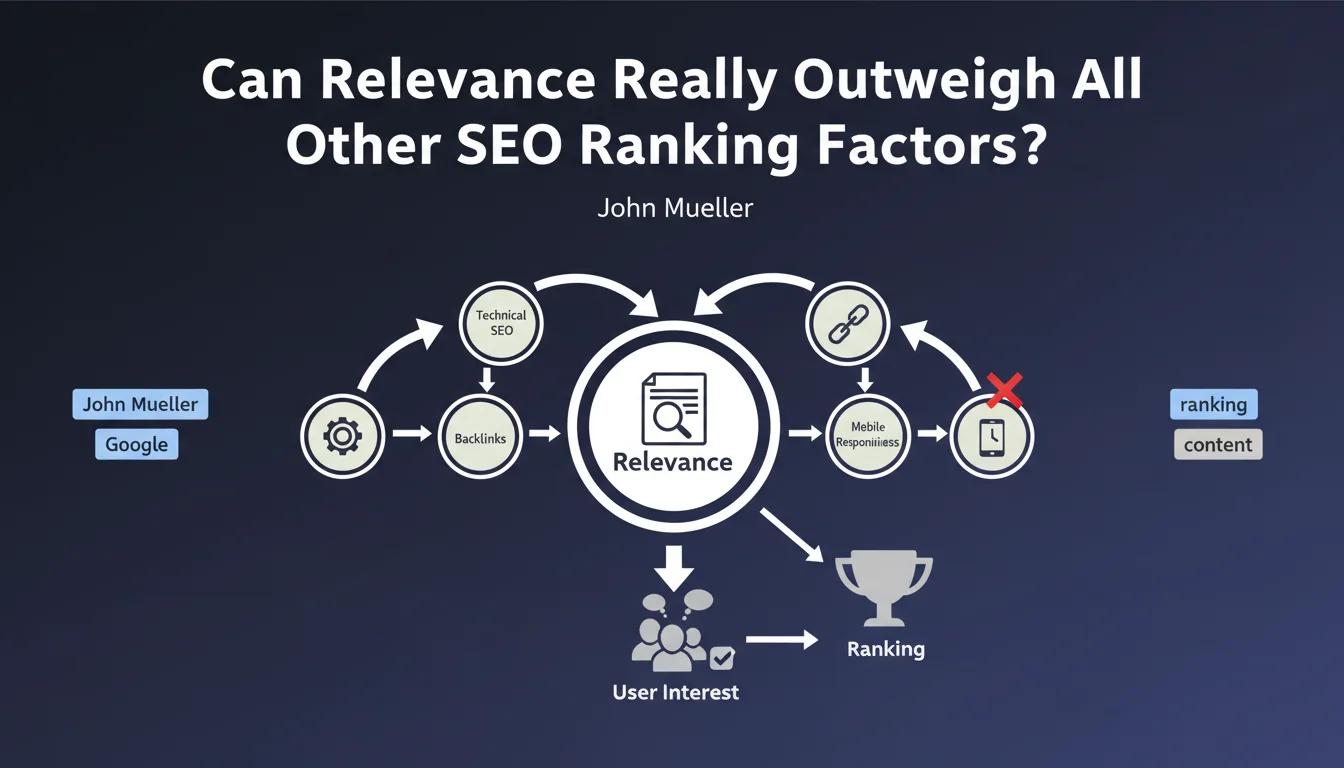
Google reminds us here of a fundamental principle often forgotten: a site doesn't rank in absolute terms, but only based on its relevance to a given query. This statement emphasizes that relevance is not one factor among others, but the primary filter through which all other signals are evaluated.
Even if your site accumulates quality backlinks, perfect technical structure, and excellent Core Web Vitals, these elements can never compensate for a lack of interest or relevance for users. Google first evaluates whether your content answers the search intent.
Why This Clarification About HTML Semantics?
John Mueller establishes a crucial distinction: certain elements help Google understand content without necessarily being direct ranking factors. HTML semantics is the perfect example. It facilitates content interpretation by robots, but doesn't add "points" to rankings.
This clarification aims to avoid the frequent misinterpretations where SEO practitioners assume that accumulating all technical elements will lead to the first position. This is an erroneous additive vision of SEO.
What Interpretation Mistake Should You Avoid?
The main mistake consists of thinking that SEO works like a points system: each optimization would add "points" that accumulate until reaching the first position. This mechanistic vision is fundamentally incorrect.
The reality is more nuanced: Google first evaluates overall relevance, then uses other signals to differentiate relevant content. Without basic relevance, no technical optimization will save you.
- Relevance is the absolute prerequisite before any other ranking factor
- Technical optimizations help with understanding but don't guarantee ranking
- A non-relevant site will never compensate for this deficit through technique alone
- Google evaluates relevance based on search intent and user interest
- Avoid the additive approach: "more optimizations = better ranking"
SEO Expert opinion
Is This Statement Consistent with Practices Observed in the Field?
Absolutely. In my 15 years of experience, I've consistently observed that the best-ranked sites are not necessarily the most technically perfect, but those that best answer search intent. Sites with average technical performance but highly relevant content regularly outperform technically impeccable but less relevant sites.
However, this statement can be misleading if taken literally. In reality, Google uses hundreds of signals to determine relevance itself: user behavior, click-through rate, time on page, bounce rate. Relevance is therefore not just a matter of textual content.
What Crucial Nuances Should Be Added to This Statement?
The first nuance concerns query competitiveness. For highly competitive keywords, several dozen sites can be considered "relevant" by Google. At this level, it's precisely technical factors, domain authority, and user signals that make the difference.
Second nuance: relevance is not binary but exists on a quality spectrum. "Sufficiently relevant" content won't beat "exceptionally relevant" content, even with better technique. Depth, originality, and added value matter enormously.
In What Cases Does This Rule Seem Not to Apply?
We sometimes observe manifestly less relevant sites ranking ahead of better quality content. This is generally explained by massive authority signals (historic domains, exceptional backlinks) that temporarily compensate for a relevance deficit. But these situations are unstable in the long term.
Another particular case: queries with ambiguous intent. When Google cannot clearly determine the intent, it diversifies results and less relevant sites can slip in. Finally, algorithmic updates sometimes create temporary inconsistencies that correct themselves over time.
Practical impact and recommendations
What Should You Concretely Do to Maximize Relevance?
Start with an in-depth analysis of search intent for each targeted keyword. Examine the top 10 results: what type of content does Google favor? What length? What format (tutorial, comparison, definition)?
Next, create content that surpasses the competition in depth and added value. Don't just rephrase what already exists. Provide original data, concrete examples, explanatory visuals, or unique expertise.
Then optimize behavioral relevance signals: structure your content to be scannable, add a clickable table of contents, immediately answer the main question, then develop in depth for those who want to go further.
What Common Mistakes Should You Absolutely Avoid?
The most frequent mistake is focusing solely on keyword density or word count, neglecting actual alignment with intent. 3000-word off-topic content will never beat 800-word perfectly targeted content.
Another trap: overinvesting in marginal optimizations (exotic schema tags, speed micro-optimizations) before establishing solid relevance. It's building the roof before the foundations.
Finally, don't underestimate the importance of freshness and updates. Previously relevant content can lose its relevance if the information evolves and you don't update it. Google favors up-to-date content for time-sensitive queries.
How Can You Check and Improve Your Site's Perceived Relevance?
Analyze your behavioral metrics in Google Search Console and Analytics: organic click-through rate, time spent, pages per session, bounce rate. A high bounce rate with low time often indicates a relevance problem.
Use Search Console data to identify queries where you're in position 5-15: these are your best improvement opportunities. Examine why better-ranked content is considered more relevant.
Implement user testing or observation sessions: watch real people interact with your content. Do they quickly find what they're looking for? Are they satisfied with the answer?
- Analyze search intent for each keyword before creating content
- Study the top 10 results to understand what Google considers relevant
- Create content that surpasses competition in depth and added value
- Optimize structure for maximum readability and scannability
- Monitor behavioral metrics as indicators of perceived relevance
- Regularly update content to maintain its relevance over time
- Test with real users to validate intent/content alignment
- Prioritize relevance before marginal technical optimizations
Relevance is the absolute foundation of ranking in Google, and no other factor can compensate for its absence. To succeed in SEO, focus first on deep understanding of search intent and creating content that answers it exceptionally well.
Technical optimizations remain important but come as support for relevance, not as a replacement. Adopt a holistic approach: content relevance, positive behavioral signals, then technical optimizations to amplify these solid foundations.
Implementing a truly relevance-centered strategy often requires multidisciplinary expertise: in-depth semantic analysis, understanding of user journeys, expert writing capabilities, and strategic vision. Faced with this complexity, support from a specialized SEO agency can prove valuable in structuring a coherent approach and maximizing your chances of success in a competitive environment.
💬 Comments (0)
Be the first to comment.