
Official statement
Other statements from this video 14 ▾
- □ Does a 403 error on mobile really block your entire site from being indexed by Google?
- □ Do 404 errors and 301 redirects really hurt your SEO rankings?
- □ Does the canonical tag really prevent your pages from being indexed?
- □ Is Google really seeing your prices in US dollars by default?
- □ Why does Google treat hreflang and canonical tags as two completely separate mechanisms?
- □ Does the disavow tool really delete toxic backlinks from Google's index?
- □ How can you create unique content for identical products without falling into duplicate content traps?
- □ Should you really verify each subdomain separately in Search Console?
- □ Do you really need to worry about a high volume of 404 errors on your site?
- □ Should you really mark every affiliate link with rel=nofollow or rel=sponsored?
- □ Do Google's quality raters really affect your site's search rankings?
- □ How long does Google actually remember old URLs after a site migration?
- □ Is mobile-first indexing really the standard for every website on the web?
- □ Is the .ai domain really being treated as a gTLD by Google?
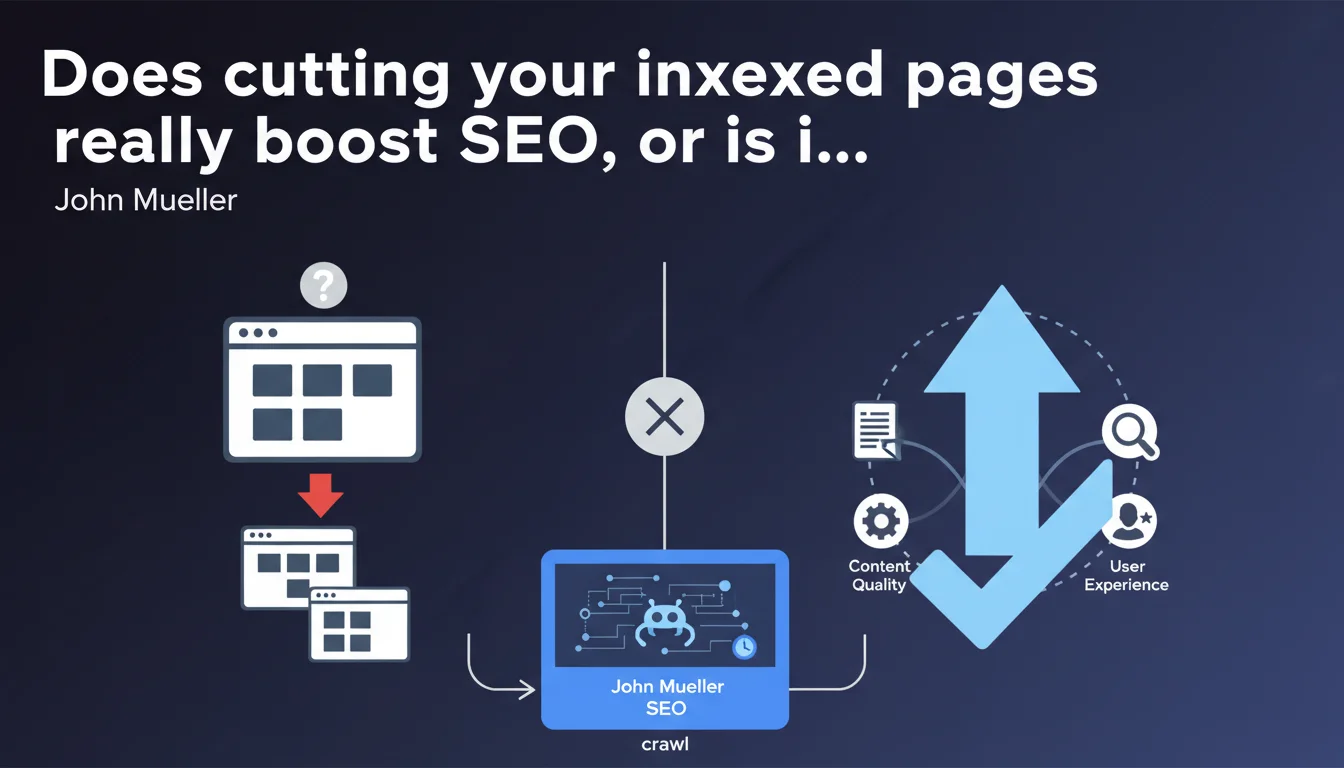
Drastically reducing indexed pages from 8 to 2 million guarantees no SEO improvement. Google is clear: the real priority is overall site quality, not mass deindexing. Volume isn't the problem if every page delivers value.
What you need to understand
Why does Google downplay the impact of massive deindexing?
This statement demolishes a persistent myth: cutting your index solves nothing if remaining pages are mediocre. Google doesn't reward arithmetic reduction — it values editorial coherence and relevance.
For large sites, dropping from 8 to 2 million pages can actually backfire if those 2 million survivors remain low-value or duplicated. The engine hunts for systemic quality signals, not reassuring numbers.
What exactly does Google mean by "overall quality"?
The phrasing is deliberately vague. You could interpret it as: coherent architecture, high-value content, optimized user experience, zero internal duplication.
But here's the catch — Google gives no numerical threshold or precise metric. [Needs verification]: hard to know what weighs most between semantic depth, content freshness, and engagement time.
Is crawl budget really a concern for every large site?
No. Google already stated it: crawl budget only becomes critical for sites with hundreds of thousands of pages updated frequently. If you have 50,000 URLs that rarely change, it's probably not your bottleneck.
However, if Googlebot wastes time on useless facets, infinite pagination, or redundant filters, then cleaning house becomes urgent.
- Index reduction alone never suffices: you must improve quality of kept pages
- Crawl budget is only a problem for massive sites with frequent updates
- Google values editorial coherence and architecture, not arbitrary volume
- No precise threshold from Google on what "overall quality" actually means
SEO Expert opinion
Does this statement align with real-world observations?
Yes and no. We regularly see sites gain visibility after index cleanup — but never without parallel work on remaining content. Deindexing 6 million orphaned or thin pages helps… if the 2 million left are solid.
The problem is many SEOs stop at "massive noindex" and wonder why nothing moves. Google says it clearly here: reduction alone guarantees nothing. You must enrich, restructure, consolidate.
What nuances should we add to this message?
Google implies a huge index isn't a problem in itself. Yet in reality, an 8-million-page site statistically carries more weak content, duplicates, parasitic URLs. Saying "volume isn't the issue" is theoretically true, practically false in typical scenarios.
Another nuance: the cited crawl budget guide remains very general. It offers no ideal ratio or hard recommendation. [Needs verification]: we desperately lack data to know at what threshold index size becomes penalizing, independent of quality.
When does this rule break down?
If your site mechanically generates millions of identical pages (e-commerce facets, auto-generated archives, crossed filters), mass deindexing can unlock the situation — provided remaining URLs are clean.
But beware: some sites think they've improved overall quality by keeping 2 million mediocre pages instead of 8 million. Result? Zero impact. The real question isn't "how many," it's "why does this page exist".
Practical impact and recommendations
What should you do concretely before reducing your index?
First, audit the value of each page segment. Identify URLs generating organic traffic, conversions, or carrying strategic internal links. Only then isolate deindexing candidates: duplicates, thin content, useless facets.
Next, improve quality of kept pages. Enrich content, optimize tags, strengthen linking structure. Reduction alone achieves nothing if what remains is mediocre or poorly structured.
Which mistakes are absolutely critical to avoid?
Never mass deindex without prior mapping. Too many sites lose rankings because they noindexed older but well-ranking pages, or critical internal linking hubs.
Another trap: confusing "index reduction" with "quality improvement." They're not synonyms. You can have a clean 2-million-page index… all mediocre. Google won't applaud.
How do you verify your strategy is working?
Track coverage rate evolution in Search Console, but especially organic performance of kept segments. If traffic doesn't rise after 2-3 months, the problem wasn't volume—it was relevance.
Also monitor server logs: is Googlebot still crawling URLs you thought you'd excluded? This can expose gaps in your noindex or robots.txt strategy.
- Map your existing index by segment (SEO value, traffic, conversions)
- Identify truly low-value pages (duplicates, thin content, useless facets)
- Qualitatively improve kept pages before deindexing
- Track organic traffic evolution by segment post-deindexing
- Analyze logs to verify Googlebot is optimizing crawl time
- Never deindex without backup or reintegration plan if error occurs
❓ Frequently Asked Questions
Réduire l'index de mon site garantit-il un meilleur classement ?
Le crawl budget est-il un problème pour tous les grands sites ?
Quels types de pages faut-il désindexer en priorité ?
Comment savoir si ma stratégie de désindexation fonctionne ?
Peut-on avoir un site de 8 millions de pages de qualité ?
🎥 From the same video 14
Other SEO insights extracted from this same Google Search Central video · published on 11/07/2023
🎥 Watch the full video on YouTube →
💬 Comments (0)
Be the first to comment.