
Official statement
Other statements from this video 14 ▾
- □ Un code 403 sur mobile bloque-t-il réellement toute indexation de votre site ?
- □ Les erreurs 404 et redirections 301 nuisent-elles vraiment au référencement ?
- □ La balise canonical bloque-t-elle vraiment l'indexation de vos pages ?
- □ Pourquoi Google voit-il majoritairement vos prix en dollars américains ?
- □ Hreflang et canonical : pourquoi Google les traite-t-il comme deux concepts distincts ?
- □ L'outil de désaveu supprime-t-il vraiment les backlinks toxiques de Google ?
- □ Comment différencier des pages produits identiques sans tomber dans le duplicate content ?
- □ Faut-il vraiment vérifier séparément chaque sous-domaine dans Search Console ?
- □ Faut-il vraiment s'inquiéter d'un volume important de 404 sur son site ?
- □ Faut-il vraiment marquer tous les liens d'affiliation avec rel=nofollow ou rel=sponsored ?
- □ Les quality raters impactent-ils vraiment le classement de votre site ?
- □ Combien de temps Google mémorise-t-il les anciennes URL après une migration ?
- □ L'indexation mobile-first est-elle vraiment généralisée à tous les sites ?
- □ Faut-il vraiment réduire le nombre de pages indexées pour améliorer son SEO ?
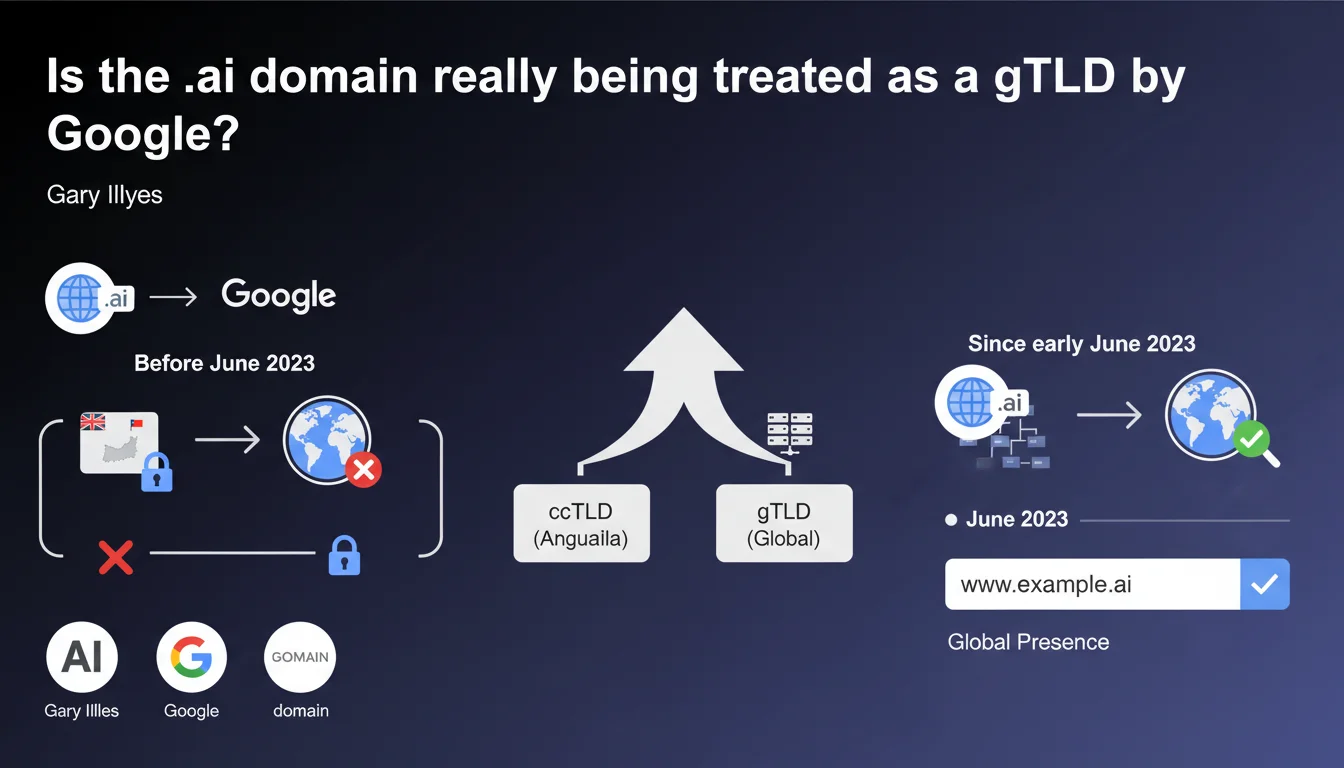
Since June 2023, Google has been treating .ai as a gTLD rather than Anguilla's ccTLD. Concretely, a .ai site can now target a global audience without being automatically geolocalised. This shift opens opportunities for international projects leveraging this trendy extension.
What you need to understand
Google has officially changed the classification of the .ai, shifting from a ccTLD (Country Code Top-Level Domain) tied to Anguilla to a gTLD (Generic Top-Level Domain). This distinction is far from trivial: it determines how the search engine interprets your site's geographic scope.
What is the concrete difference between ccTLD and gTLD?
A ccTLD (.fr, .de, .uk) signals a default intention of geographic targeting: Google assumes the site is aimed at a local audience. Conversely, a gTLD (.com, .org, .net) is neutral — the engine then relies on other signals (language, hreflang, Search Console) to determine the target zone.
Before June 2023, a .ai domain risked being perceived as intended for the Caribbean, which limited its global reach. Now, that constraint disappears.
Why did Google make this change for .ai?
The explosion in .ai usage within the tech ecosystem — AI startups, SaaS, innovative projects — likely influenced the decision. The link to Anguilla had become purely administrative, no longer reflecting actual usage. Google simply aligned its classification with observed practices.
Other extensions have undergone the same shift: .co (Colombia) and .io (British Indian Ocean Territory) have been treated as gTLDs for years.
- .ai is no longer geolocalised by default: you can target the entire world without friction.
- You retain control of targeting via Search Console and hreflang tags.
- This shift has been effective since June 2023 — no retroactive action needed if your site was already live.
- Other geolocalisation signals remain decisive: server location, language, local backlinks, etc.
SEO Expert opinion
Is this statement consistent with field observations?
Yes. Since mid-2023, .ai sites no longer suffer forced geolocalisation to Anguilla in SERPs. Tests on international .ai projects show neutral indexing, similar to .com. No artificial distortion appears in geolocalised results.
That said, neutrality isn't magical: if your content, language, backlinks, and hosting scream "France," Google will take that into account. The .ai doesn't guarantee anything on its own — it simply stops being a hindrance.
What nuances should be added to this announcement?
Google doesn't specify whether other popular extensions (such as .ly or .me) will follow this logic. [To be verified]: the lack of an exhaustive list of ccTLDs treated as gTLDs forces case-by-case testing. The engine remains opaque about the exact criteria triggering a reclassification.
Another point: some mainstream SEO tools (Ahrefs, SEMrush) haven't always updated their databases. You might see "ccTLD" alerts while Google is already applying gTLD treatment. Trust actual behaviors in Search Console rather than software labels.
In what cases does this rule not apply?
If you force geographic targeting via Search Console (the "International targeting" parameter), it takes precedence. A .ai configured to target only France will behave as a geolocalised site, despite its gTLD status. Manual configuration overrides default neutrality.
Practical impact and recommendations
What should you concretely do if you own a .ai?
If your site was already live before June 2023, no urgent technical action. Google applied the change on its end. Take the opportunity to verify in Search Console that the international targeting parameter reflects your intentions (global, or a specific country if relevant).
If you're launching a new project in .ai, set up hreflang properly from the start if you're targeting multiple language zones. The gTLD gives you flexibility — it's up to you to leverage it with clear signals for each market.
What mistakes should you avoid with a .ai domain?
Don't assume "gTLD = automatically global." If your content is in French, hosted in France, with .fr backlinks, Google will understand a French-speaking audience, regardless of TLD. Signal consistency trumps the extension.
Also avoid changing domains purely for the .ai trend. A poorly managed migration (approximate redirects, backlink loss, indexing delays) can cost you traffic. The .ai brings nothing in itself — the project does.
How do you verify that your .ai site is correctly interpreted?
- Check Search Console > Settings > International targeting to confirm the absence of forced geolocalisation.
- Analyze your geographic impressions in Search Console > Performance > Countries: if you're targeting the world, you should see diversity.
- Test with queries from different regions (VPN, SERP simulation tools) to validate the absence of distortion.
- Verify that your hreflang tags (if multilingual) point correctly and don't contradict your targeting strategy.
- Ensure the declared language (lang tag) matches the actual content of each page.
❓ Frequently Asked Questions
Un site en .ai peut-il cibler uniquement la France ?
Faut-il migrer d'un .com vers un .ai pour améliorer son SEO ?
Le .ai est-il plus cher à enregistrer qu'un .com ?
Google traite-t-il d'autres ccTLD comme des gTLD ?
Cette bascule affecte-t-elle les sites existants en .ai ?
🎥 From the same video 14
Other SEO insights extracted from this same Google Search Central video · published on 11/07/2023
🎥 Watch the full video on YouTube →
💬 Comments (0)
Be the first to comment.