
Official statement
Other statements from this video 14 ▾
- □ Un code 403 sur mobile bloque-t-il réellement toute indexation de votre site ?
- □ Les erreurs 404 et redirections 301 nuisent-elles vraiment au référencement ?
- □ La balise canonical bloque-t-elle vraiment l'indexation de vos pages ?
- □ Pourquoi Google voit-il majoritairement vos prix en dollars américains ?
- □ Hreflang et canonical : pourquoi Google les traite-t-il comme deux concepts distincts ?
- □ L'outil de désaveu supprime-t-il vraiment les backlinks toxiques de Google ?
- □ Comment différencier des pages produits identiques sans tomber dans le duplicate content ?
- □ Faut-il vraiment vérifier séparément chaque sous-domaine dans Search Console ?
- □ Faut-il vraiment s'inquiéter d'un volume important de 404 sur son site ?
- □ Faut-il vraiment marquer tous les liens d'affiliation avec rel=nofollow ou rel=sponsored ?
- □ Combien de temps Google mémorise-t-il les anciennes URL après une migration ?
- □ L'indexation mobile-first est-elle vraiment généralisée à tous les sites ?
- □ Le domaine .ai est-il vraiment traité comme un gTLD par Google ?
- □ Faut-il vraiment réduire le nombre de pages indexées pour améliorer son SEO ?
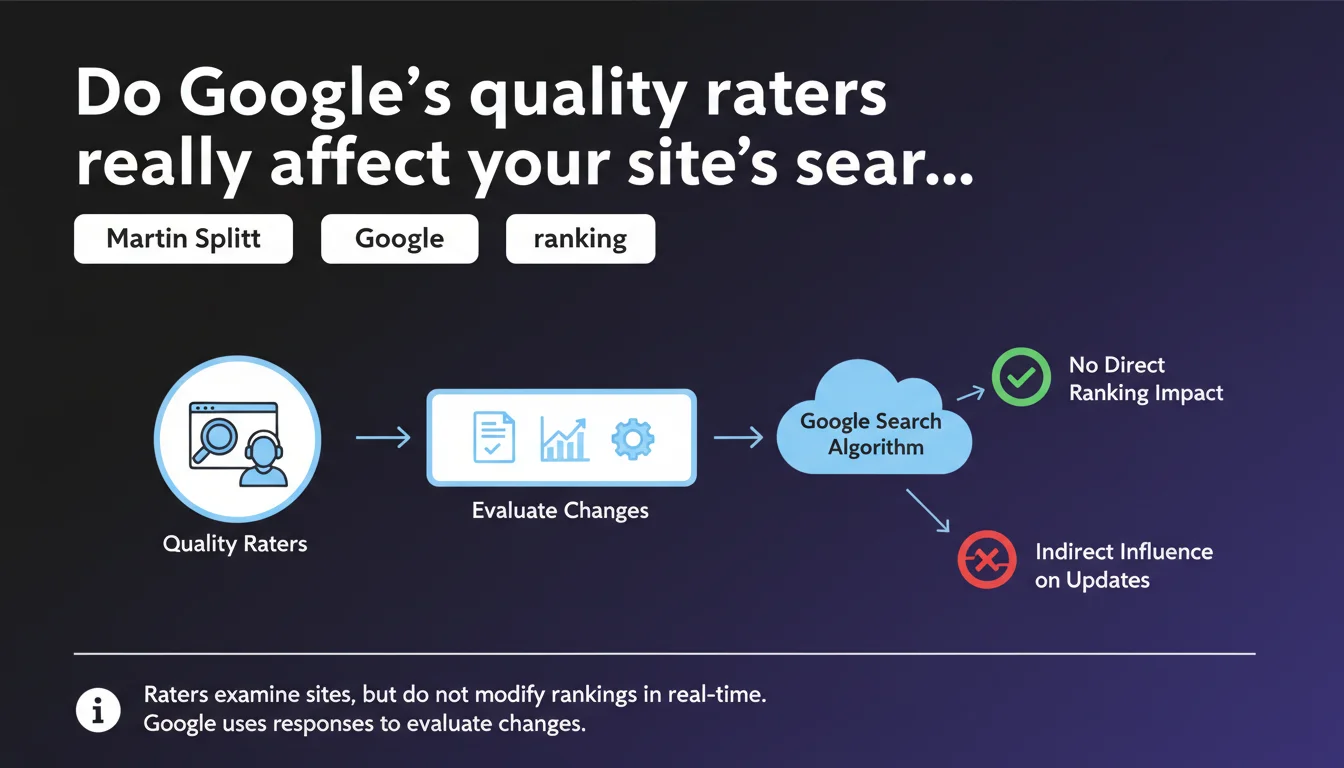
Google's quality raters evaluate individual sites but never directly modify rankings in SERPs. Their feedback is used solely to validate algorithm changes internally. In practice, there's no rater logging in and manually lowering your position because they don't like your site.
What you need to understand
What is the real role of quality raters at Google?
Quality raters are external human evaluators hired by Google to analyze the quality of search results. They are not Google employees and have no access to production ranking systems.
Their mission: evaluate samples of sites according to the Search Quality Rater Guidelines and rate their relevance, usefulness, and level of expertise. These ratings are then sent to engineering teams who use them as validation data when testing algorithm changes.
How are their evaluations actually used in practice?
Google regularly runs A/B tests on its algorithms — a modified version of the search engine against the current version. Quality raters examine the results produced by each version and provide their feedback.
If the new version produces results that raters judge as better according to the guidelines, that's a positive signal to deploy the change. But raters never directly trigger a ranking modification — it's the algorithm that learns from their aggregated feedback.
Why is this distinction between evaluation and direct impact so important?
Because it dispels a persistent myth: no, a rater cannot decide to penalize your site. There is no blacklist fed by raters. They don't judge "this site should drop," they answer specific questions about a page's quality.
The nuance is critical for understanding that quality rater guidelines are not "rules" to follow to the letter, but rather a window into what Google considers quality. Algorithms then attempt to replicate this human judgment at scale.
- Quality raters have no direct access to Google's ranking systems
- Their evaluations serve to validate algorithm changes during testing phases
- They work only on samples of results, not the entire index
- The Search Quality Rater Guidelines are an indicator of quality criteria targeted by Google, not an SEO specification sheet
- Impact on rankings is always indirect: the algorithm adjusts based on patterns detected in evaluations
SEO Expert opinion
Is this statement consistent with what we observe in the field?
Yes, completely. For years, we have never observed a direct correlation between a site's evaluation by a rater and an immediate position change. If that were the case, ranking variations would be sporadic and localized — instead, we observe massive movements during core updates.
Timing also confirms this logic: algorithm updates take weeks to roll out, and raters work upstream. There is no "real-time" in their influence. Their role is comparable to that of testers in a lab, not a moderator manually adjusting results.
Should we ignore the Search Quality Rater Guidelines anyway?
Let's be honest: that would be a mistake. Even if raters don't directly impact rankings, the guidelines they apply are the blueprint of what Google is trying to automate. The concepts of E-E-A-T, Needs Met, page quality — all of that eventually translates into algorithmic signals.
The nuance is that following the guidelines guarantees nothing. [To verify]: Google claims that algorithms replicate rater judgment, but nobody knows exactly which signals are used or with what weighting. We're in interpretation, not certainty.
What are the risks of overestimating the role of quality raters?
The main pitfall is treating guidelines like an SEO checklist. Some consultants fall into "ultra-optimized YMYL" or "forced E-E-A-T" by adding unnecessary author biographies or certification badges that add nothing for the user.
Raters judge intent and relevance, not the presence of a specific section. If your content is mediocre but you check all the "E-E-A-T" boxes, a rater will see it — and the algorithm will probably eventually see it too. Form never compensates for poor substance.
Practical impact and recommendations
What should you actually do with this information?
First, stop panicking if a rater potentially evaluates your site. It won't trigger a manual penalty or cause your positions to plummet overnight. Raters are not auditors issuing sanctions.
Second, continue to read and integrate the Search Quality Rater Guidelines into your understanding of what Google values. But do it intelligently: look for patterns and intentions, not ready-made recipes. Ask yourself "does this page really answer the user's need?" rather than "did I include an author photo?".
How should you adapt your SEO strategy considering the role of quality raters?
Focus on fundamental quality standards: genuine expertise, useful content, smooth user experience. If a rater were to evaluate your site tomorrow, what would they rate? This is a good mental test, but it shouldn't become an obsession.
Remember that raters work on samples. Even if your site is evaluated, it's probably as part of a larger algorithm test. The impact will come from the algorithm, not from the evaluation itself. Your job is to create a site that the algorithm judges positively — and for that, aim for what a qualified human would judge positively.
What mistakes should you avoid after learning this?
Don't fall into the opposite trap: completely ignoring the guidelines on the grounds that raters have no direct impact. That's like saying "crash tests don't directly impact car sales, so I don't care about safety." The guidelines are a valuable indicator of where algorithms are heading.
Also avoid trying to "optimize for raters." They are not a target, they are a measurement tool. Optimize for the user and for quality criteria we know matter — topical authority, relevance, usefulness, trustworthiness.
- Read the Search Quality Rater Guidelines regularly to understand the quality criteria targeted by Google
- Don't panic if you suspect a rater has evaluated your site — there is no direct impact
- Focus on quality as perceived by a real user, not on an artificial checklist
- Integrate E-E-A-T concepts in a natural and substantive way, not cosmetically
- Use guidelines as a diagnostic tool: if a rater scored your site poorly, why?
- Don't try to "optimize for raters" — optimize for the user according to standards a rater would apply
❓ Frequently Asked Questions
Un quality rater peut-il déclencher une pénalité manuelle sur mon site ?
Si un quality rater évalue mon site négativement, cela impacte-t-il mon SEO ?
Faut-il optimiser mon site en fonction des Search Quality Rater Guidelines ?
Comment savoir si mon site a été évalué par un quality rater ?
Les quality raters évaluent-ils tous les sites ou seulement certains secteurs ?
🎥 From the same video 14
Other SEO insights extracted from this same Google Search Central video · published on 11/07/2023
🎥 Watch the full video on YouTube →
💬 Comments (0)
Be the first to comment.