
Official statement
Other statements from this video 14 ▾
- □ Un code 403 sur mobile bloque-t-il réellement toute indexation de votre site ?
- □ Les erreurs 404 et redirections 301 nuisent-elles vraiment au référencement ?
- □ La balise canonical bloque-t-elle vraiment l'indexation de vos pages ?
- □ Pourquoi Google voit-il majoritairement vos prix en dollars américains ?
- □ L'outil de désaveu supprime-t-il vraiment les backlinks toxiques de Google ?
- □ Comment différencier des pages produits identiques sans tomber dans le duplicate content ?
- □ Faut-il vraiment vérifier séparément chaque sous-domaine dans Search Console ?
- □ Faut-il vraiment s'inquiéter d'un volume important de 404 sur son site ?
- □ Faut-il vraiment marquer tous les liens d'affiliation avec rel=nofollow ou rel=sponsored ?
- □ Les quality raters impactent-ils vraiment le classement de votre site ?
- □ Combien de temps Google mémorise-t-il les anciennes URL après une migration ?
- □ L'indexation mobile-first est-elle vraiment généralisée à tous les sites ?
- □ Le domaine .ai est-il vraiment traité comme un gTLD par Google ?
- □ Faut-il vraiment réduire le nombre de pages indexées pour améliorer son SEO ?
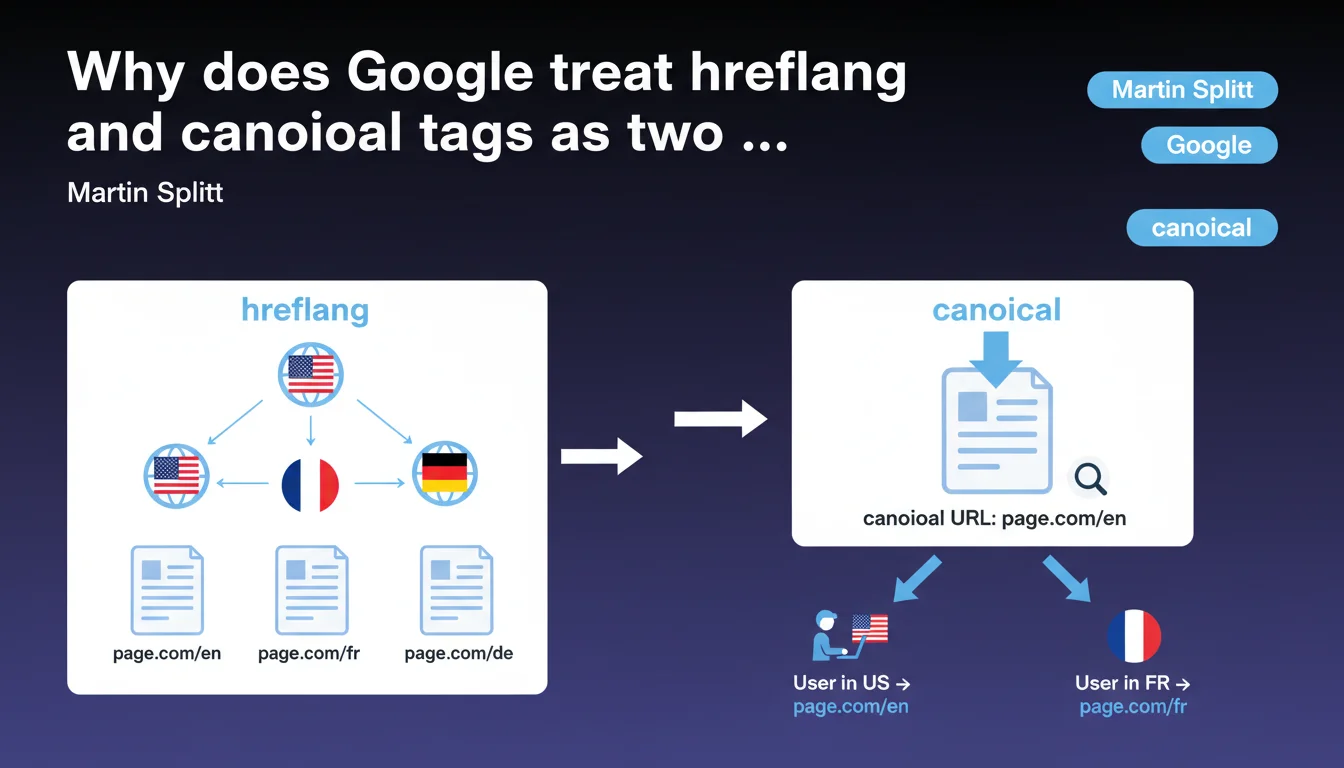
Google clearly separates hreflang from canonicalization: hreflang signals language and regional variants, then canonicalization selects the main URL for the index. Non-canonical URLs can still appear in search results depending on the user's language and region. This distinction changes how you must structure multilingual websites.
What you need to understand
What is exactly the difference between hreflang and canonical tags?
The hreflang attribute tells Google that a page exists in multiple language or regional versions. It's a signal of relationship between equivalent content. It doesn't say "index this page instead of another."
The canonical tag, on the other hand, designates which URL should be considered as the main version in the index. It's a technical preference signal. Google executes these two processes in this order: first it identifies variants via hreflang, then it applies canonicalization.
Why does this distinction create practical problems?
Many SEO professionals confuse the two concepts. They think that setting up hreflang is enough for Google to understand which version to display. That's wrong. Without proper canonical configuration, Google can index any variant as the primary one, even if it's not the version you want.
Another common confusion: believing that the canonical tag prevents other URLs from appearing in SERPs. Splitt's statement clarifies that non-canonical URLs can still rank if they better match the user's language or region.
In what order does Google process these signals?
Google first analyzes hreflang annotations to understand the cluster of related pages. Next, it applies canonicalization logic to choose the reference URL. This canonical URL becomes the one that accumulates ranking signals (backlinks, authority, etc.).
But — and this is crucial — when displaying results, Google can substitute the canonical URL with a more relevant hreflang variant based on the search context. Indexing and display are two distinct mechanics.
- Hreflang = signal of relationship between language/regional variants
- Canonical = choice of the main URL in the index
- Order of execution: hreflang first, canonicalization second
- Non-canonical URLs can appear in SERPs based on user language/region
- Confusing the two concepts generates structural errors on multilingual sites
SEO Expert opinion
Is this conceptual separation consistent with real-world observations?
Yes, completely. We regularly observe websites where a French canonical URL gets "replaced" by the Italian variant in Google.it, even if the FR version is the one indexed. This exactly matches what Splitt describes: canonicalization on one side, display substitution on the other.
However — and this is where it gets tricky — this mechanism isn't always respected when signals contradict each other. If your canonicals all point to /en/ but your hreflang creates a cluster including /fr/, Google must decide. And it doesn't always choose what we expect.
What gray areas remain in this explanation?
Splitt doesn't specify what happens when canonical and hreflang contradict each other. Concrete example: page /fr/ with canonical pointing to /en/, but hreflang declaring /fr/ as a French variant. Which instruction takes precedence? [Needs verification] on real cases, but experience shows the canonical usually wins.
Another unclear point: what becomes of a URL with hreflang but no explicit canonical? Should Google treat it as self-canonical or search for a main version elsewhere in the cluster? The statement remains silent on this.
In what cases does this logic fail?
When technical signals are too contradictory. I've seen sites with correct hreflang but canonical chains in loops (A→B, B→C, C→A). Google abandons the entire chain and picks a URL at random. Result: the wrong version indexed, the right one invisible.
Another classic scenario: hreflang declared in the HTML but canonical in the HTTP header, with different values. Google gives priority to the header, but not always. Again, inconsistency = chaos.
Practical impact and recommendations
How should you properly structure hreflang and canonical together?
Basic rule: each page in a hreflang cluster must have a self-canonical (it points to itself). No cross-canonical between language variants, unless you explicitly want one version to become the reference for all.
If you have 5 variants (/fr/, /de/, /it/, /es/, /en/), each must have:
- A canonical pointing to itself
- Hreflang tags to the 4 other variants + itself
This structure allows Google to understand they're equivalent but distinct, and to index each one for its market.
What critical mistakes must you absolutely avoid?
Never mix duplicate content with hreflang. If /fr/product/ and /be-fr/product/ display exactly the same text for business reasons, use canonical + hreflang. But if the content is truly identical without geographic reason, opt for canonical only.
Another deadly trap: declaring incomplete hreflang. If you signal that /fr/ has an /en/ variant but /en/ doesn't link back to /fr/, Google considers the cluster broken. Hreflang annotations must be bidirectional and complete.
- Verify that each language variant has a self-canonical
- Ensure all hreflang tags are reciprocal (if A→B then B→A)
- Check that no canonical points from one language to another (unless deliberate strategy)
- Test in Search Console that Google correctly interprets the hreflang cluster
- Regularly audit indexed pages by market to detect unexpected canonicalization
- Explicitly document your strategy to prevent accidental changes
How do you verify that your implementation actually works?
Search Console remains the most reliable tool. Section "International Targeting" → verify that hreflang clusters are detected without errors. If Google reports warnings, the structure is faulty.
Next, test manually: search for a target query from different countries (VPN or Google.fr / Google.de / Google.it). The ranking URL should match the language/region. If Google.it systematically displays your /en/ version, canonicalization or hreflang is malfunctioning.
❓ Frequently Asked Questions
Peut-on utiliser hreflang sans canonical ?
Si une page a un canonical vers une autre langue, hreflang fonctionne-t-il encore ?
Pourquoi Google affiche-t-il parfois une URL différente de celle indexée ?
Faut-il mettre un hreflang x-default sur tous les sites multilingues ?
Les erreurs hreflang bloquent-elles l'indexation des pages ?
🎥 From the same video 14
Other SEO insights extracted from this same Google Search Central video · published on 11/07/2023
🎥 Watch the full video on YouTube →
💬 Comments (0)
Be the first to comment.