
Official statement
Other statements from this video 17 ▾
- □ Do you really need to choose between www and non-www for SEO?
- □ Are guest posts really banned by Google for building backlinks?
- □ Do you really need text on category pages to rank well in Google?
- □ Does semantic HTML really impact your Google rankings?
- □ Should you really worry about 404 errors generated by JSON and JavaScript in Google Search Console?
- □ Does Google really prioritize meta descriptions when page content is thin?
- □ Does Google really expect you to block indexation of menus and common site sections?
- □ Can infinite scroll really work for SEO when each section has its own unique URL?
- □ Does mobile-first indexing really force you to prioritize the mobile version above all else?
- □ Can PDFs hosted on Google Drive actually be indexed by Google search?
- □ Why is Google indexing your URLs even when robots.txt blocks them?
- □ Is your low-quality content actually hurting your SEO rankings?
- □ Does your CMS really impact how Google ranks your website?
- □ Can a noindex on your homepage really cause other pages to rank first instead?
- □ Should you really optimize INP if it's not (yet) a ranking factor?
- □ Should you really clean up every hacked page or let Google handle the sorting?
- □ Should you stop forcing indexing when Google deindexes your pages?
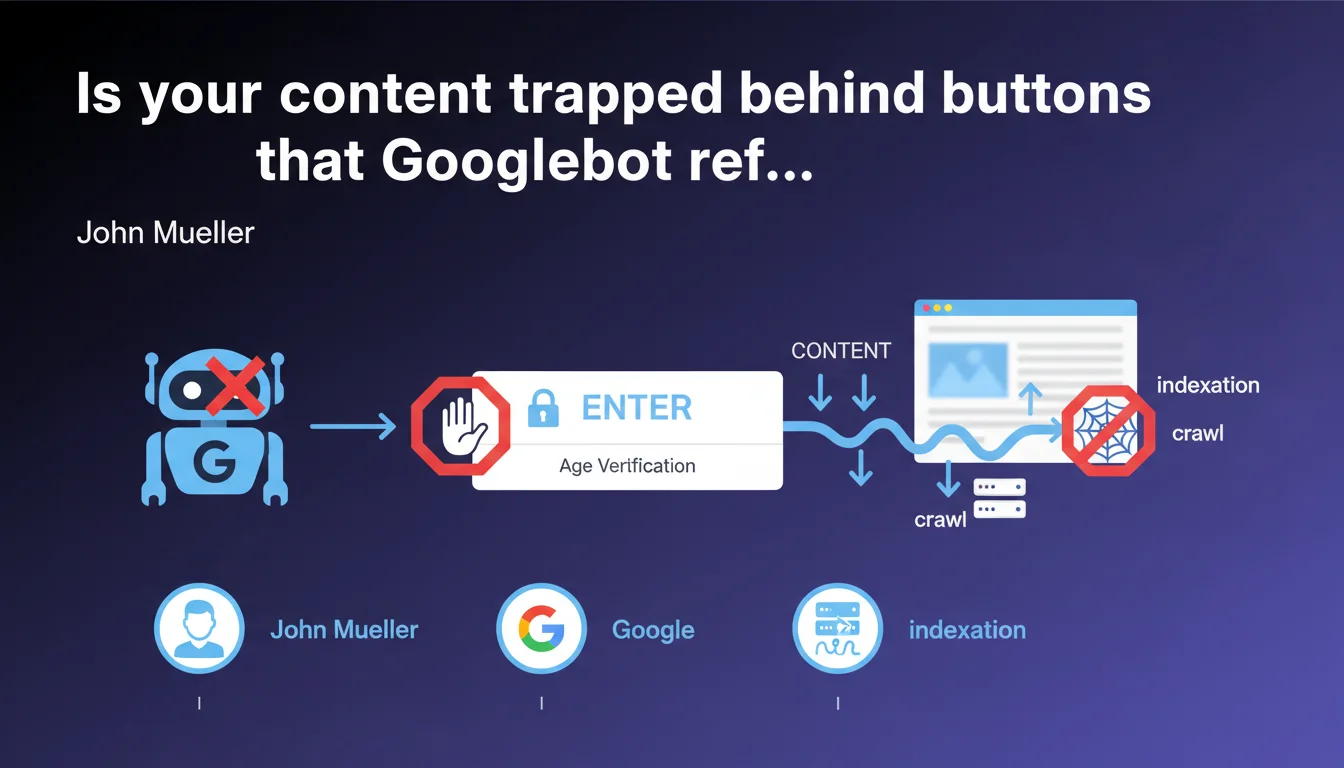
Googlebot does not trigger JavaScript events through button clicks. Links must be exposed in HTML as standard <a> elements to be discovered and crawled. This technical limitation directly impacts the indexing of modern websites with JS-based navigation.
What you need to understand
What exactly does "Googlebot doesn't click on buttons" mean?
Gary Illyes is stating the obvious for some, but revealing a ground-truth reality that many still overlook. Googlebot parses HTML and executes JavaScript — true — but it does not simulate user interactions like clicks.
In practical terms? If your main navigation relies on <button> or <div> elements with JavaScript event listeners, those links will never be discovered by the crawler. Zero chance they'll appear in the index.
Why does this limitation still exist?
Google indexes the web at a scale that defies comprehension — billions of pages. Simulating every possible interaction (clicks, scrolls, hovers, form submissions) would multiply the crawl budget required exponentially.
Google's solution? Stick to the initial HTML/JS rendering, without interactions. It's a technical compromise between comprehensiveness and feasibility — but you bear the consequences if your architecture isn't compatible.
What counts as a "standard HTML element" according to Google?
Gary remains deliberately vague, but the SEO interpretation is clear: <a href> tags are the only guaranteed option. Semantic elements like <nav>, <ul>, <li> provide structure, but it's the href that carries the link.
Modern frameworks (React, Vue, Angular) sometimes generate pseudo-links through custom components — if the final rendering doesn't produce real HTML anchors, you lose your crawl.
- Googlebot doesn't click: JavaScript buttons are not followed
- Only
<a href>works: standard tags are mandatory - The final HTML rendering matters: verify what the bot sees, not what the browser displays
- Crawl budget is not expandable: Google cannot simulate every interaction
SEO Expert opinion
Does this statement really reflect observed behavior in the field?
Yes, and it actually understates the reality. Technical audits regularly reveal SPA (Single Page Applications) sites where 80% of internal linking is invisible to Googlebot. Modern Navigation APIs, React Router Links — all of it falls through the cracks if the final HTML doesn't contain real href attributes.
The problem is that front-end developers optimize for user experience, not crawlers. Result: beautiful, fluid, performant websites — and nearly invisible in Google.
What nuances should be added to this statement?
Gary says "generally speaking," which leaves room for interpretation. Google does execute JavaScript — so dynamically generated links at initial page load can be discovered, provided they appear in the rendered DOM without interaction.
[To verify]: some SEOs report edge cases where links triggered by onload or DOMContentLoaded events seem to be crawled. But this is anecdotal and not officially documented — betting on it is risky.
In which cases does this rule cause the most problems?
Modern architectures are the first victims. E-commerce with Ajax filters, SaaS portals with tab-based navigation, media sites with infinite scroll — whenever navigation relies on JS event handling, you lose crawl.
Let's be honest: many corporate sites think an XML sitemap solves the problem. It helps, but it doesn't replace internal HTML linking. Google always prioritizes organic discovery through internal links — the sitemap is a safety net, not a solution.
Practical impact and recommendations
What should you audit as a priority on your site?
First step: validate that your critical links are real <a href> elements. Open the Google Search Console inspection tool, paste a key URL, and examine the rendered HTML. If your menus, breadcrumbs, or calls-to-action appear as <button> or <div onclick>, you have a problem.
Second point: test with a third-party crawler (Screaming Frog, OnCrawl) with JavaScript disabled. That simulates the worst-case scenario — if your links disappear, your architecture is fragile.
How do you fix navigation that's incompatible with Googlebot?
The cleanest solution? Progressive Enhancement. Build your navigation with real <a> tags, then layer JavaScript on top for UX enrichment. Modern frameworks (Next.js, Nuxt) integrate this natively through their <Link> components.
If you're stuck with legacy code or proprietary CMS, a partial refactor may be necessary. And that's where it gets painful — these technical projects require dev time, cross-browser testing, and continuous SEO validation.
What critical mistakes should you avoid at all costs?
Don't rely on event listeners to expose your links. onClick, onMouseOver, onScroll — it's all invisible to the bot. Even if you dynamically generate <a> tags after a click, Googlebot will never see that content.
Second trap: links stored in data-href or custom attributes. Some frameworks store URLs in non-standard attributes — if it's not a valid href, it doesn't count.
- Verify that all navigation links use
<a href> - Test HTML rendering with the Google Search Console inspection tool
- Crawl your site with JavaScript disabled to identify missing links
- Implement Progressive Enhancement on critical components
- Avoid using
<button>for main navigation - Validate that XML sitemaps cover non-discoverable URLs
❓ Frequently Asked Questions
Est-ce que les liens générés par JavaScript au chargement de la page sont crawlés ?
Les sitemaps XML peuvent-ils compenser l'absence de liens HTML internes ?
Comment vérifier si mes liens sont visibles par Googlebot ?
Les frameworks comme React ou Vue sont-ils incompatibles avec le SEO ?
Google prévoit-il d'améliorer le crawl des interactions JavaScript ?
🎥 From the same video 17
Other SEO insights extracted from this same Google Search Central video · published on 06/09/2023
🎥 Watch the full video on YouTube →
💬 Comments (0)
Be the first to comment.