
Official statement
Other statements from this video 17 ▾
- □ Do you really need to choose between www and non-www for SEO?
- □ Why does Googlebot ignore your buttons and how can you work around this limitation?
- □ Are guest posts really banned by Google for building backlinks?
- □ Do you really need text on category pages to rank well in Google?
- □ Does semantic HTML really impact your Google rankings?
- □ Should you really worry about 404 errors generated by JSON and JavaScript in Google Search Console?
- □ Does Google really prioritize meta descriptions when page content is thin?
- □ Can infinite scroll really work for SEO when each section has its own unique URL?
- □ Does mobile-first indexing really force you to prioritize the mobile version above all else?
- □ Can PDFs hosted on Google Drive actually be indexed by Google search?
- □ Why is Google indexing your URLs even when robots.txt blocks them?
- □ Is your low-quality content actually hurting your SEO rankings?
- □ Does your CMS really impact how Google ranks your website?
- □ Can a noindex on your homepage really cause other pages to rank first instead?
- □ Should you really optimize INP if it's not (yet) a ranking factor?
- □ Should you really clean up every hacked page or let Google handle the sorting?
- □ Should you stop forcing indexing when Google deindexes your pages?
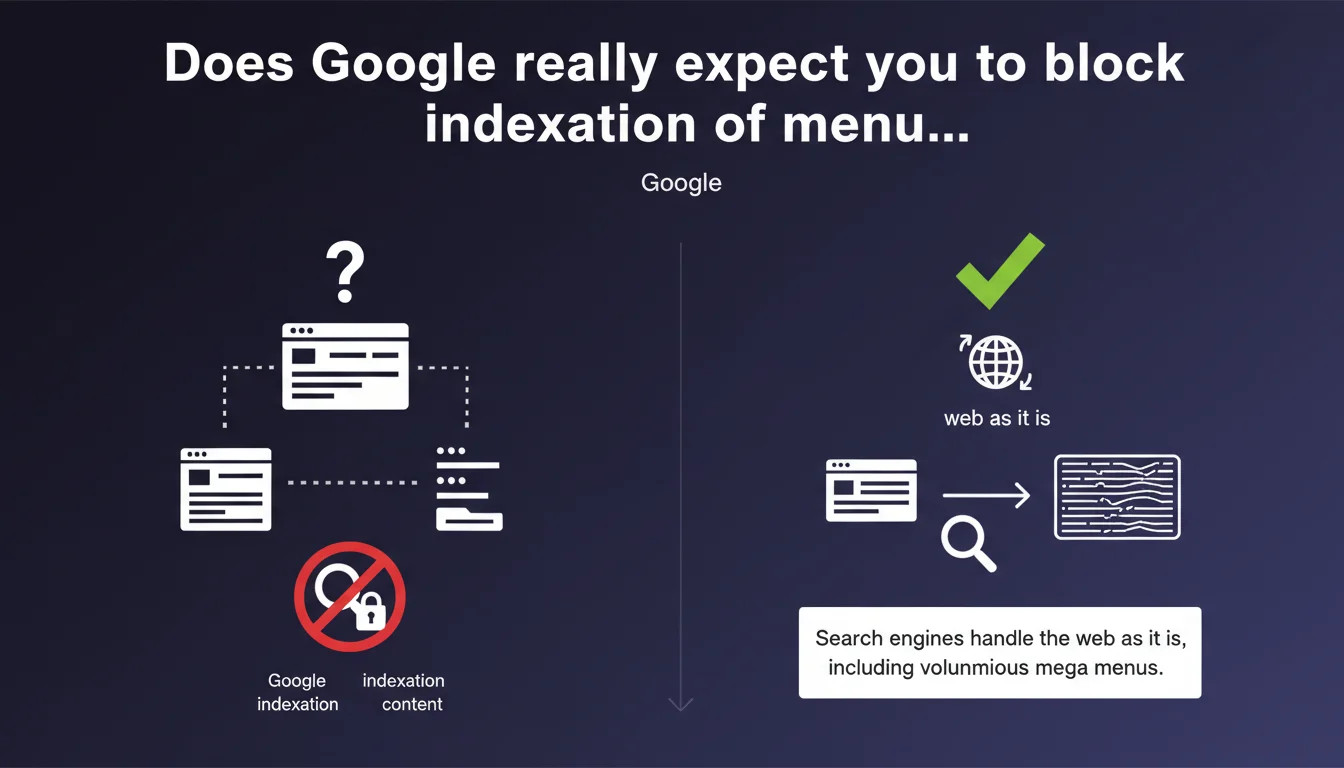
Google states that it is not necessary to block the indexation of headers, menus, sidebars or footers. Search engines handle the web as it is, including voluminous mega menus. This position invites a reconsideration of certain technical obfuscation practices that are still widespread.
What you need to understand
Why does this statement contradict certain common practices?
For years, many SEO practitioners have recommended blocking indexation or making invisible to crawlers the common navigation areas. The argument: avoid dilution of unique content in an ocean of repeated links on each page.
Google puts an end to this approach. According to this statement, algorithms are perfectly capable of distinguishing editorial content from structural markup. Blocking these areas would therefore be an unnecessary optimization, or even counterproductive.
What does Google mean by "common content"?
These are all repeated elements across multiple pages of a site: header with logo and main navigation, sidebar with widgets or contextual links, footer with legal notices and sitemap. Mega menus, even voluminous ones, fall into this category.
These areas are not considered main content but rather structure. Google states it handles this distinction natively, without any particular technical intervention from the webmaster.
What is the practical implication for indexation?
If Google correctly processes common areas, there is no need to waste time hiding them via server-side JavaScript, excluding them through complex directives, or artificially fragmenting the DOM. The engine knows how to read a page as it is served to users.
This also means that priority should remain on the quality of main content and its differentiation from one page to another, rather than on technical contortions to purify indexed HTML.
- Search engines distinguish structure and editorial content without technical assistance
- Blocking menu indexation does not provide measurable SEO benefits
- Voluminous mega menus do not penalize indexation according to Google
- Priority remains the differentiation of main content between pages
SEO Expert opinion
Is this statement consistent with field observations?
Yes and no. On well-structured sites with clean semantic markup (header, nav, main, aside, footer), we do observe that Google does not seem penalized by the repetition of common areas. Search result snippets almost systematically target main content.
But on poorly coded sites — flat DOM without ARIA landmarks, main content buried in a sea of divs — the situation is different. Google may struggle to identify what really matters. [To verify]: the statement implicitly assumes a minimum level of technical rigor that not all sites have.
In what cases might this rule not apply?
First case: sites with dynamically generated menus containing hundreds of internal links that are not relevant to each page. A poorly designed e-commerce mega menu can dilute crawl budget if each page exposes 500 links to unrelated categories.
Second case: Single Page Applications where the DOM is reconstructed client-side. If JavaScript takes time to execute or crashes, Google may index an incomplete snapshot where the menu occupies 80% of visible content.
What nuance should be added regarding crawl budget?
Google says it handles voluminous menus, but this does not mean they have no impact. A mega menu with 300 duplicate links across 10,000 pages generates 3 million occurrences of those same URLs in the index.
On a large site, this can fragment crawl budget — not because Google "gets lost", but because the robot must constantly re-evaluate already-known links. Crawl efficiency decreases mechanically. [To verify] whether Google considers this scenario negligible or assumes webmasters have already optimized their internal linking.
Practical impact and recommendations
What should you actually do on an existing site?
First action: audit your semantic markup. Verify that your HTML correctly uses header, nav, main, aside, footer tags. If everything is divs without ARIA roles, Google may struggle to isolate main content despite its algorithms.
Second action: examine your snippets in search results. Conduct targeted site: searches on strategic pages. If snippets display text from the menu or footer rather than editorial content, that's a warning signal — your HTML structure may not be clear enough.
Third action: review your internal linking. Just because Google tolerates a voluminous mega menu does not mean you should abuse it. Reduce the number of links in common areas, prioritize contextual links in the body text.
What errors should you avoid following this statement?
Do not eliminate all your structural optimization efforts on the grounds that "Google handles it". The statement does not say that everything is equivalent, it says it is not necessary to actively block indexation.
Also avoid artificially inflating your menus thinking it has no consequence. An obese menu degrades user experience, slows down rendering, and can impact Core Web Vitals — all signals that Google considers.
- Audit semantic HTML5 markup (header, nav, main, footer)
- Check SERP snippets to detect any parasitic excerpts
- Reduce the number of links in common areas if > 100 per page
- Prioritize contextual links within main content
- Measure menu impact on Core Web Vitals (LCP, CLS)
- Do not remove existing structural optimizations without A/B testing
How can you verify that your site is compliant?
Use Search Console to analyze indexed pages and identify those where main content is poorly detected. Compare raw HTML with the render in the URL inspection tool.
Run a crawl with Screaming Frog or Oncrawl to map the distribution of internal links. If 80% of links point to the same 20 URLs (menu), that's a sign of dilution.
❓ Frequently Asked Questions
Dois-je supprimer mes balises noindex sur les menus et footers ?
Un mega menu de 200 liens impacte-t-il mon crawl budget ?
Comment Google distingue-t-il le menu du contenu principal ?
Cette règle s'applique-t-elle aussi aux SPA en JavaScript ?
Faut-il quand même optimiser les liens internes dans les menus ?
🎥 From the same video 17
Other SEO insights extracted from this same Google Search Central video · published on 06/09/2023
🎥 Watch the full video on YouTube →
💬 Comments (0)
Be the first to comment.