
Official statement
Other statements from this video 17 ▾
- □ Faut-il vraiment choisir entre www et non-www pour le SEO ?
- □ Pourquoi Googlebot ignore-t-il vos boutons et comment contourner cette limite ?
- □ Les guest posts pour des backlinks sont-ils vraiment bannis par Google ?
- □ Faut-il vraiment du texte sur les pages catégories pour bien ranker ?
- □ Le HTML sémantique a-t-il vraiment un impact sur le classement Google ?
- □ Faut-il vraiment s'inquiéter des erreurs 404 générées par JSON et JavaScript dans GSC ?
- □ Faut-il vraiment bloquer l'indexation des menus et zones communes d'un site ?
- □ L'infinite scroll est-il compatible avec le SEO si chaque section possède une URL unique ?
- □ L'indexation mobile-first impose-t-elle vraiment la version mobile comme unique référence ?
- □ Les PDF hébergés sur Google Drive sont-ils vraiment indexables par Google ?
- □ Pourquoi Google indexe-t-il vos URLs même quand robots.txt les bloque ?
- □ Faut-il supprimer ou améliorer le contenu de faible qualité sur votre site ?
- □ Le CMS influence-t-il vraiment le jugement de Google sur votre site ?
- □ Un noindex sur la homepage peut-il vraiment faire apparaître d'autres pages en premier ?
- □ Faut-il vraiment optimiser l'INP si ce n'est pas (encore) un facteur de classement ?
- □ Faut-il vraiment nettoyer toutes les pages hackées ou laisser Google faire le tri ?
- □ Faut-il arrêter de forcer l'indexation quand Google désindexe vos pages ?
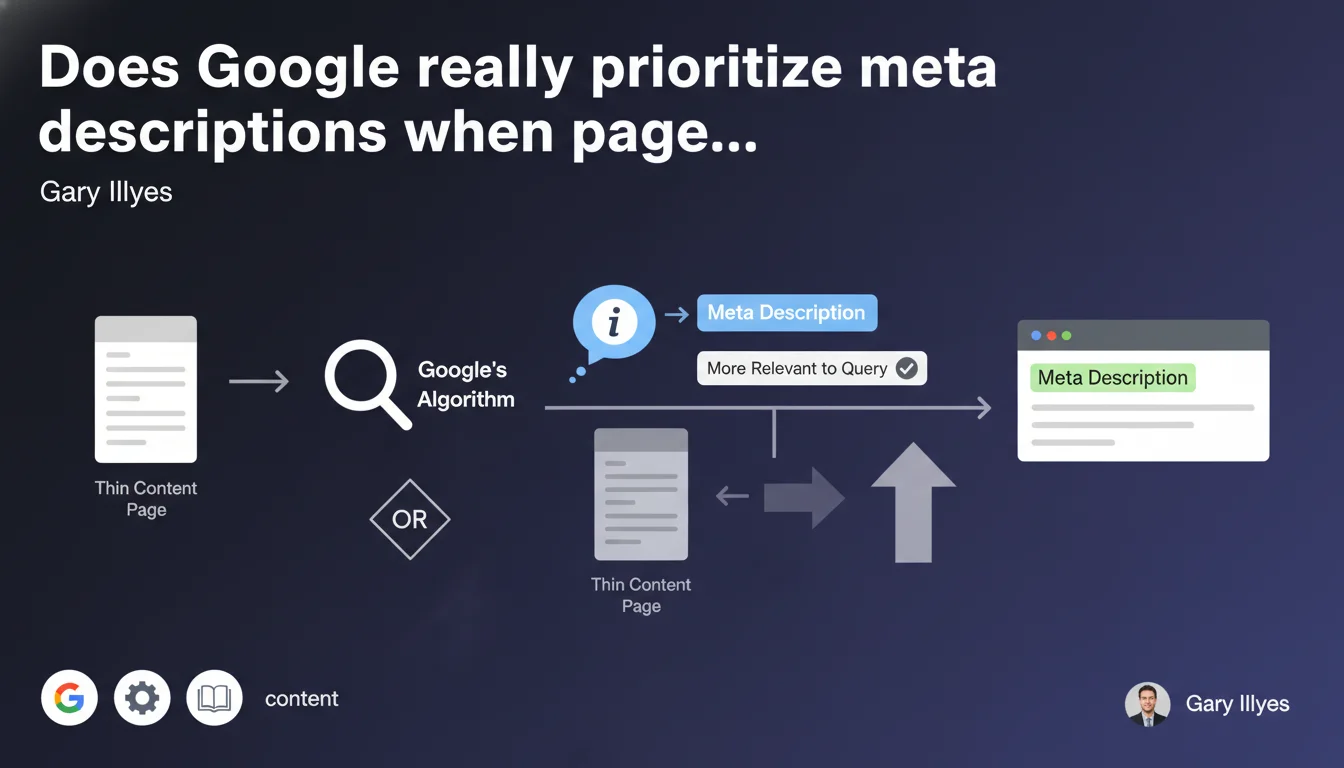
Google typically uses your meta description when a page contains little content or when it's more relevant than visible text to answer the user's search query. This statement confirms that the meta description isn't just a cosmetic element in SERPs — it can completely replace actual content in certain contexts.
What you need to understand
In what specific cases does Google display the meta description?
Gary Illyes identifies two distinct scenarios where Google pulls from your meta description rather than the page content. First case: pages with very little text content — think minimalist landing pages, skeletal product cards, or visually-driven pages.
Second case, more nuanced: when the meta description aligns better with search intent than the actual page content. In other words, even if your page contains 2000 words, if your meta description precisely targets what the user is looking for and your content drifts away, Google may choose to display your meta.
What does Google consider as "not much content"?
The wording remains vague. [To verify]: Google doesn't quantify this threshold. Are we talking 50 words? 150? 300? Field experience suggests pages under 200 words are particularly affected, but no official limit exists.
What matters is information density: a well-structured 100-word page may be treated better than a bloated 500-word piece with no substance. Google evaluates quality, not just character count.
Does the meta description influence ranking or just display?
Critical distinction: this statement concerns snippet display in search results, not ranking. The meta description remains officially a non-ranking factor — it won't improve your position.
But indirectly, a relevant meta description displayed in SERPs boosts click-through rate (CTR), and high CTR can send positive signals to Google. The link is indirect, but real.
- Google favors the meta description on pages with low text content
- Relevance to the query outweighs page content length
- No official quantitative threshold for "limited content"
- Meta description affects CTR, not directly ranking
- Google may rewrite your meta even if it follows best practices
SEO Expert opinion
Is this statement consistent with what we observe in practice?
Yes, largely. Tests show that Google indeed displays the meta description more often on lightweight transactional pages (checkout, forms, landing pages) than on full articles. The nuance about relevance to the query is also validated: we regularly observe Google preferring a well-targeted meta to an excerpt from generic content.
However — and this is where it gets tricky — Google will still rewrite your meta in 60 to 70% of cases according to recent studies, even when it's perfectly optimized. This statement suggests "generally" faithful usage, but the reality is messier.
What nuances should we add to this claim?
First nuance: "generally" is a catch-all term. Gary Illyes provides no quantification. In practice, Google often blends your meta with content excerpts, creates hybrid snippets, or completely ignores your text to compose its own.
Second point: the notion of "more relevant to the query" means Google evaluates your meta differently depending on the search. The same page might display its meta for query A and a content excerpt for query B. It's dynamic, not fixed.
[To verify]: no precise criteria are given to determine this relevance. We assume it involves semantic matching and keyword presence, but Google doesn't explicitly confirm this.
In what cases is this rule clearly not applied?
On long-tail informational queries, Google massively ignores meta descriptions to compose ultra-targeted snippets extracted from content. A generic meta doesn't fit the user's precise intent.
Another exception: pages with structured data markup (FAQ Schema, HowTo, etc.) often see their enriched snippet dominate, relegating the meta description to the background. Google then prioritizes the structured format.
Practical impact and recommendations
What should you concretely do to optimize your meta descriptions?
Write meta descriptions that faithfully summarize your content while targeting the primary search intent. Aim for 150-160 characters, naturally include your main keyword, and add a call-to-action when relevant.
For low-content pages (product cards, landing pages), it's even more critical: your meta becomes your sole textual showcase in the SERPs. Care for every word. Test different formulations via A/B testing if your tracking tool allows it.
Avoid generic auto-generated meta descriptions like "Discover our services" — they'll be systematically rewritten. Prefer unique and specific descriptions for each page.
What mistakes must you absolutely avoid?
Duplicating meta descriptions across multiple pages is the classic mistake. Google hates redundancy and quasi-systematically rewrites these duplicates. Each page deserves its own meta.
Another pitfall: keyword stuffing in your meta. You gain no ranking points, and you tank your CTR with unreadable text. The meta description is a conversion tool, not a keyword field.
Finally, never leave meta blank on low-content pages. Google will compose a snippet from whatever little text is available — often the menu, footer, or off-topic elements. The result is catastrophic.
How can you verify that your meta descriptions are being used correctly?
Use Google Search Console to monitor your CTR by page. A sudden drop may signal that Google is rewriting your meta in a counterproductive way. Compare performance before/after meta changes.
Test your main pages in real search: type the target query and check whether your meta displays or if Google rewrites it. For critical pages, do this check regularly — snippets evolve.
- Write unique meta descriptions for each page (150-160 characters)
- Target primary search intent, not just the keyword
- Carefully craft meta for low-text-content pages
- Avoid duplications and generic auto-generated text
- Monitor CTR in Search Console to detect problematic rewrites
- Test snippet display in real conditions on your target queries
- Prefer clarity over keyword density
❓ Frequently Asked Questions
La meta description influence-t-elle directement le classement dans Google ?
Quelle est la longueur idéale d'une meta description en SEO ?
Pourquoi Google réécrira-t-il ma meta description même si elle est bien optimisée ?
Faut-il mettre des mots-clés dans la meta description ?
Que se passe-t-il si je ne rédige aucune meta description ?
🎥 From the same video 17
Other SEO insights extracted from this same Google Search Central video · published on 06/09/2023
🎥 Watch the full video on YouTube →
💬 Comments (0)
Be the first to comment.