
Official statement
Other statements from this video 17 ▾
- □ Do you really need to choose between www and non-www for SEO?
- □ Why does Googlebot ignore your buttons and how can you work around this limitation?
- □ Do you really need text on category pages to rank well in Google?
- □ Does semantic HTML really impact your Google rankings?
- □ Should you really worry about 404 errors generated by JSON and JavaScript in Google Search Console?
- □ Does Google really prioritize meta descriptions when page content is thin?
- □ Does Google really expect you to block indexation of menus and common site sections?
- □ Can infinite scroll really work for SEO when each section has its own unique URL?
- □ Does mobile-first indexing really force you to prioritize the mobile version above all else?
- □ Can PDFs hosted on Google Drive actually be indexed by Google search?
- □ Why is Google indexing your URLs even when robots.txt blocks them?
- □ Is your low-quality content actually hurting your SEO rankings?
- □ Does your CMS really impact how Google ranks your website?
- □ Can a noindex on your homepage really cause other pages to rank first instead?
- □ Should you really optimize INP if it's not (yet) a ranking factor?
- □ Should you really clean up every hacked page or let Google handle the sorting?
- □ Should you stop forcing indexing when Google deindexes your pages?
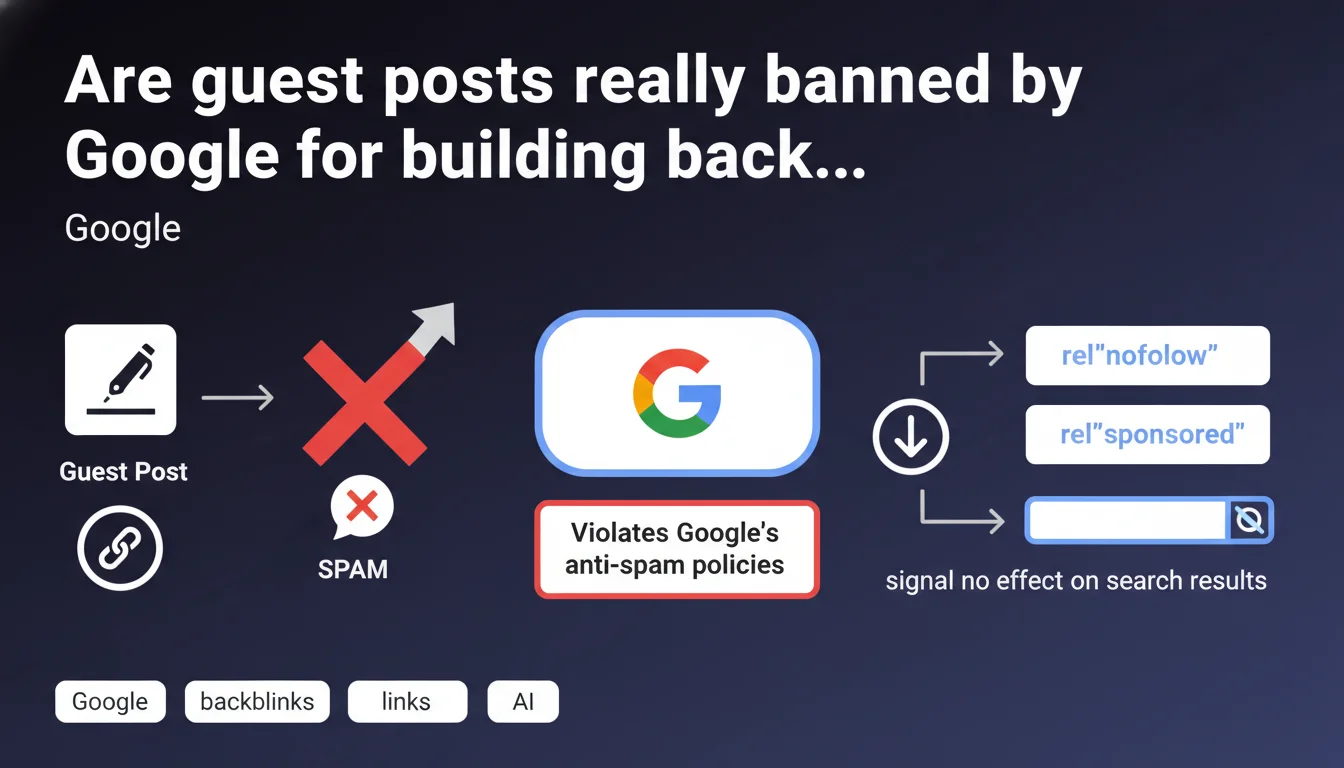
Google states that guest posts used solely to obtain backlinks violate its anti-spam policies. These links must be marked with rel="nofollow" or rel="sponsored" to avoid impacting search rankings. In practice, Google targets articles created exclusively to manipulate PageRank, not legitimate editorial contributions.
What you need to understand
This Google statement is part of its ongoing battle against artificial link schemes. The search engine specifically targets practices where guest posts serve as currency to acquire manipulative backlinks.
The nuance is critical: Google does not condemn guest posting itself, but its purely SEO instrumentalization. A guest article providing real editorial value remains perfectly acceptable.
Why is Google cracking down on guest posts now?
This position is not new — it dates back to the Penguin updates. Google has simply intensified its communication in response to the industrialization of guest posting.
The major problem: entire networks of content exchange exist solely to generate backlinks, regardless of quality or relevance. These schemes distort search results.
What is the exact definition of a guest post that "breaks the rules"?
Google targets content created solely to obtain a link. The criteria include: generic articles recycled across multiple sites, topics unrelated to the host site, poor editorial quality.
Conversely, an authentic editorial collaboration — where the guest author brings genuine expertise to the host site's audience — remains compliant, even with a natural backlink.
What do rel="nofollow" and rel="sponsored" concretely mean in this context?
These attributes tell Google to not transfer PageRank through these links. The rel="sponsored" attribute explicitly signals paid or exchanged content.
In practice, any guest post negotiated to obtain a backlink should carry one of these attributes. Otherwise, you risk a manual action for artificial links.
- Distinguish between legitimate editorial contribution and disguised link exchange
- Systematically mark with rel="nofollow" or rel="sponsored" all links from negotiated guest posts
- Prioritize quality and thematic relevance over volume
- Avoid large-scale networks for exchanging guest content
- Document the genuine editorial value of each collaboration
SEO Expert opinion
Is this statement consistent with field observations?
Yes and no. Google does penalize obvious guest posting schemes — sites accepting any content in exchange for a backlink, PBN networks disguised as guest blogger platforms.
But reality is murkier. Perfectly legitimate sites publish guest articles with dofollow backlinks without ever encountering issues. The difference? Editorial quality and thematic relevance. Google lacks the algorithmic capacity to detect all intentions behind a guest post.
What nuances should be added to this rule?
Google's directive lacks operational precision. Where is the line between editorial collaboration and link manipulation? [To verify]: no quantified criteria or thresholds are provided.
In the field, observations show that Google tolerates guest posts when: the host site maintains high editorial standards, the article topic aligns with the site's core focus, the author has recognized expertise, the content generates genuine engagement.
Let's be honest: detection largely relies on crude algorithmic patterns. A site publishing 20 guest posts monthly with links to varied sectors will be flagged. A site publishing 2-3 contributions per quarter from industry experts? Probably never questioned.
In what cases does this rule not really apply?
Google makes a distinction — even if implicit — between established media and opportunistic sites. A guest article in Le Monde, Forbes, or TechCrunch with a dofollow backlink will never pose a problem.
Why? These publications have strict editorial processes and a reputation to protect. Google grants them algorithmic trust that blogs created to monetize guest posts lack.
Practical impact and recommendations
What should you concretely do with your existing guest posts?
Audit your current backlink profile. Identify links from negotiated guest posts or questionable quality sources. Assess whether the content provides real value or exists solely for the link.
For low-quality guest posts, add the rel="sponsored" attribute or request removal if the host site cooperates. For legitimate contributions, document their editorial value in case Google questions these links.
What mistakes should you absolutely avoid in your guest content strategy?
Never participate in large-scale exchange platforms promising "50 backlinks in one month" through guest posting. These networks are in Google's sights and are systematically penalized.
Avoid generic recyclable articles — the infamous "Top 10 tips for..." published across 15 different sites with just the link changing. Google detects these duplicate or near-duplicate content.
Don't accept publishing completely off-topic guest posts on your site just to "return the favor." A gardening e-commerce site publishing an article about blockchain raises an immediate red flag.
How do you build a compliant and effective guest posting strategy?
Target ultra-selective editorial collaborations. Aim for 3-4 publications yearly on reference media in your sector rather than 30 placements on anonymous blogs.
Produce substantial and unique content — 2000+ words, original data, expert insights. An article that could appear in your own content strategy without hesitation.
Integrate the backlink naturally and contextually. No author bio stuffed with 5 links and optimized anchors. One editorial link relevant to the body text suffices — and use rel="nofollow" if any doubt exists about Google's perception.
- Audit all your backlinks from guest posts in Search Console and your SEO tool
- Categorize each guest post: genuine editorial value vs. link manipulation
- Add rel="sponsored" to all links from negotiated or paid guest posts
- Remove or disavow links from low-quality sites
- Drastically limit volume: prioritize 4-5 premium placements yearly
- Create internal editorial standards for your own guest publications
- Document the added value and relevance of each collaboration
- Monitor new backlinks monthly to detect any unsolicited guest posts
Guest posting strategy in 2024+ relies on ultra-selectivity and editorial authenticity. Abandon the volume approach entirely to adopt a logic of rare but prestigious collaborations.
Concretely: a single guest article on a reference media in your sector is worth 50 placements on anonymous blogs. And it presents zero algorithmic risk.
These strategic adjustments require a complete overhaul of your link building processes and fine expertise to distinguish legitimate opportunities from algorithmic pitfalls. If your team lacks resources or experience to operate this transition, the support of a specialized SEO agency can prove invaluable for securing your link profile without sacrificing visibility.
❓ Frequently Asked Questions
Un guest post avec un lien en nofollow a-t-il encore une valeur SEO ?
Comment Google détecte-t-il qu'un guest post vise uniquement à obtenir un backlink ?
Dois-je déclarer en disavow tous mes anciens guest posts ?
Les médias comme Forbes ou HuffPost marquent-ils leurs guest posts en nofollow ?
Peut-on alterner liens dofollow et nofollow dans un même article invité ?
🎥 From the same video 17
Other SEO insights extracted from this same Google Search Central video · published on 06/09/2023
🎥 Watch the full video on YouTube →
💬 Comments (0)
Be the first to comment.