
Official statement
Other statements from this video 17 ▾
- □ Do you really need to choose between www and non-www for SEO?
- □ Why does Googlebot ignore your buttons and how can you work around this limitation?
- □ Are guest posts really banned by Google for building backlinks?
- □ Do you really need text on category pages to rank well in Google?
- □ Does semantic HTML really impact your Google rankings?
- □ Should you really worry about 404 errors generated by JSON and JavaScript in Google Search Console?
- □ Does Google really prioritize meta descriptions when page content is thin?
- □ Does Google really expect you to block indexation of menus and common site sections?
- □ Can infinite scroll really work for SEO when each section has its own unique URL?
- □ Does mobile-first indexing really force you to prioritize the mobile version above all else?
- □ Can PDFs hosted on Google Drive actually be indexed by Google search?
- □ Why is Google indexing your URLs even when robots.txt blocks them?
- □ Is your low-quality content actually hurting your SEO rankings?
- □ Does your CMS really impact how Google ranks your website?
- □ Can a noindex on your homepage really cause other pages to rank first instead?
- □ Should you really optimize INP if it's not (yet) a ranking factor?
- □ Should you really clean up every hacked page or let Google handle the sorting?
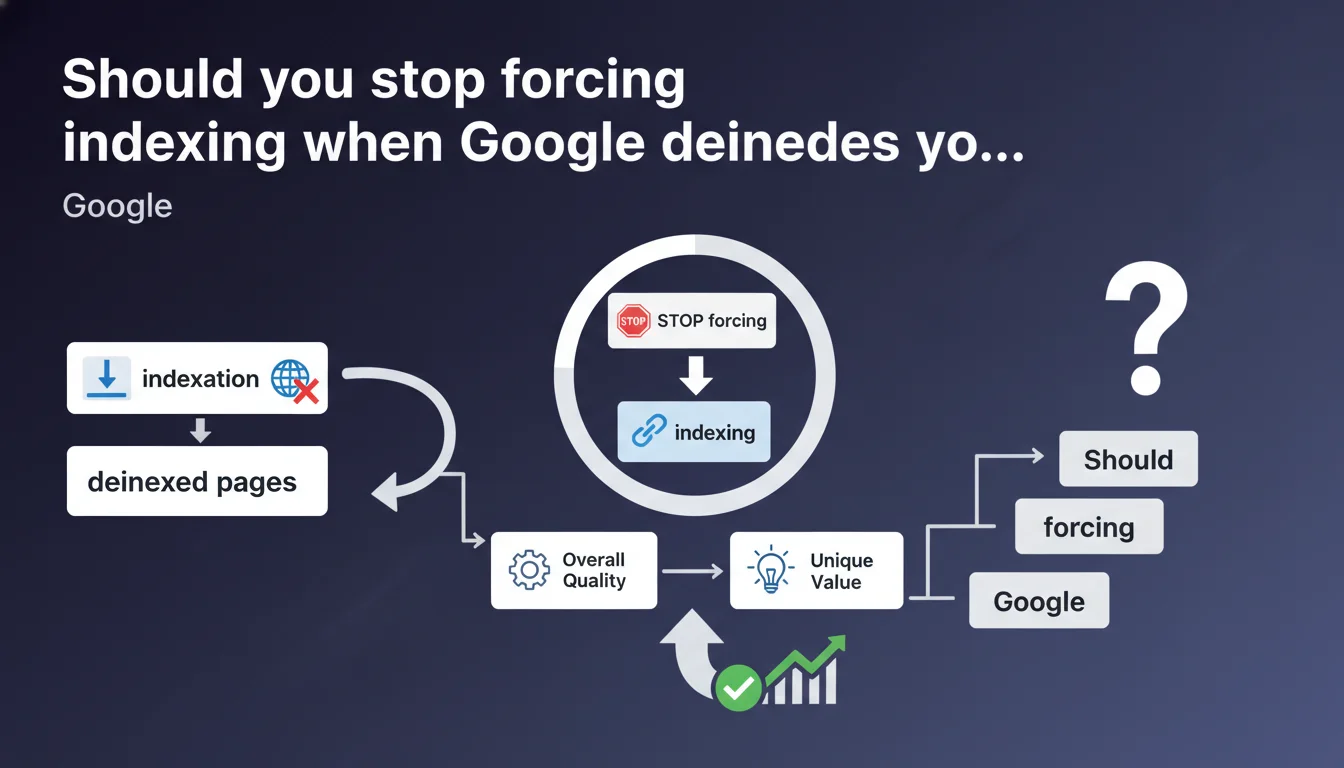
Google is clear: if your pages are deindexed despite repeated submissions, it's a signal that your site lacks value in their systems' eyes. Continuing to force indexing serves no purpose — you need to overhaul your overall quality and unique content contribution. The underlying message: stop playing with submission tools, focus on substance.
What you need to understand
Why does Google deindex pages after submission?
When you submit a URL via Search Console and it disappears from the index shortly after, it's because Google's algorithms estimate it doesn't deliver enough value. Not necessarily that it's bad — just that it doesn't deserve a place in the index against billions of other pages.
This phenomenon has intensified with anti-spam filters and updates like Helpful Content. Google now evaluates the overall relevance of your site, not just the technical compliance of an isolated page.
What does "unique value to the web" mean according to Google?
Google deliberately remains vague on this concept. We understand it means original content that answers an unmet need, with discernible expertise. But the precise criteria? They never give those away.
What's certain: rehashing information already everywhere, publishing generic content or mass-produced AI content without added value — that's exactly what Google doesn't want to index anymore. The engine seeks to favor sites that bring a unique perspective, expertise, or new information.
Does forcing indexation make the problem worse?
In theory, no — submitting a URL isn't penalizing in itself. But in practice, it's a symptom. If you spend your time resubmitting pages that keep getting ejected, you're wasting time on the real issue: why Google doesn't want your content.
It's also an internal signal: if you have to manually force indexation, it means your internal linking, your authority, and your thematic relevance aren't enough to convince the engine naturally.
- Deindexation after submission = signal of a perceived quality problem by Google
- "Unique value" remains a fuzzy concept, but refers to originality + expertise + answering a real need
- Forcing indexation isn't the solution — it's even a symptom of structural problems
- Recent algorithmic filters (Helpful Content, spam) are stricter on globally weak sites
SEO Expert opinion
Is this directive consistent with what we observe in the field?
Yes, and that's even an understatement. Since 2023, we've seen entire sites with thousands of technically correct pages but completely ignored by Google. Manual submission, XML sitemap, internal linking — nothing helps if the site lacks authority or the content is judged redundant.
Google's underlying message is simple: we no longer guarantee indexation. You can have a technically perfect site, but if your content doesn't stand out, it will remain invisible. This is a paradigm shift — indexation is no longer a given, it's a reward.
What nuances should be added to this statement?
Google talks about "overall site quality" but gives no threshold, no measurable criteria. [To verify]: will a site with 80% good content and 20% low-quality content be globally penalized? No official answer on that.
Another murky point: the notion of "unique value". Does an e-commerce site with 10,000 product pages similar to competitors' have "unique value"? Technically no, but these pages can legitimately be indexable if they answer a commercial intent. Google oversimplifies — reality is more nuanced.
Finally, this directive applies mainly to small sites and niche sites. Large media outlets or established authority sites continue to see their pages indexed even when content is questionable. The quality filter is asymmetrical.
In what cases doesn't this rule apply completely?
If you have a new site with few backlinks, even excellent content may take weeks to index. It's not necessarily a quality judgment, it's a problem of crawl budget and initial trust.
Similarly, some ultra-competitive sectors (health, finance) scrutinize their pages more severely. Content perfectly acceptable in another domain may be deemed insufficient in these YMYL niches. Context matters — and Google never states it clearly.
Practical impact and recommendations
What should you do concretely if your pages are deindexed after submission?
First, stop resubmitting. It serves no purpose and wastes your time. Next, do a quality audit: do these pages truly bring something you can't find elsewhere? If the answer is no, you have your diagnosis.
Then take action: consolidate, enrich, or delete. Merge weak content into more comprehensive pages. Add visible expertise (case studies, hard data, concrete examples). If some pages have no reason to exist, delete them and redirect — a smaller but more coherent site performs better than a site bloated with useless content.
How to improve your site's "overall quality" in Google's eyes?
That's the million-dollar question. Google doesn't provide a checklist, but we can deduce some axes: thematic authority (being recognized on a specific topic), expertise signals (identified authors, cited sources, depth of treatment), user engagement (time spent, bounce rate, shares).
On the technical side, a fast, well-structured site with coherent internal linking and quality backlinks sends positive signals. But beware: if the content is weak, no technical optimization will compensate. Content first, form second — always.
What mistakes should you absolutely avoid?
Don't multiply "me-too" pages: content that rehashes what already exists without adding value. Don't publish in bulk without editorial strategy — quantity without quality will sink you. And most importantly, don't use generative AI to produce generic texts without human review or enrichment. Google detects them better and better.
Another trap: wanting to index all your pages at any cost. Some pages (archives, tags, pagination pages) aren't meant to be indexed. Focus your efforts on high-value content, not on index exhaustiveness.
- Stop forcing indexation via Search Console if pages are systematically deindexed
- Audit your content's real quality: does it provide unique, verifiable value?
- Consolidate or remove weak content rather than let it dilute overall quality
- Strengthen thematic authority: better to be expert on one topic than generalist on ten
- Improve expertise signals: identified authors, sources, concrete examples, hard data
- Optimize internal linking so important pages are naturally discovered by Google
- Eliminate technical issues (noindex, canonicals, robots.txt) before concluding there's a quality problem
❓ Frequently Asked Questions
Est-ce que soumettre une URL via Search Console peut nuire à mon site ?
Mon contenu est de qualité mais Google ne l'indexe pas, pourquoi ?
Combien de temps faut-il pour qu'une page soit indexée naturellement ?
Faut-il supprimer les pages faibles ou les améliorer ?
Google donne-t-il des critères précis pour évaluer la qualité d'un site ?
🎥 From the same video 17
Other SEO insights extracted from this same Google Search Central video · published on 06/09/2023
🎥 Watch the full video on YouTube →
💬 Comments (0)
Be the first to comment.