
Official statement
Other statements from this video 17 ▾
- □ Do you really need to choose between www and non-www for SEO?
- □ Why does Googlebot ignore your buttons and how can you work around this limitation?
- □ Are guest posts really banned by Google for building backlinks?
- □ Do you really need text on category pages to rank well in Google?
- □ Does semantic HTML really impact your Google rankings?
- □ Should you really worry about 404 errors generated by JSON and JavaScript in Google Search Console?
- □ Does Google really prioritize meta descriptions when page content is thin?
- □ Does Google really expect you to block indexation of menus and common site sections?
- □ Can infinite scroll really work for SEO when each section has its own unique URL?
- □ Does mobile-first indexing really force you to prioritize the mobile version above all else?
- □ Can PDFs hosted on Google Drive actually be indexed by Google search?
- □ Why is Google indexing your URLs even when robots.txt blocks them?
- □ Does your CMS really impact how Google ranks your website?
- □ Can a noindex on your homepage really cause other pages to rank first instead?
- □ Should you really optimize INP if it's not (yet) a ranking factor?
- □ Should you really clean up every hacked page or let Google handle the sorting?
- □ Should you stop forcing indexing when Google deindexes your pages?
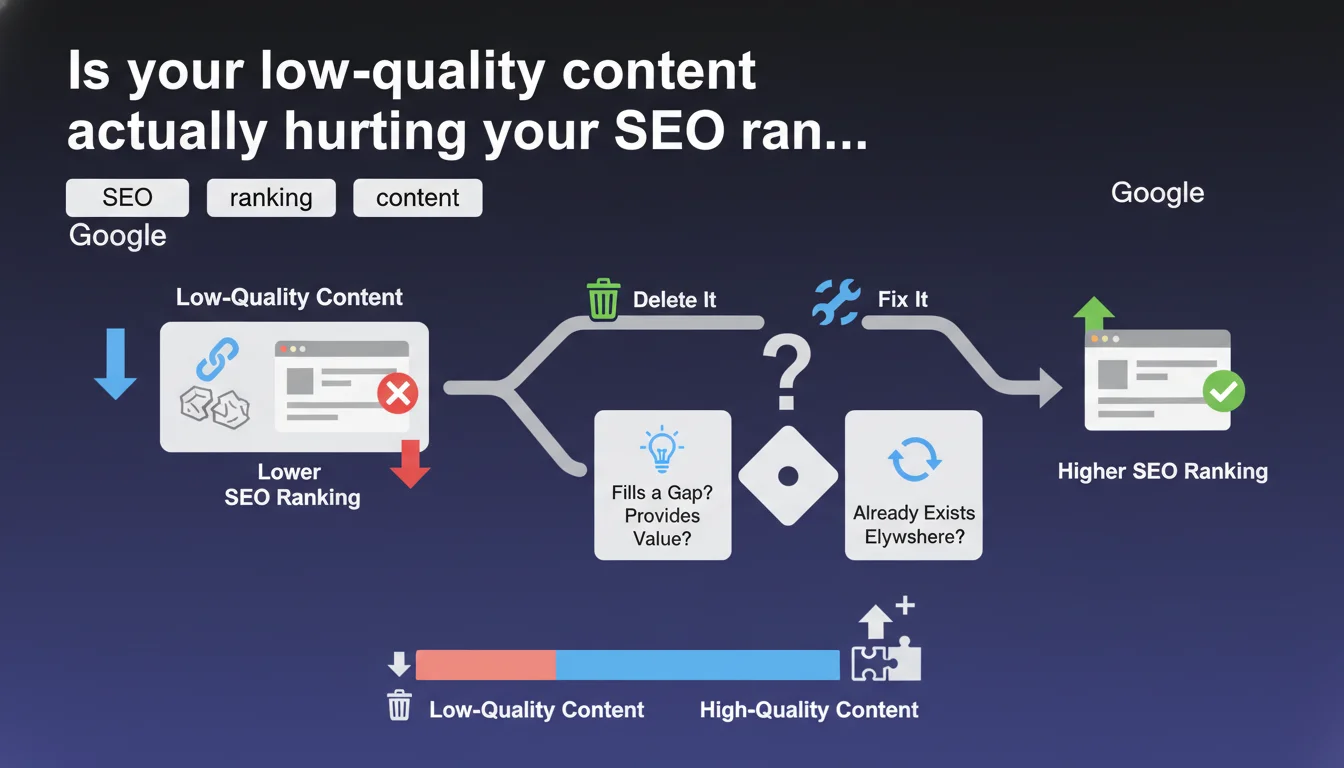
Google explicitly recommends deleting or improving low-quality content. The core question: does this content provide unique value or is it just a duplicate of what already exists elsewhere? This position confirms that simply accumulating pages has no value—and can actually harm your site's overall ranking performance.
What you need to understand
Why is Google so insistent on removing content?
Since several algorithmic updates, Google has been penalizing sites that accumulate pages without real added value. The underlying logic: a site with 100 excellent pages outperforms a site with 100 excellent + 500 mediocre ones.
This statement formalizes what many SEO professionals observe on the ground. A site cluttered with weak content dilutes its quality signals and reduces crawl frequency on important pages. Google wastes time crawling it, and you lose traffic in return.
What exactly counts as "low-quality" content according to Google?
The definition remains intentionally vague, but two criteria stand out clearly: uniqueness and added value. If your page simply repeats what exists elsewhere without offering a new angle, exclusive data, or deeper analysis, it's in Google's crosshairs.
In practice? Generic product sheets copied from manufacturers, recycled blog articles without expertise, empty or near-empty category pages, unvetted aggregations. Basically anything that could vanish from the web and nobody would notice.
What does it really mean to "improve" weak content?
Improvement doesn't mean artificially padding word count. It means enriching the angle, adding verifiable data, incorporating field expertise, and structuring information better. The goal: transform that page into a go-to resource on its topic, however narrow.
- Delete or improve—there's no gray zone in between
- Your decision criteria: does this content actually fill a gap on the web?
- A site with fewer but better pages can outperform a massive site
- Quality dilution affects crawl budget and overall site signals
- Google doesn't distinguish between "low-quality content" and "mild spam" when it comes to impact
SEO Expert opinion
Is Google actually enforcing this recommendation in its algorithm?
Yes—and increasingly so. Field reports since the Helpful Content updates and subsequent Core Updates show sites experiencing traffic drops after publishing generic content en masse. Conversely, aggressive pruning (removing 40-60% of pages) has triggered dramatic traffic rebounds.
But here's the catch: correlation isn't automatic. Some sites with mediocre content keep ranking if domain authority or backlinks compensate. [To verify]: Google has never published a precise threshold or metric to objectively measure "low quality." We're still operating in the fog.
When does this rule not apply as strictly?
Transactional sites (e-commerce especially) get stuck in a bind. Impossible to delete thousands of mediocre product pages—they still convert through long-tail queries. Here the logic shifts: noindex weak pages to limit dilution while keeping them accessible to users.
Another edge case: news or ultra-niche sites. Their "low quality" sometimes stems from low search volume, not inherent flaws. Google seems more lenient when the site's overall editorial expertise is established.
What's the major nuance Google never spells out?
The real metric is value density at the site level. One mediocre page surrounded by excellence goes unnoticed. One hundred mediocre pages on a 150-page site? That's a disaster. Google evaluates by ratio, not in absolute terms.
Let's be honest: this guidance remains frustrating. It states a clear principle but provides zero tools to objectively determine whether your content qualifies as "low quality." You're forced to guess using indirect metrics—bounce rate, time on page, organic click-through rate, scroll depth. Nothing official.
Practical impact and recommendations
How do you actually identify content to delete or improve?
Start by exporting all indexed pages via Google Search Console. Filter for impressions < 100 over 12 months and CTR < 1%. These pages generate neither traffic nor engagement—they're prime pruning candidates.
Cross-reference with analytics: time on page < 30 seconds, bounce rate > 80%, zero conversions. If a page hits all three signals, Google and users likely perceive it as weak.
Final filter: manually audit a random sample. Ask yourself bluntly—if this page vanished tomorrow, would anyone search for it? If not, delete it.
What mistakes should you avoid when pruning content?
Never delete pages with inbound backlinks without 301-redirecting to equivalent or better content. You'd waste link juice unnecessarily. Check Ahrefs, Majestic, or SEMrush before removing anything.
Avoid also blanket noindexing "just in case." Noindex prevents indexing but Google still crawls the page—you're wasting crawl budget. If it's truly weak, delete and redirect.
What if you decide to improve instead of deleting?
Improvement must be substantial, not cosmetic. Adding 200 words of filler has zero impact. But integrating exclusive data points, testimonials, annotated screenshots, detailed comparisons—that changes everything.
Restructure the information too. Dense but poorly organized content reads as weak. Add clear heading hierarchy, bullet lists, comparison tables, internal links to your best resources. Make the page scannable and actionable.
- Export all indexed pages with their metrics (GSC + Analytics)
- Filter by impressions, CTR, time on page, bounce rate
- Check inbound backlinks before any deletion
- Create 301 redirects to equivalent or higher-value content
- For pages you're improving: enrich with exclusive data, restructure, add multimedia
- Monitor post-pruning fluctuations for at least 4-6 weeks
- Document every decision so you can adjust if needed
❓ Frequently Asked Questions
Supprimer du contenu faible peut-il réellement améliorer le classement global du site ?
Faut-il rediriger systématiquement les pages supprimées en 301 ?
Comment savoir si un contenu est vraiment « de faible qualité » selon Google ?
Peut-on noindex les contenus faibles au lieu de les supprimer ?
Combien de temps faut-il pour voir l'impact d'un élagage de contenu ?
🎥 From the same video 17
Other SEO insights extracted from this same Google Search Central video · published on 06/09/2023
🎥 Watch the full video on YouTube →
💬 Comments (0)
Be the first to comment.