
Official statement
Other statements from this video 17 ▾
- □ Faut-il vraiment choisir entre www et non-www pour le SEO ?
- □ Pourquoi Googlebot ignore-t-il vos boutons et comment contourner cette limite ?
- □ Les guest posts pour des backlinks sont-ils vraiment bannis par Google ?
- □ Faut-il vraiment du texte sur les pages catégories pour bien ranker ?
- □ Le HTML sémantique a-t-il vraiment un impact sur le classement Google ?
- □ Faut-il vraiment s'inquiéter des erreurs 404 générées par JSON et JavaScript dans GSC ?
- □ Google privilégie-t-il vraiment la meta description quand le contenu est pauvre ?
- □ Faut-il vraiment bloquer l'indexation des menus et zones communes d'un site ?
- □ L'infinite scroll est-il compatible avec le SEO si chaque section possède une URL unique ?
- □ L'indexation mobile-first impose-t-elle vraiment la version mobile comme unique référence ?
- □ Les PDF hébergés sur Google Drive sont-ils vraiment indexables par Google ?
- □ Pourquoi Google indexe-t-il vos URLs même quand robots.txt les bloque ?
- □ Faut-il supprimer ou améliorer le contenu de faible qualité sur votre site ?
- □ Le CMS influence-t-il vraiment le jugement de Google sur votre site ?
- □ Un noindex sur la homepage peut-il vraiment faire apparaître d'autres pages en premier ?
- □ Faut-il vraiment nettoyer toutes les pages hackées ou laisser Google faire le tri ?
- □ Faut-il arrêter de forcer l'indexation quand Google désindexe vos pages ?
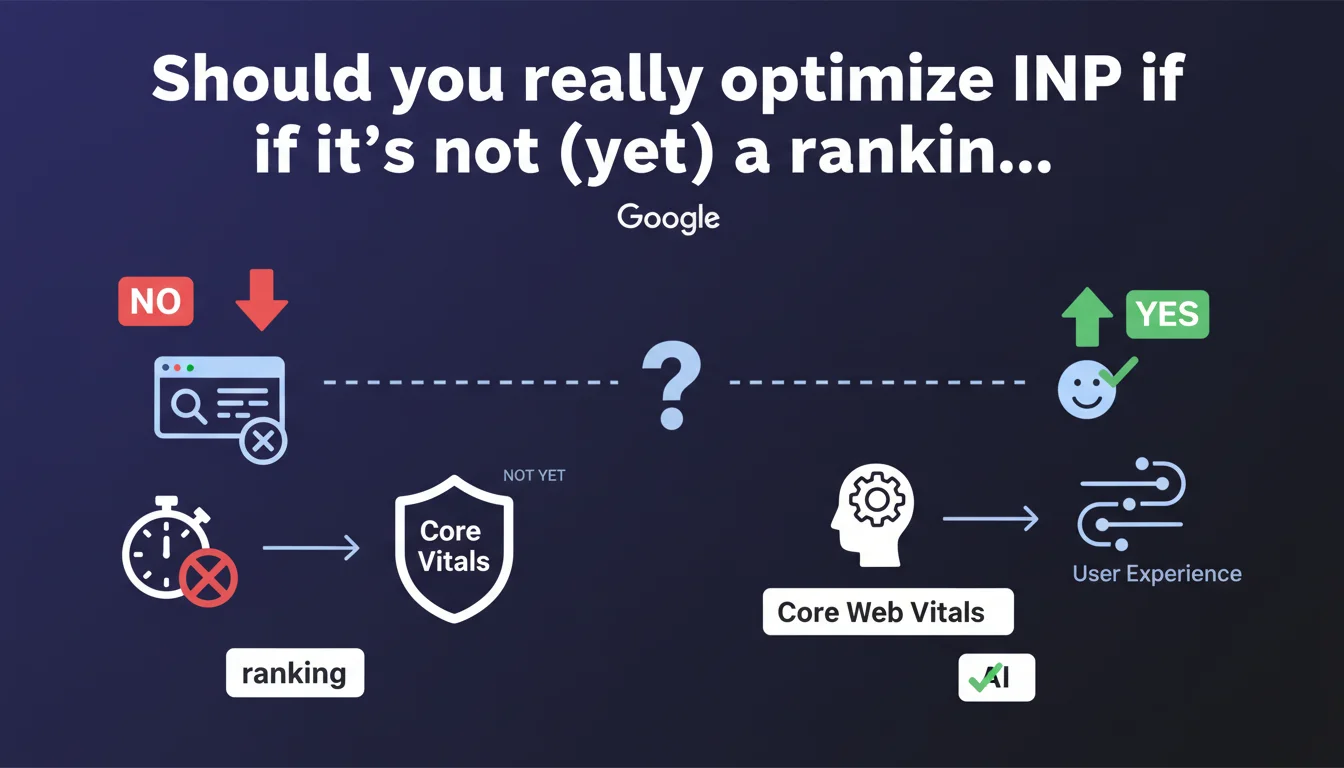
Google confirms that Interaction to Next Paint (INP) is not integrated into Core Web Vitals and therefore does not directly impact search ranking results. Optimizing INP improves user experience, but don't expect visible SEO gains from it. The message implies that a change could occur eventually.
What you need to understand
What is INP and why is Google talking about it now?
Interaction to Next Paint measures how responsive a page is to user interactions (clicks, keyboard inputs, etc.). Unlike First Input Delay (FID), which only captures the first interaction, INP evaluates the entire lifecycle of the page.
Google introduced this metric to address the weaknesses of FID, which was considered too lenient. INP provides a more complete picture of the smoothness perceived by real users.
Why clarify that it's not yet part of the Core Web Vitals?
Core Web Vitals (LCP, CLS, FID) are the only user experience metrics officially integrated as ranking signals. Anything outside this trio has no direct impact on your positioning.
By emphasizing "not yet", Google suggests that a shift from FID to INP is being considered — but no date or firm commitment is given.
What does "no visible change in ranking" concretely mean?
Even if you improve your INP from 500 ms to 100 ms, don't expect to climb the SERPs. The ranking algorithm simply doesn't incorporate this data at the moment.
That said, better responsiveness can indirectly reduce bounce rate and increase engagement, which influences other behavioral signals… but this is a second-order effect, not a direct lever.
- INP measures overall responsiveness, not just the first interaction (unlike FID)
- Only the current Core Web Vitals (LCP, CLS, FID) count as ranking signals
- Optimizing INP improves UX but guarantees no ranking gains
- The "not yet" suggests probable evolution, without an official timeline
SEO Expert opinion
Is this statement consistent with signals observed in the field?
Yes, absolutely. Since Core Web Vitals became a ranking factor, no professional has observed a correlation between INP and position fluctuations. Monitoring tools show no direct link.
Google has always been transparent about the scope of CWV: LCP, CLS, FID. Everything else — FCP, TTI, Speed Index, and now INP — remains in the "UX best practice" category, not "SEO lever".
Why does Google bother clarifying such an obvious point?
Because there has been confusion in the ecosystem. Many agencies and tools position INP as "the new FID" or "the next SEO priority", which pushes some sites to overinvest without understanding the real stakes.
Google wants to prevent resources from being allocated to a criterion that isn't determining for ranking. It's also a way to manage expectations before a possible official shift. [To verify]: no public roadmap confirms the replacement of FID with INP in Core Web Vitals.
In what cases should you still care about it?
If your site relies on rich interactions (e-commerce with filters, dashboards, SPA), high INP kills user experience and drives visitors away, regardless of your ranking.
Concretely? A site that ranks well but converts poorly because of sluggish UI will lose qualified traffic to better-optimized competitors. INP becomes a conversion issue, not an SEO one.
Practical impact and recommendations
Should you stop optimizing INP if it doesn't impact SEO?
No. INP remains a relevant user experience indicator. If your goal is to maximize satisfaction, conversion rate or retention, it deserves your full attention.
But if your priority is organic ranking gains, focus first on the three official CWV (LCP, CLS, FID), internal linking, content quality and E-E-A-T signals.
What mistakes should you avoid in managing performance metrics?
The most common: overinvesting in secondary metrics at the expense of real ranking levers. I've seen sites spend weeks optimizing INP while their LCP exceeded 4 seconds.
Another trap: believing that a Google metric = an SEO lever. PageSpeed Insights displays a dozen metrics — only three count for ranking. The rest serves to diagnose UX, not to climb the SERPs.
How should you prioritize performance optimizations?
Follow this logic: first the official Core Web Vitals, then UX metrics like INP if you have room to maneuver. Don't spread yourself thin.
- Check your CWV on Search Console and PageSpeed Insights (field data)
- Prioritize LCP < 2.5 s, CLS < 0.1, FID < 100 ms before any other optimization
- Monitor INP in Google Analytics 4 or via RUM (Real User Monitoring) to detect UX issues
- Never sacrifice an official CWV to improve INP
- If INP exceeds 500 ms on key pages (checkout, product filters), fix it — but for UX, not for SEO
- Document your optimizations to react quickly if Google makes INP official as a CWV
❓ Frequently Asked Questions
L'INP va-t-il remplacer le FID dans les Core Web Vitals ?
Optimiser l'INP peut-il quand même aider mon référencement indirectement ?
Quelle valeur d'INP viser pour une bonne expérience utilisateur ?
Dois-je suivre l'INP dans mes outils de monitoring SEO ?
Si mon INP est mauvais mais mes CWV sont bons, que faire ?
🎥 From the same video 17
Other SEO insights extracted from this same Google Search Central video · published on 06/09/2023
🎥 Watch the full video on YouTube →
💬 Comments (0)
Be the first to comment.