
Official statement
Other statements from this video 17 ▾
- □ Faut-il vraiment choisir entre www et non-www pour le SEO ?
- □ Pourquoi Googlebot ignore-t-il vos boutons et comment contourner cette limite ?
- □ Les guest posts pour des backlinks sont-ils vraiment bannis par Google ?
- □ Le HTML sémantique a-t-il vraiment un impact sur le classement Google ?
- □ Faut-il vraiment s'inquiéter des erreurs 404 générées par JSON et JavaScript dans GSC ?
- □ Google privilégie-t-il vraiment la meta description quand le contenu est pauvre ?
- □ Faut-il vraiment bloquer l'indexation des menus et zones communes d'un site ?
- □ L'infinite scroll est-il compatible avec le SEO si chaque section possède une URL unique ?
- □ L'indexation mobile-first impose-t-elle vraiment la version mobile comme unique référence ?
- □ Les PDF hébergés sur Google Drive sont-ils vraiment indexables par Google ?
- □ Pourquoi Google indexe-t-il vos URLs même quand robots.txt les bloque ?
- □ Faut-il supprimer ou améliorer le contenu de faible qualité sur votre site ?
- □ Le CMS influence-t-il vraiment le jugement de Google sur votre site ?
- □ Un noindex sur la homepage peut-il vraiment faire apparaître d'autres pages en premier ?
- □ Faut-il vraiment optimiser l'INP si ce n'est pas (encore) un facteur de classement ?
- □ Faut-il vraiment nettoyer toutes les pages hackées ou laisser Google faire le tri ?
- □ Faut-il arrêter de forcer l'indexation quand Google désindexe vos pages ?
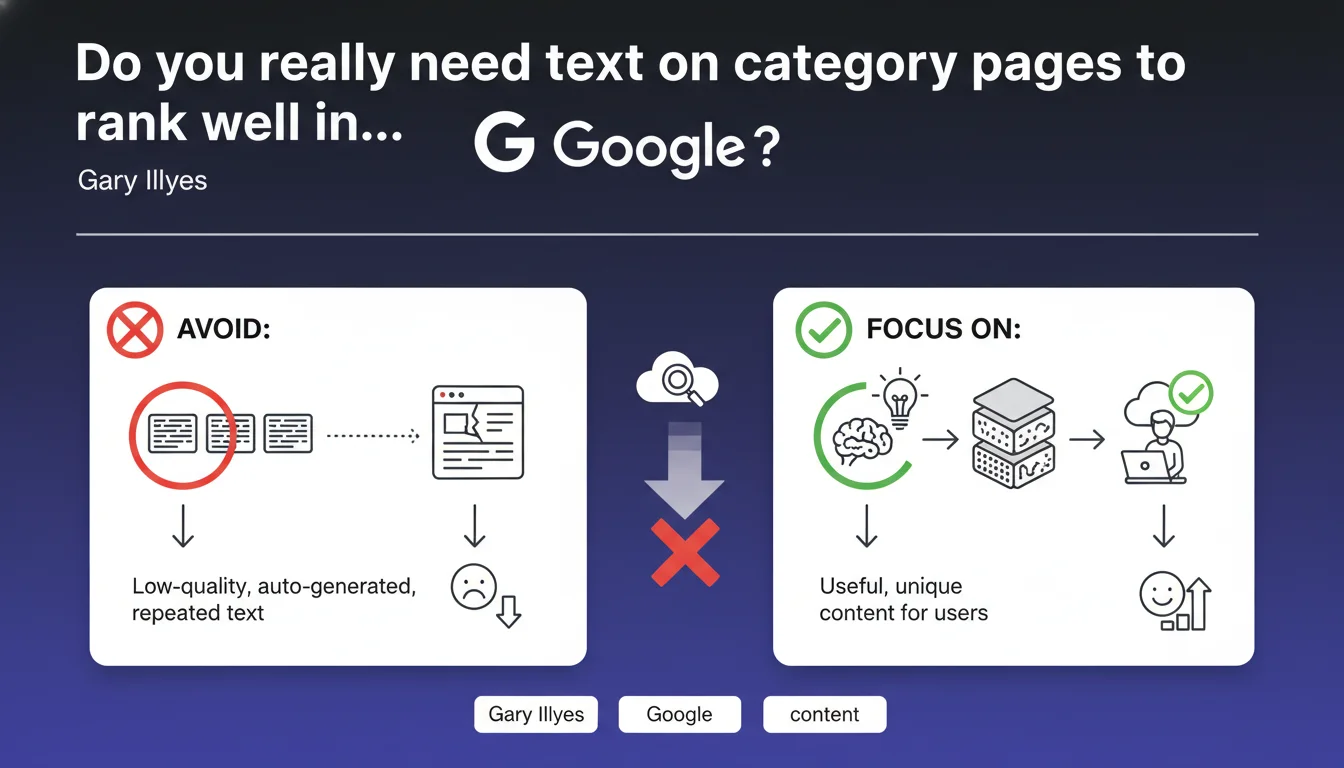
Google explicitly discourages repetitive auto-generated text on category pages. The goal isn't to check off a 'text content' box to please the algorithm, but to add content only if it brings real value to users. If you're generating text just because you think Google requires it, you're heading down the wrong path.
What you need to understand
Why is Google specifically targeting category pages?
Category pages are often the playground for the most mechanical SEO practices. We've all seen those 300-word blocks auto-generated and stuffed with variations of the main keyword, repeated identically across hundreds of categories with just the product name changing.
Gary Illyes isn't talking here about empty product listings — he's targeting fabricated textual content designed to create the illusion of 'optimization'. The problem? This content adds nothing to the user experience, and Google is starting to treat it as disguised spam.
What does Google mean by 'repetitive auto-generated'?
The phrasing is pretty clear: content produced via templates, with minimal variations. Classic example: 'Discover our selection of premium [category]. We offer the best [category] at the best price. Our [category] are...'
This type of pattern-based content — even if it's not technically duplicated — is considered low quality. Google isn't looking for keyword density; it's looking for differentiating information.
Is a category page without text penalized?
No. And that's the whole point of this statement. Google isn't saying 'add content,' it's saying 'don't add hollow content'.
A category page with a strong title, relevant filters, structured product metadata, and clear navigation can rank very well without a single introductory paragraph. The inverse is also true: 500 generic words will never compensate for poor UX.
- Repetitive auto-generated content on category pages is now explicitly targeted by Google
- Google clearly distinguishes between useful content and content created 'for SEO'
- A category page without text isn't penalized if it fulfills its function
- Quality trumps quantity — always
SEO Expert opinion
Is this recommendation consistent with what we're seeing in the field?
Yes, and it's a welcome confirmation. Since the latest Helpful Content updates, we're seeing e-commerce sites with fabricated category text losing traffic, while pure-play operators focused on UX without a single line of text are holding steady or even gaining ground.
But let's be honest: this guideline remains binary. Google doesn't say what constitutes 'useful content' for a category. Is it a buying guide? A comparison? An FAQ? Technical specs? [To be verified] — no public data specifies which formats are favored.
In what cases does category page text actually make sense?
There are sectors where the absence of textual content would be a strategic mistake. Think of technical categories (tools, electronics) where the user needs to understand differences between product subtypes before clicking through.
In those cases, an explanatory paragraph — unique, manually written, that genuinely helps with decision-making — makes sense. But if you're selling t-shirts and your category text explains 'what is a t-shirt,' you're completely off track.
What nuances should we add to this statement?
Gary Illyes is talking about 'repetitive auto-generated text,' not structured content. A category-specific FAQ, enriched filters with descriptions, customer review snippets — that's all content, but it's not filler text.
The real danger is mechanical application: 'all my categories must have 300 words.' No. Some categories need nothing. Others deserve 1500 words. There's no one-size-fits-all rule.
Practical impact and recommendations
What should you concretely do if your categories already have auto-generated text?
First step: audit. Identify categories with pattern-based content (template + variables). Then ask yourself: does this text actually help the user make a choice, or is it just noise?
If the answer is 'noise,' you have three options: remove it, rewrite it manually with real added value, or replace it with a more useful format (FAQ, comparison table, buying guide).
How to create useful content on a category page without falling into bullshit?
Start with user behavior. What questions does someone ask when they land on this category? What missing information prevents them from clicking on a product?
Concrete examples: on a 'trail running shoes' category, a table of sole types by terrain makes sense. On '3-seater sofas,' standard dimensions and arrangement tips do too. But a generic paragraph about 'the importance of comfort'? Trash it.
What mistakes should you absolutely avoid?
Don't fall into the opposite trap: stripping all textual content from your categories on principle. Some pages genuinely need context, especially in technical niches or high-value-add sectors.
Another classic mistake: replacing auto-generated text with another 'improved' auto-generated text. If you're just changing the template, you've solved nothing. The problem isn't the generation engine; it's the lack of value.
- Audit existing categories with pattern-based textual content
- Evaluate the real relevance of each text block from a user perspective
- Remove or rewrite generic content without added value
- Prioritize actionable formats: FAQs, buying guides, comparison tables
- Don't apply a one-size-fits-all rule to all categories — analyze case by case
- Monitor metrics after modifications (traffic, bounce rate, conversions)
❓ Frequently Asked Questions
Est-ce que supprimer le texte des pages catégories peut faire chuter mon trafic ?
Google pénalise-t-il activement les pages catégories avec du contenu auto-généré ?
Peut-on utiliser l'IA pour générer du contenu catégorie de qualité ?
Les filtres et facettes comptent-ils comme du contenu aux yeux de Google ?
Faut-il un nombre minimum de mots sur une page catégorie pour ranker ?
🎥 From the same video 17
Other SEO insights extracted from this same Google Search Central video · published on 06/09/2023
🎥 Watch the full video on YouTube →
💬 Comments (0)
Be the first to comment.