
Official statement
Other statements from this video 17 ▾
- □ Pourquoi Googlebot ignore-t-il vos boutons et comment contourner cette limite ?
- □ Les guest posts pour des backlinks sont-ils vraiment bannis par Google ?
- □ Faut-il vraiment du texte sur les pages catégories pour bien ranker ?
- □ Le HTML sémantique a-t-il vraiment un impact sur le classement Google ?
- □ Faut-il vraiment s'inquiéter des erreurs 404 générées par JSON et JavaScript dans GSC ?
- □ Google privilégie-t-il vraiment la meta description quand le contenu est pauvre ?
- □ Faut-il vraiment bloquer l'indexation des menus et zones communes d'un site ?
- □ L'infinite scroll est-il compatible avec le SEO si chaque section possède une URL unique ?
- □ L'indexation mobile-first impose-t-elle vraiment la version mobile comme unique référence ?
- □ Les PDF hébergés sur Google Drive sont-ils vraiment indexables par Google ?
- □ Pourquoi Google indexe-t-il vos URLs même quand robots.txt les bloque ?
- □ Faut-il supprimer ou améliorer le contenu de faible qualité sur votre site ?
- □ Le CMS influence-t-il vraiment le jugement de Google sur votre site ?
- □ Un noindex sur la homepage peut-il vraiment faire apparaître d'autres pages en premier ?
- □ Faut-il vraiment optimiser l'INP si ce n'est pas (encore) un facteur de classement ?
- □ Faut-il vraiment nettoyer toutes les pages hackées ou laisser Google faire le tri ?
- □ Faut-il arrêter de forcer l'indexation quand Google désindexe vos pages ?
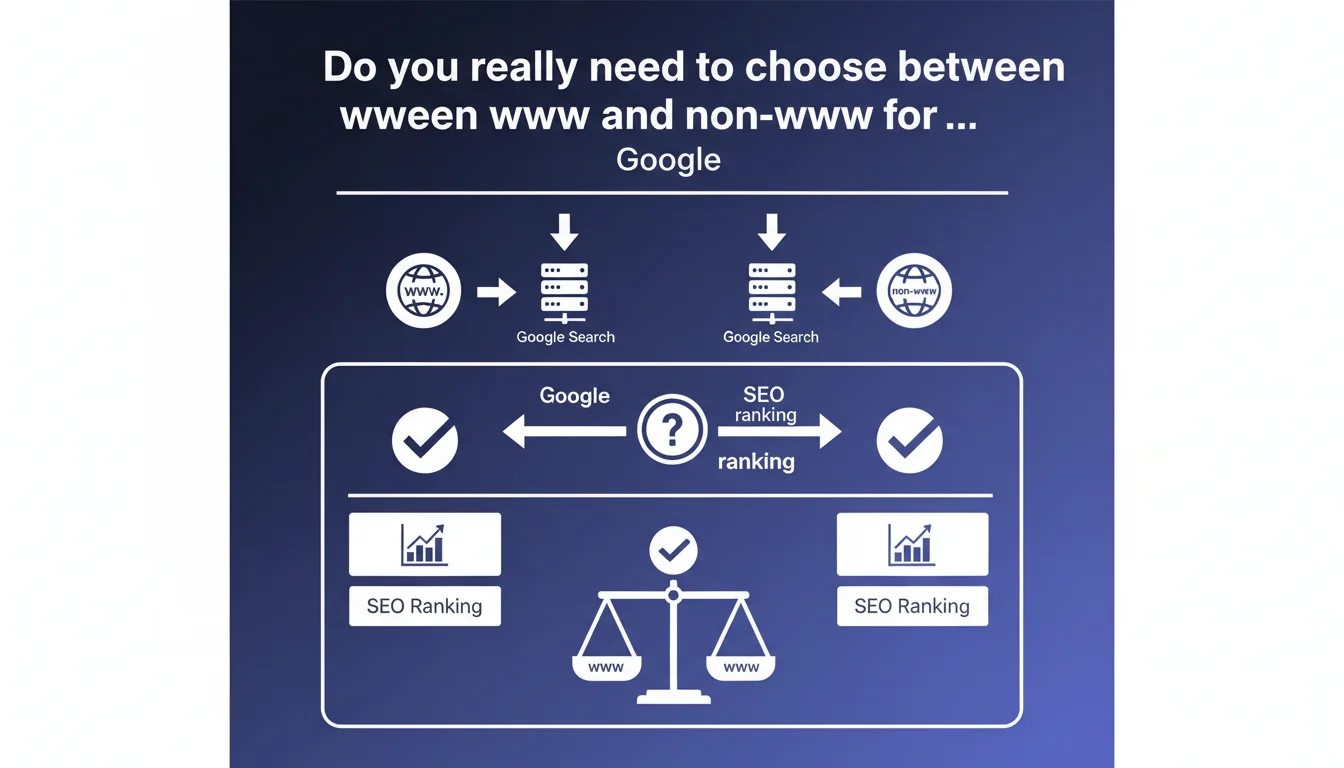
Google confirms that neither version (www or non-www) has any inherent SEO advantage. The search engine treats both formats as strictly equivalent. What matters most is choosing one canonical version and sticking with it consistently.
What you need to understand
Why does Google clarify that both versions are acceptable?
This clarification addresses persistent confusion among some practitioners who still believe one version would have a different impact on rankings. Google makes no algorithmic distinction between www.example.com and example.com.
The search engine treats these two URLs as separate entities that it can handle independently. This is precisely why you must indicate your preference through Search Console and 301 redirects.
Does this neutrality apply in all scenarios?
The statement addresses only the pure SEO aspect. It says nothing about technical considerations (server configuration, SSL certificates), impact on user memorability, or industry conventions.
Certain sectors have entrenched habits — www remains dominant in traditional hosting, while tech startups often favor the apex version. But from Google's perspective? Zero impact.
What are the key takeaways?
- Complete equivalence : neither version receives any particular algorithmic boost
- Mandatory consolidation : you must choose a single canonical version to avoid signal dilution
- Technical consistency : 301 redirects, canonical tags, and Search Console declaration must all point to the same version
- No impact on crawl budget : if properly configured, Google won't waste resources exploring both versions
SEO Expert opinion
Is this statement consistent with real-world observations?
Absolutely. For years, no correlation has ever been established between the www/non-www choice and ranking performance. Sites dominating the SERPs use both formats indifferently.
The real problem occurs when a site leaves both versions accessible without clear consolidation. Then you see duplicate content, fragmented backlink signals, and sometimes chaotic indexation. But this is a configuration issue — not an inherent flaw of one version or the other.
What nuances should be added to this statement?
Google remains oddly silent on one point: migrating from one version to another. In practical terms? If you switch from www to non-www (or vice versa) on an established site, you're technically launching a full URL migration.
This involves massive 301 redirects, potential temporary ranking loss, and a reconsolidation delay for signals. [To be verified] but some sites reported fluctuations during 2-3 weeks after this type of switch, even with flawless implementation.
In what cases does this rule not fully apply?
The statement assumes clean technical configuration. But on complex infrastructures (multi-CDN, dynamic subdomains, hybrid environments), managing the canonical version can become a nightmare.
Some CMS or frameworks impose constraints — for example, server configurations where www is technically necessary for DNS routing reasons. In these cases, the choice becomes forced, but the SEO impact remains zero if consolidation is correct.
Practical impact and recommendations
What should you do concretely on an existing site?
First step: verify which version is currently indexed as canonical. Type "site:example.com" and "site:www.example.com" into Google. If both return significant results, you have a consolidation problem.
Next, ensure that your preferred domain is declared in Search Console. Verify that all internal URLs, XML sitemaps, and canonical tags point to this single version.
What errors should you avoid during configuration?
Never leave both versions accessible on HTTP 200. One must redirect with a 301 permanent to the other. No 302s, no JavaScript or meta refresh redirects — clean server-side 301.
Another classic trap: changing the canonical version in Search Console without implementing server-side redirects. Google will continue to see both versions as active and the confusion will persist.
How do you verify everything is properly configured?
- Test all 4 combinations: http://www, https://www, http://, https:// — only one should return 200, the other 3 should redirect with 301
- Inspect 5-10 random pages: the canonical tag must point to your chosen version
- Check the XML sitemap: all URLs must use the canonical version
- Monitor major backlinks: if they point overwhelmingly to the non-canonical version, consider a link update campaign
- Review server logs: Google should crawl the canonical version predominantly (95%+ ratio after a few weeks)
❓ Frequently Asked Questions
Dois-je migrer mon site de www vers non-www si je lance une refonte ?
Les backlinks vers la mauvaise version sont-ils perdus ?
Faut-il déclarer les deux versions dans la Search Console ?
Le choix www/non-www a-t-il un impact sur la vitesse de chargement ?
Peut-on utiliser les deux versions pour des sous-sections différentes du site ?
🎥 From the same video 17
Other SEO insights extracted from this same Google Search Central video · published on 06/09/2023
🎥 Watch the full video on YouTube →
💬 Comments (0)
Be the first to comment.