
Official statement
Other statements from this video 9 ▾
- □ Pourquoi Google supprime-t-il 7% de son index vidéo et comment éviter d'en faire partie ?
- □ Pourquoi les incidents d'indexation paralysent-ils autant les sites d'actualités ?
- □ Pourquoi Google laisse-t-il des incidents 'ouverts' sur son tableau de bord même après résolution ?
- □ Faut-il s'inquiéter des incidents techniques mineurs chez Google ?
- □ Pourquoi Google ne crawle-t-il pas votre site aussi souvent que vous le souhaitez ?
- □ Pourquoi Google utilise-t-il des messages pré-approuvés lors d'incidents techniques ?
- □ Pourquoi votre contenu n'apparaît-il pas dans les SERP malgré la résolution de votre incident d'indexation ?
- □ Pourquoi les expériences de Google provoquent-elles des incidents dans les résultats de recherche ?
- □ Google va-t-il enfin communiquer sur les bonnes nouvelles de son moteur ?
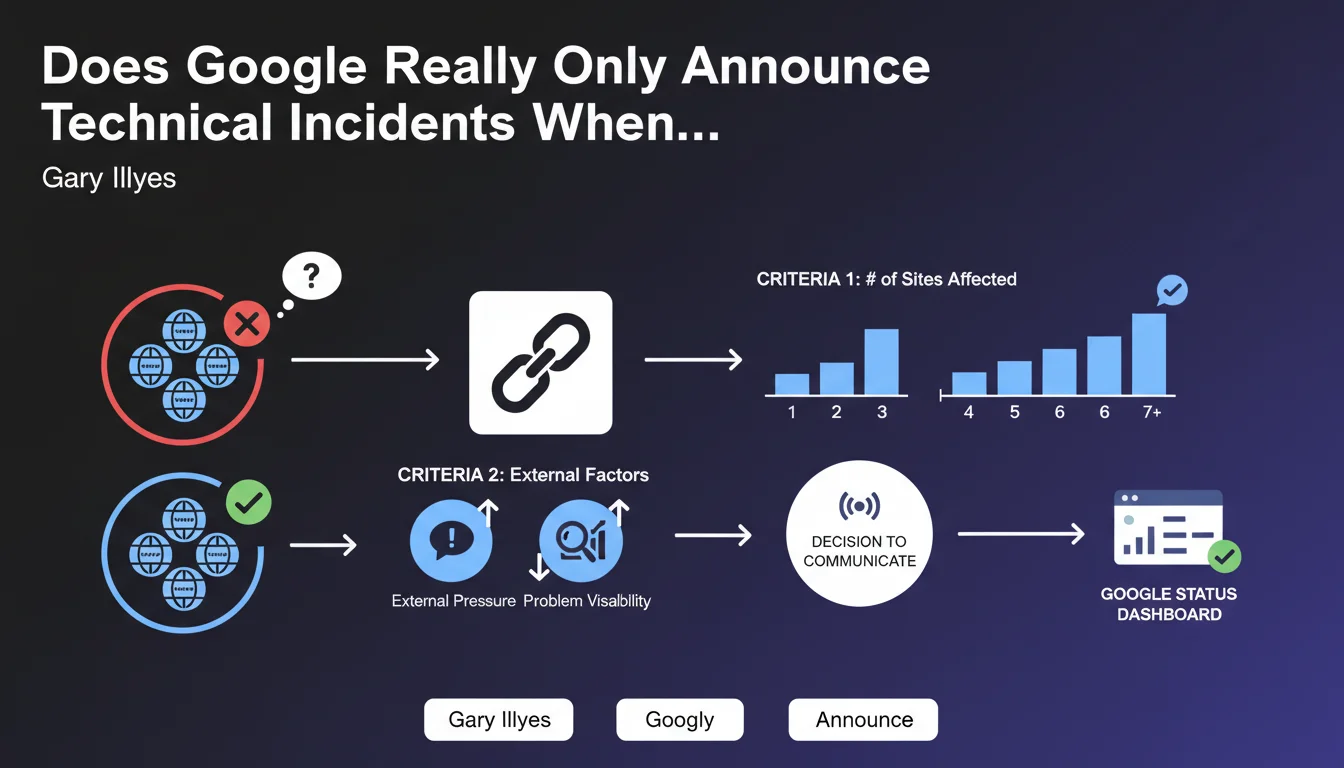
Google publishes an incident on its status dashboard only if multiple sites are affected — ideally more than seven, minimum three. The decision also depends on external pressure and media visibility of the problem. If your site is the only one affected, don't expect an official announcement.
What you need to understand
What's the Threshold of Affected Sites Before an Incident Becomes Public?
Gary Illyes confirms that Google applies a quantitative criterion: at least three sites must be impacted, but the ideal scenario involves seven or more sites. Below that threshold, the incident likely remains handled internally without publication on the status dashboard.
This threshold explains why certain severe but isolated technical problems generate no official communication. If your client sees their rankings drop sharply without Google publishing anything, it doesn't mean the search engine is ignoring the problem — just that it hasn't crossed the visibility threshold.
How Much Influence Does External Pressure Have on Google's Communication?
The decision isn't purely technical. Media pressure and community backlash play a decisive role. If Twitter (or X) blows up, if SEO forums go wild, if tech journalists ask questions, Google may choose to communicate even if the number of affected sites remains limited.
In practical terms, this means an incident affecting high-visibility sites (major media outlets, large e-commerce platforms) has a better chance of being externalized than a problem hitting invisible SMBs. Unfair? Perhaps. Realistic? Absolutely.
Why Does This Communication Policy Create Problems for SEO Practitioners?
This system creates frustrating information asymmetry. When a client loses 40% of their daily traffic overnight without an official announcement, there's no way to know whether it's a widespread Google bug flying under the radar, a targeted penalty, or a technical issue on the client's end.
The absence of communication becomes a source of uncertainty in itself. Practitioners must cross-reference community reports, monitor forums, compare Analytics curves across multiple clients — a time-consuming investigation that shouldn't be necessary.
- Minimum threshold: 3 affected sites, ideally 7+
- Qualitative criterion: external pressure and media visibility
- Practical consequence: isolated incidents rarely documented officially
- Information asymmetry: impossible to distinguish Google bug from local issue without public data
SEO Expert opinion
Is This Communication Policy Consistent With What We Observe in the Field?
Yes, and it's frustrating. We regularly observe major undocumented fluctuations affecting a few sites with no official declaration. The seven-site threshold explains why certain critical bugs remain invisible for weeks.
The external pressure criterion also confirms what we suspected: Google responds more to incidents that generate noise than to silent problems. Small sites simply don't have the media weight to force communication.
What Nuances Should We Add to This Statement?
Gary Illyes discusses a decision-making process, not an absolute rule. The terms "ideally" and "influence" leave fuzzy room for interpretation. [Needs verification]: are there exceptions where Google communicates about an incident affecting fewer than three sites if the impact is critical?
Another point: the definition of "same problem" remains vague. Three sites losing visibility for different technical reasons won't trigger communication, but three sites affected by an identical indexing bug will. This distinction is never officially clarified.
In What Cases Does This Rule Probably Not Apply?
Security incidents (mass hacking, zero-day vulnerabilities) and infrastructure outages (Googlebot inaccessible, Search Console down) likely follow a separate communication protocol. These cases fall under crisis management, not the affected-sites threshold.
Similarly, planned algorithm updates (Core Updates) are announced independently of how many sites are impacted. The seven-site threshold applies only to unexpected technical incidents.
Practical impact and recommendations
What Should You Do When Your Site Experiences Unexplained Traffic Loss?
First, verify whether other sites are affected. Monitor Twitter/X, SEO forums (WebmasterWorld, Reddit /r/SEO), specialized Slack groups. If multiple professionals report similar anomalies, it's probably an undocumented Google incident.
Next, document precisely: screenshots of Search Console, Analytics exports, list of affected pages, exact timeline. If the problem turns out to be a widespread Google bug, this data will accelerate diagnosis once Google finally communicates.
How Should You Interpret the Absence of Official Communication?
Never assume Google's silence means "everything is fine." The absence of an announcement may simply indicate your site is part of a group too small to trigger a dashboard publication.
Triangulation is necessary: compare your metrics with those of competing sites (using third-party tools like Semrush, Sistrix), consult community reports, carefully test your own recent changes. Only after eliminating all internal causes can you reasonably suspect an undocumented Google incident.
What Mistakes Should You Avoid in This Uncertain Context?
Classic mistake: panic and massively modify your site during a traffic drop. If it's a temporary Google bug, you risk making things worse with hasty changes. Patience and methodology first.
Another trap: waiting passively for an official announcement. Even if Google eventually communicates, it could take days or weeks. In the meantime, act on what you control: content quality, user experience, technical signals.
- Monitor SEO forums and social media daily to detect undocumented incidents
- Precisely document any anomaly: dates, affected pages, key metrics
- Compare your trends with competing sites using third-party tools
- Systematically eliminate all internal causes before concluding it's a Google bug
- Never massively modify your site in a panicked reaction to unexplained drops
- Maintain a history of past incidents to identify recurring patterns
❓ Frequently Asked Questions
Si mon site est le seul affecté, Google ne communiquera jamais ?
La pression externe peut-elle forcer Google à communiquer sur un incident mineur ?
Comment savoir si une baisse de trafic est due à un bug Google non documenté ?
Le seuil de sept sites s'applique-t-il aussi aux mises à jour d'algorithme ?
Que faire si Google ne répond pas à un ticket Search Console sur un incident potentiel ?
🎥 From the same video 9
Other SEO insights extracted from this same Google Search Central video · published on 06/06/2024
🎥 Watch the full video on YouTube →
💬 Comments (0)
Be the first to comment.