
Official statement
Other statements from this video 9 ▾
- □ Pourquoi Google supprime-t-il 7% de son index vidéo et comment éviter d'en faire partie ?
- □ Pourquoi les incidents d'indexation paralysent-ils autant les sites d'actualités ?
- □ Pourquoi Google laisse-t-il des incidents 'ouverts' sur son tableau de bord même après résolution ?
- □ Faut-il s'inquiéter des incidents techniques mineurs chez Google ?
- □ Comment Google décide-t-il de communiquer publiquement sur un incident technique ?
- □ Pourquoi Google ne crawle-t-il pas votre site aussi souvent que vous le souhaitez ?
- □ Pourquoi votre contenu n'apparaît-il pas dans les SERP malgré la résolution de votre incident d'indexation ?
- □ Pourquoi les expériences de Google provoquent-elles des incidents dans les résultats de recherche ?
- □ Google va-t-il enfin communiquer sur les bonnes nouvelles de son moteur ?
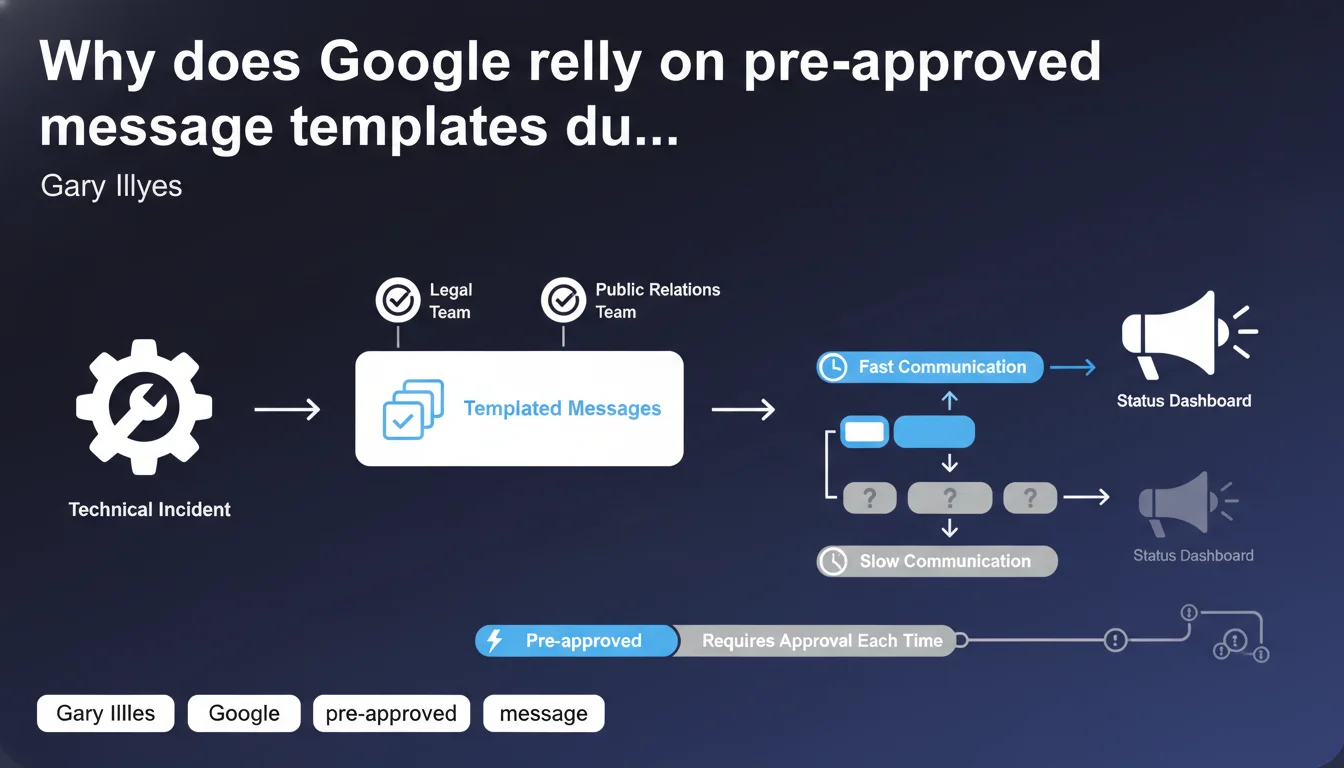
Google relies on templated messages validated in advance by its legal and public relations teams to communicate quickly during technical incidents. This approach enables Google to publish updates to its status dashboard without seeking approvals each time. For SEO professionals, this explains why Google's communications about bugs often remain vague and formatted.
What you need to understand
Why does Google favor standardized messages?
The reason is purely operational: every public communication from Google must pass through multiple layers of legal and PR validation. Waiting for these approvals at each incident would significantly slow down the dissemination of critical information.
By pre-approving templated messages, Google can instantly publish updates to its status dashboard the moment a problem is detected. The trade-off? Deliberately generic wording that reveals only the bare minimum.
What are the implications for transparency?
This approach explains the recurring frustration among SEO professionals with Google's official communications. Preformatted messages rarely contain precise technical details about the nature of bugs, their scope, or their resolution timeline.
In practical terms, when you read "We are investigating indexing issues," it's probably a message drawn from a pre-approved catalog. Technical teams often know much more, but cannot share it without going through the validation process.
What does this message catalog actually contain?
Gary Illyes doesn't detail the exact composition, but we can infer that there are different levels of severity and incident types covered: indexing problems, crawl issues, ranking fluctuations, Search Console problems.
Each category likely has variants for different stages: detection, investigation ongoing, fix deployed, resolution confirmed. Everything is calibrated to minimize Google's legal exposure while meeting a minimal transparency requirement.
- Templated messages are pre-approved by legal and PR teams to accelerate publication
- This method sacrifices precision in favor of communication speed
- Technical details often remain inaccessible because they're not covered by pre-approved messages
- Google's status dashboard becomes the only official source during major incidents
SEO Expert opinion
Is this practice consistent with what we observe in the field?
Absolutely. Anyone who has ever tried to obtain precise information during a Google bug will recognize this pattern. Official responses arrive quickly, but remain frustratingly vague.
What Gary Illyes reveals here is that this frustration isn't due to ill will from technical teams — it's a structural constraint. Engineers probably know exactly what's happening, but they can only communicate through these calibrated messages.
What are the limitations of this approach for professionals?
The major problem: the inability to distinguish between a minor incident and a major catastrophe until Google publishes multiple updates. A typical "We are investigating" message can cover anything from a bug affecting 0.1% of sites to a widespread outage.
This opacity forces SEO professionals to rely on informal channels: forums, Twitter, private groups, cross-checked observations. The official dashboard becomes almost secondary — you first try to understand the real scope through the community.
[To verify]: Gary Illyes doesn't specify whether certain types of incidents escape this standardized communication entirely. Minor or highly technical bugs might never appear on the status dashboard, simply because no corresponding template message exists.
Should we reconsider our expectations about Google's incident communication?
Yes — and this is perhaps the main takeaway. Expecting detailed and technical communications from Google during incidents amounts to ignoring the constraints of a publicly traded company constantly exposed to legal risks.
Complete transparency will never arrive through official channels. Real information will continue to leak through other means: Googlers' personal statements, conference talks, off-the-record tweets. The pre-approved message system is merely a legally secure smoke screen.
Practical impact and recommendations
How to correctly interpret Google status dashboard messages?
First instinct: never take the message at face value. An "We are investigating indexing issues" tells you nothing about scope, cause, or likely duration. It's an acknowledgment, not a diagnosis.
Second instinct: observe the frequency of updates. If Google publishes multiple messages within hours, the incident is probably serious. A single notification followed by silence suggests either a minor problem or a resolution bottleneck.
Third critical point — check your own data. Search Console, server logs, analytics: is your site actually impacted or is this an incident that doesn't concern you? Don't panic by default.
What mistakes should you avoid during a reported incident?
The classic mistake: hastily modifying your site thinking the problem originates from your side. If Google publishes a message confirming a bug on their end, wait for the fix before changing anything.
Another frequent trap: assuming the absence of a message means the absence of a problem. Some bugs never appear on the official dashboard, either because they're too specific or because they don't match any pre-approved message.
Finally, don't waste time looking for technical details in official communications. You won't find any. Focus on alternative sources: quality rater forums, Googlers' Twitter accounts, discussions among professionals.
What strategy should you adopt to manage these incidents effectively?
Implement a robust monitoring system that alerts you immediately to any anomalies: sudden traffic drops, pages disappearing from the index, unexplained ranking variations. Never rely solely on Google's dashboard.
Build a network of reliable SEO contacts with whom to quickly cross-reference observations during incidents. A Google bug is always confirmed by similar patterns observed across multiple independent sites.
Systematically document each incident: date, symptoms, duration, resolution. This history will let you identify recurring patterns and anticipate certain problems. Google doesn't communicate about root causes — it's up to you to build your own knowledge base.
- Check Google's status dashboard as soon as an anomaly is detected
- Systematically cross-reference with your own Analytics and Search Console data
- Never modify a site as long as a Google bug hasn't been confirmed as resolved
- Follow community discussions to obtain unofficial details
- Document each incident in a technical incident log
- Set up automated alerts on critical SEO metrics
❓ Frequently Asked Questions
Google dispose-t-il de messages pré-approuvés pour tous les types d'incidents ?
Pourquoi Google ne peut-il pas communiquer plus en détail lors d'incidents ?
Le tableau de bord d'état Google est-il la source la plus fiable lors d'incidents ?
Faut-il attendre une confirmation Google avant d'agir lors d'une anomalie sur mon site ?
Les Googlers peuvent-ils donner des informations en dehors des messages officiels ?
🎥 From the same video 9
Other SEO insights extracted from this same Google Search Central video · published on 06/06/2024
🎥 Watch the full video on YouTube →
💬 Comments (0)
Be the first to comment.