
Official statement
Other statements from this video 9 ▾
- □ Pourquoi Google supprime-t-il 7% de son index vidéo et comment éviter d'en faire partie ?
- □ Pourquoi les incidents d'indexation paralysent-ils autant les sites d'actualités ?
- □ Pourquoi Google laisse-t-il des incidents 'ouverts' sur son tableau de bord même après résolution ?
- □ Comment Google décide-t-il de communiquer publiquement sur un incident technique ?
- □ Pourquoi Google ne crawle-t-il pas votre site aussi souvent que vous le souhaitez ?
- □ Pourquoi Google utilise-t-il des messages pré-approuvés lors d'incidents techniques ?
- □ Pourquoi votre contenu n'apparaît-il pas dans les SERP malgré la résolution de votre incident d'indexation ?
- □ Pourquoi les expériences de Google provoquent-elles des incidents dans les résultats de recherche ?
- □ Google va-t-il enfin communiquer sur les bonnes nouvelles de son moteur ?
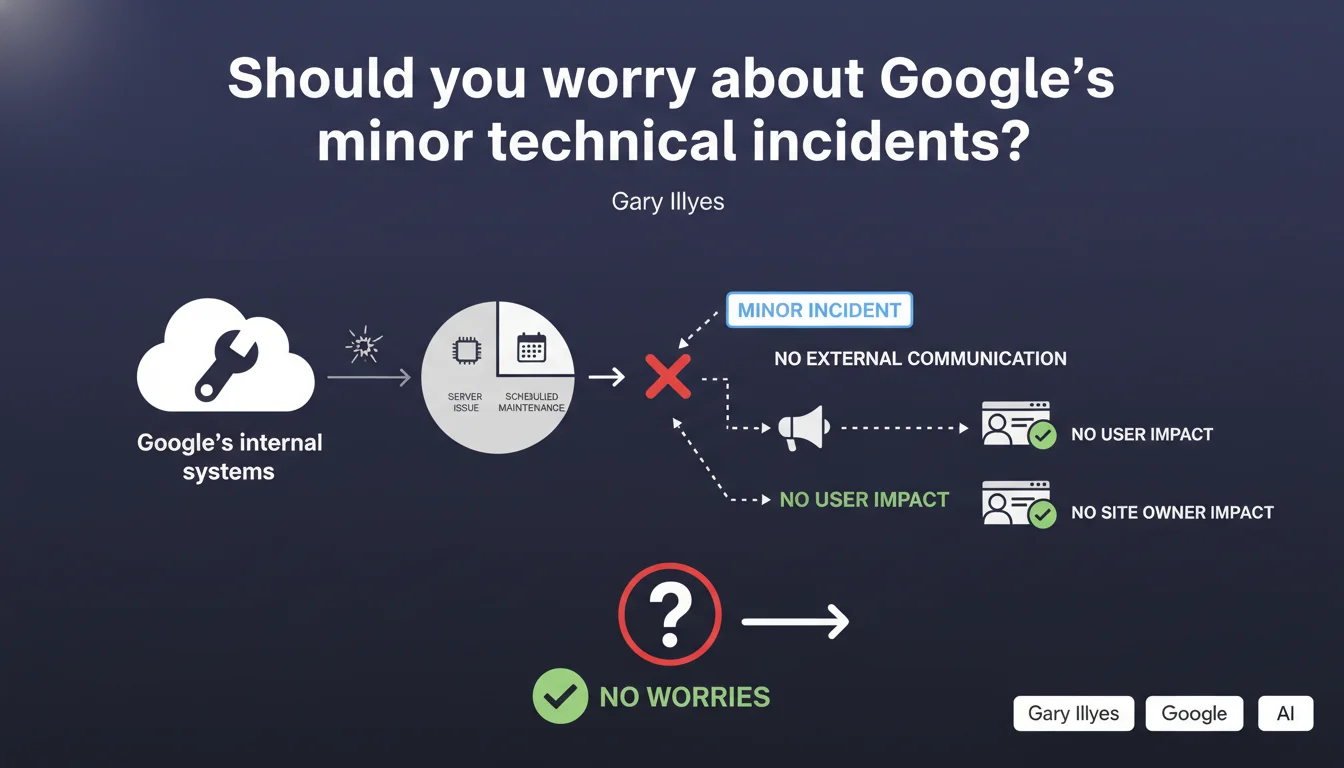
Google doesn't communicate about internal incidents classified as 'minor' — a server running low on RAM, datacenter maintenance — because they've never visibly impacted users or site owners. For SEOs, this means unexplained traffic fluctuations are probably not linked to these micro-outages that Google won't discuss.
What you need to understand
What does Google mean by a 'minor incident'?
A minor incident, according to Gary Illyes, covers isolated technical issues: a server lacking RAM, a datacenter under scheduled maintenance, or any other internal malfunction that remains confined to Google's infrastructure.
These incidents generate no external communication — no tweets, no official blog posts, no Search Status Dashboard updates. The stated reason? Historically, they've never had measurable impact on user experience or indexed site performance.
Why clarify this now?
This statement likely responds to a recurring demand from SEO professionals who scrutinize every traffic fluctuation and try to correlate variations with technical incidents on Google's side.
By drawing this line — "minor incidents don't warrant communication" — Google discourages speculation around micro-outages that have no real bearing on search results.
What's the boundary between minor and major incidents?
Google doesn't detail the precise criteria that push an incident from "minor" to "major". We understand that an incident becomes reportable once it visibly affects users: widespread slowness, massive indexation errors, temporary page disappearances from results.
The threshold remains completely unclear — how many sites must be affected? For how long? This absence of public metrics leaves a gray area that Google doesn't clarify.
- Minor incidents involve isolated infrastructure failures
- No external communication is planned for these cases
- The minor/major distinction rests on visible user impact, but without a numerical threshold
- Unexplained traffic fluctuations are probably not linked to these micro-outages
SEO Expert opinion
Is this communication policy consistent with observed practices?
Yes, and perhaps too much so. Google has always been extremely selective about announcing incidents. The Search Status Dashboard often remains silent while professionals detect anomalies across multiple sites simultaneously.
Gary Illyes's statement formalizes an already entrenched posture: Google only discusses dysfunctions it can't ignore. The problem? This opacity fuels speculation and complicates diagnostics for SEOs trying to distinguish a Google bug from a site-side issue.
What's the main weakness of this statement?
[To verify] The claim that minor incidents "have never impacted users" is unverifiable from outside. Google publishes no data allowing measurement of the actual effect of these micro-outages on site performance.
Moreover, an incident can be "minor" from Google's perspective — managing billions of queries — but critical for a site whose origin server was temporarily ignored during a crawl. The perspective differs radically depending on whether you run the infrastructure or suffer its vagaries.
Should we conclude that any unexplained fluctuation must come from the site?
No, and that's where the problem lies. Google says "we don't communicate about minor incidents", but doesn't say "minor incidents don't exist". This nuance is crucial.
If your traffic drops suddenly with no visible site-side changes, you can never rule out a Google infrastructure issue — you just know Google won't talk about it. This information asymmetry remains deeply frustrating for professionals who must diagnose with one hand tied behind their backs.
Practical impact and recommendations
What should you do when traffic fluctuates without obvious explanation?
First instinct: check your own systems. Review server logs, Search Console, 4xx/5xx errors, response time. A minor incident on Google's side will never be publicly confirmed — best to assume the problem is on your end.
Next, compare with other sites in your sector. If no one else reports a drop, it's probably specific to your site. If multiple players observe the same anomaly, it could indicate a Google bug — but you'll never get official confirmation.
What mistakes should you avoid facing unexplained fluctuation?
Don't blame Google too quickly. This stance is comfortable but sterile: even if a minor incident exists on Google's side, you can't do anything about it and Google won't confirm it.
Also avoid making multiple technical changes in panic. If you modify your internal linking, tags, site structure at the same time as a potential Google incident, you'll never know what caused or resolved the problem.
How do you build reliable diagnosis despite Google's opacity?
Document everything. Keep a detailed log of technical modifications, content updates, infrastructure changes. Facing a fluctuation, you can cross-reference these events with Search Console and Analytics data.
Engage with active SEO communities. Forums, Slack groups, specialized Twitter accounts allow you to share observations. If ten professionals observe the same anomaly at the same time, you know it's not just an isolated issue — even if Google says nothing.
- Systematically check your server logs and Search Console before blaming Google
- Compare your observations with other sites in your sector
- Document every technical modification to isolate potential causes
- Never modify multiple elements simultaneously during a fluctuation
- Join active SEO communities to cross-reference observations
- Remember that Google will never confirm a minor incident
❓ Frequently Asked Questions
Combien de temps dure un incident mineur chez Google ?
Un incident mineur peut-il affecter uniquement certaines régions géographiques ?
Le Search Status Dashboard signale-t-il tous les incidents majeurs ?
Faut-il contacter le support Google si je soupçonne un incident mineur ?
Les incidents mineurs peuvent-ils impacter l'indexation de nouvelles pages ?
🎥 From the same video 9
Other SEO insights extracted from this same Google Search Central video · published on 06/06/2024
🎥 Watch the full video on YouTube →
💬 Comments (0)
Be the first to comment.