
Official statement
Other statements from this video 9 ▾
- □ Pourquoi les incidents d'indexation paralysent-ils autant les sites d'actualités ?
- □ Pourquoi Google laisse-t-il des incidents 'ouverts' sur son tableau de bord même après résolution ?
- □ Faut-il s'inquiéter des incidents techniques mineurs chez Google ?
- □ Comment Google décide-t-il de communiquer publiquement sur un incident technique ?
- □ Pourquoi Google ne crawle-t-il pas votre site aussi souvent que vous le souhaitez ?
- □ Pourquoi Google utilise-t-il des messages pré-approuvés lors d'incidents techniques ?
- □ Pourquoi votre contenu n'apparaît-il pas dans les SERP malgré la résolution de votre incident d'indexation ?
- □ Pourquoi les expériences de Google provoquent-elles des incidents dans les résultats de recherche ?
- □ Google va-t-il enfin communiquer sur les bonnes nouvelles de son moteur ?
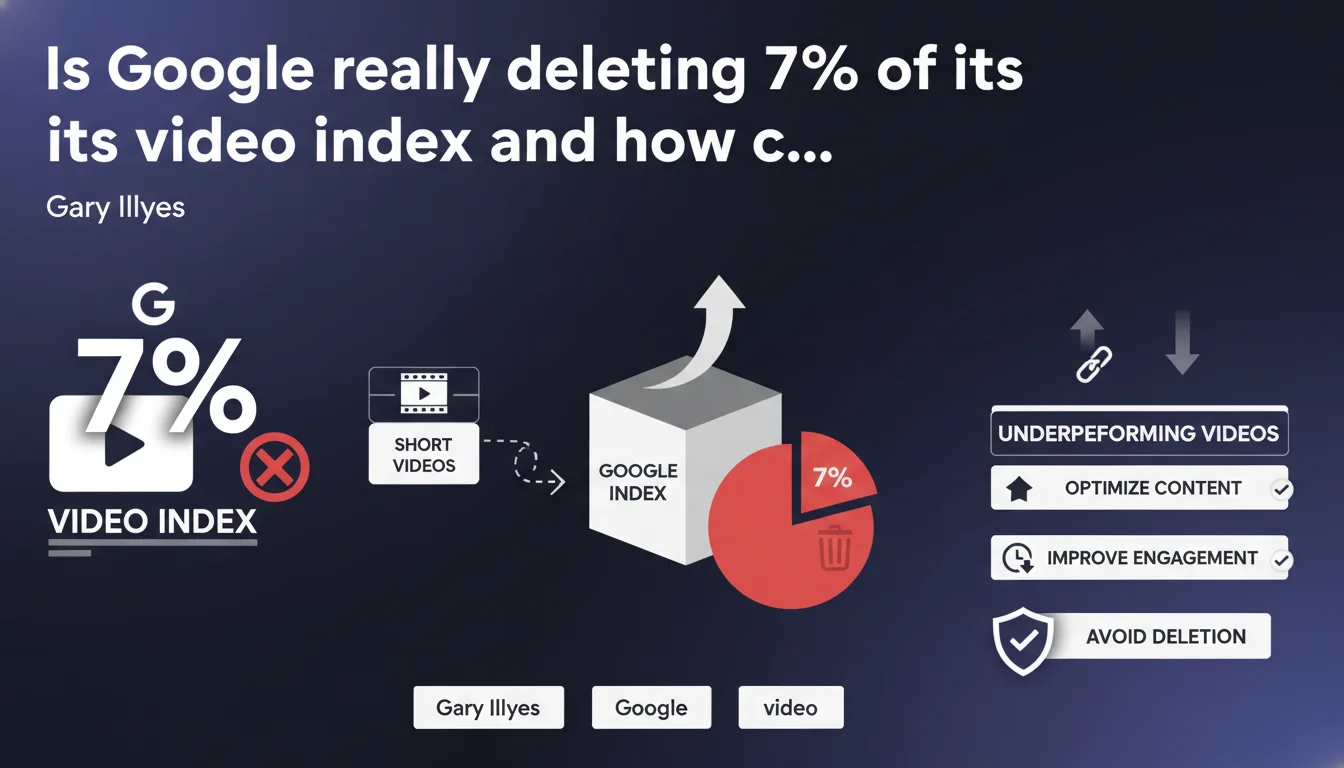
Google has reduced its video index by 7% by removing underperforming videos to make room for short formats (like Shorts and Reels). This purge aims to optimize index relevance in the face of explosive growth in short-form video content. If your videos show weak metrics, they risk being deindexed.
What you need to understand
What does this 7% reduction in video index actually mean in concrete terms?
Google has conducted a massive cleanup of its video index by removing approximately 7% of indexed URLs. This decision is far from trivial: it reflects a reallocation of crawl and storage resources toward short-form videos, a format that is exploding on YouTube Shorts, TikTok, and Instagram Reels.
"Underperforming videos" refers to those that generate few clicks, low watch time, or fail to answer user search queries. Google doesn't specify exact thresholds—typical of their vague communication style—but the signal is crystal clear: quality trumps quantity.
Why this sudden priority shift toward short videos?
User behavior has shifted toward fast consumption of content. Short videos generate more immediate engagement, more shares, and better match mobile search intent.
Google is following this trend to stay relevant in SERPs. Massively indexing Shorts is also about competing with TikTok and Instagram on their own turf. The trade-off? Less space for long-form videos that don't perform well.
Which types of videos are affected by this purge?
- Older videos with no recent traffic or engagement
- Duplicate content or content with low added value
- Long-form videos with catastrophic retention rates
- Video pages without basic SEO optimization (title, description, metadata)
- Content without authority signals (backlinks, shares, interactions)
SEO Expert opinion
Is this statement consistent with real-world observations?
Yes and no. Several websites have indeed experienced sudden deindexing of older videos in early 2024. But the correlation with indexing new short formats remains unproven—Gary Illyes provides no numerical data on the volume of new short-form formats being indexed. [To be verified]
What's shocking is the lack of advance notice. Google removes 7% from a major index without alerting affected publishers. No message in Search Console, no grace period. This confirms a trend: Google manages its index like an internal product, not a public service.
What nuances should be applied to this announcement?
The term "underperforming videos" is intentionally vague. Google doesn't define exact metrics or performance thresholds. Is it based on CTR? Average watch time? Social signals? Likely a mix, but impossible to optimize without knowing the relative weights.
Another point: does this purge only affect YouTube or also videos hosted on other platforms and websites? The statement remains evasive. Real-world feedback suggests YouTube remains privileged, but self-hosted videos with VideoObject Schema markup appear to be impacted too.
Should you panic if your videos have disappeared from the index?
Not necessarily. Some deindexings are temporary and linked to crawl bugs or server errors. First, check Search Console: 404 errors, video sitemap issues, robots.txt blockers.
If the video is genuinely "underperforming" by Google's criteria, reindexing without improvement won't help. Better to rework the content: better title, more engaging thumbnail, chapters, optimized transcript.
Practical impact and recommendations
What should you do concretely to avoid deindexing?
Start with a complete audit of your existing videos. Identify those with CTR below industry average (typically < 2-3% for organic videos). Analyze retention metrics: if 70% of viewers leave before 30 seconds, the content isn't delivering on its promise.
Next, prioritize high-impact actions: rewrite titles with intentional keywords, optimize descriptions to include structured summaries and timestamps, improve thumbnails to increase CTR.
- Audit video performance through Search Console (Performance tab > Video Search)
- Remove or redirect obsolete videos with no traffic
- Optimize VideoObject Schema markup (name, description, thumbnailUrl, uploadDate, duration)
- Add text transcripts to enrich indexable content
- Produce short videos (< 60s) to capture Shorts/Reels audience
- Monitor engagement signals: likes, shares, comments
- Test different durations to identify your audience's sweet spot
What mistakes should you avoid at all costs?
Don't multiply low-value videos just to "claim territory." Google now favors quality density over volume. A library of 10 performing videos is worth more than 100 mediocre ones.
Also avoid neglecting technical metadata. A misconfigured video sitemap, changing URLs, or missing Schema markup can cost you visibility even if the content is good.
How can you verify your videos remain properly indexed?
Use the search operator site:yourdomain.com inurl:video or site:youtube.com/c/yourname to list indexed URLs. Compare with your actual inventory to spot disappearances.
Set up Search Console alerts for video coverage errors. If Google encounters problems crawling your content, you'll be notified before potential deindexing.
❓ Frequently Asked Questions
Les vidéos désindexées peuvent-elles être réindexées ?
Google privilégie-t-il YouTube par rapport aux autres plateformes vidéo ?
Quelle durée idéale pour les vidéos indexables en 2024 ?
Le sitemap vidéo est-il toujours obligatoire ?
Comment mesurer si mes vidéos sont considérées comme performantes par Google ?
🎥 From the same video 9
Other SEO insights extracted from this same Google Search Central video · published on 06/06/2024
🎥 Watch the full video on YouTube →
💬 Comments (0)
Be the first to comment.