
Official statement
Other statements from this video 9 ▾
- □ Pourquoi Google supprime-t-il 7% de son index vidéo et comment éviter d'en faire partie ?
- □ Pourquoi les incidents d'indexation paralysent-ils autant les sites d'actualités ?
- □ Pourquoi Google laisse-t-il des incidents 'ouverts' sur son tableau de bord même après résolution ?
- □ Faut-il s'inquiéter des incidents techniques mineurs chez Google ?
- □ Comment Google décide-t-il de communiquer publiquement sur un incident technique ?
- □ Pourquoi Google ne crawle-t-il pas votre site aussi souvent que vous le souhaitez ?
- □ Pourquoi Google utilise-t-il des messages pré-approuvés lors d'incidents techniques ?
- □ Pourquoi les expériences de Google provoquent-elles des incidents dans les résultats de recherche ?
- □ Google va-t-il enfin communiquer sur les bonnes nouvelles de son moteur ?
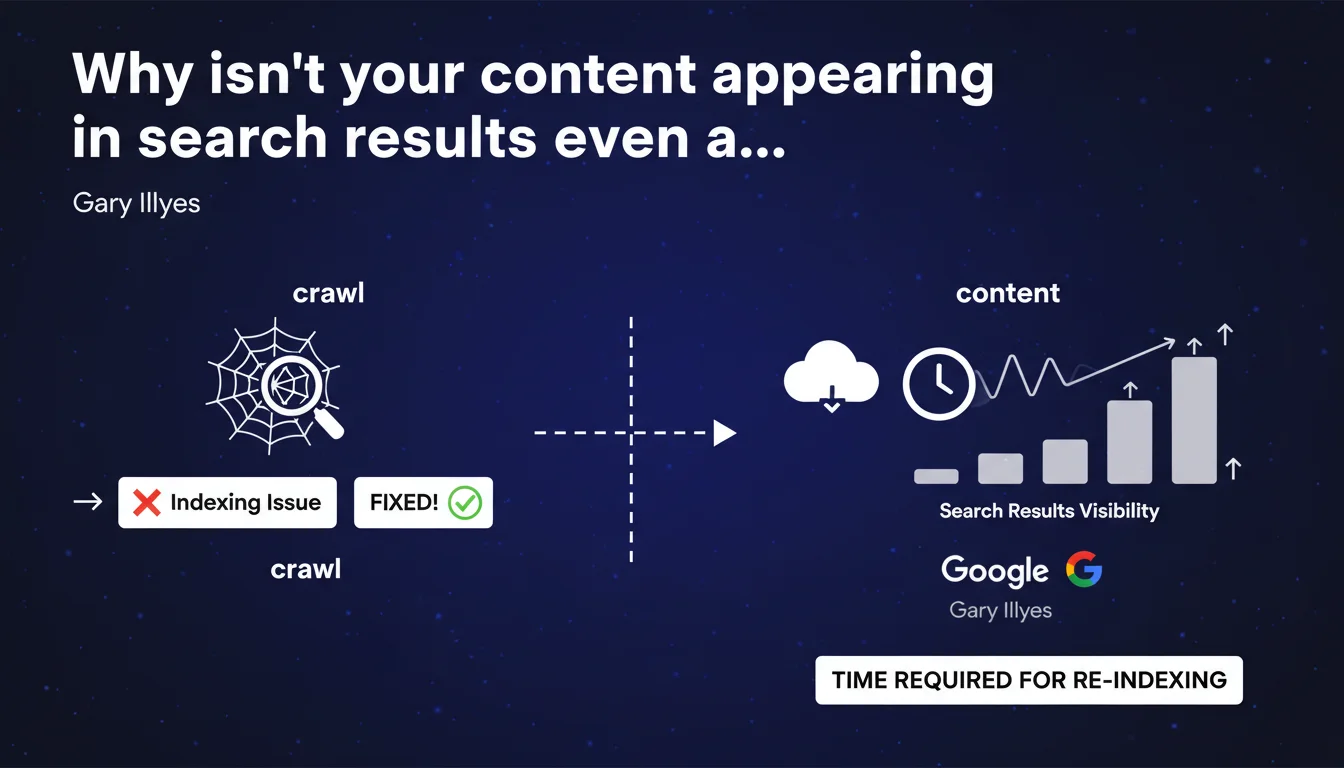
Google closes indexing incidents before complete reindexing is finished. Once the technical problem is resolved, full return to search results can take several days or even weeks. Closing a ticket in Search Console doesn't guarantee your pages have already been recrawled and repositioned.
What you need to understand
What actually happens after an indexing incident is resolved?
When Google identifies and resolves an indexing or crawl problem affecting your site, the official closure of the incident in Search Console doesn't mean everything is instantly back to normal. This is a crucial distinction that many SEO professionals overlook.
The reindexing process follows Google's own pace — and that pace depends on your crawl budget, the freshness of your content, and its priority in the algorithm. In other words: technical correction is one thing, propagation in the index is another.
How long do you really need to wait?
Google doesn't provide a specific timeframe. Real-world experience shows that for medium-sized sites, a gradual return is observed over 7 to 14 days. For larger sites or less-priority content? Several weeks are not uncommon.
Visibility returns in waves: some pages reappear quickly, others lag behind. If you've suffered a massive deindexation, don't panic after 48 hours — but don't sit idle either.
How does Google communicate about this lag?
That's where it gets tricky. Google closes the ticket by specifying that reindexing is "underway," but without any progress indicator. No loading bar, no percentage. Just a generic message that leaves practitioners in the dark.
This opacity is frustrating, but it reflects reality: Google cannot accurately predict how long the complete recrawl of thousands of pages scattered across its infrastructure will take.
- Closing an incident doesn't mean your site is already recrawled — only that Google's technical problem is resolved.
- Your crawl budget and the algorithmic priority of your content directly influence the reindexing timeframe.
- Visibility returns in a progressive and non-uniform manner — some pages before others.
- No precise timeframe is communicated by Google — field observations indicate between 7 days and several weeks.
SEO Expert opinion
Is this statement consistent with practices observed in the field?
Yes — and it's actually one of the rare points where Google is transparent about an operational reality. SEO professionals who have experienced major incidents (misconfigured robots.txt, accidental deindexation via noindex, lifted technical penalty) all confirm this time lag between resolution and return to the SERPs.
What's less clear is the prioritization criteria. Why do some pages return in 48 hours while others take 3 weeks? Google talks about "priority," but without detailing the signals used. [To verify]: is it linked to Core Web Vitals, historical traffic, content freshness, backlinks? Probably a mix, but Google remains vague.
In what cases doesn't this rule apply?
If your incident concerned a single strategic page and you request a manual inspection via Search Console, the return can be nearly immediate — within a few hours. Google prioritizes these individual requests.
But if you have 10,000 deindexed pages and you're counting on natural recrawling? Then patience becomes mandatory. Your XML sitemap can speed up the process, provided it's clean and properly submitted — but that's not a guarantee of speed.
Should you worry if nothing moves after 15 days?
Not necessarily. If the incident is officially closed and you see signs of recrawling in your server logs (Googlebot returns regularly), the process is advancing. The problem is when logs remain silent.
In that case, verify that the technical fix is actually in effect: no involuntary redirects, no parasitic canonical tags, no robots.txt rule still blocking certain sections. And if everything is clean? [To verify]: there could be a structural crawl budget problem — too many low-value pages saturating your quota.
Practical impact and recommendations
What do you need to do concretely during the reindexing period?
First rule: don't touch anything. If you've just fixed an incident, let Google do its work. Modifying your internal link structure, changing your canonical tags, or restructuring your sitemap during reindexing can complicate the process.
Monitor your server logs. This is the only reliable way to know if Googlebot is actually recrawling your pages. If you see sustained activity but no return to the SERPs, it means Google is indexing but not ranking yet — often linked to a perceived quality or duplication issue.
What mistakes should you avoid during this critical phase?
Don't multiply manual inspection requests. Google limits the number of daily requests, and overloading this tool won't accelerate overall recrawling. Reserve it for truly strategic pages.
Also avoid brutally reactivating a large volume of deindexed pages. If you lift 5,000 noindex tags at once, you risk saturating your crawl budget and slowing the process. Better to proceed in stages, prioritizing high-potential pages.
How do you verify that the return to the index is progressing well?
Use the site:yourdomain.com operator in Google. It's not perfect, but it gives an idea of the volume of indexed pages. Compare it with your pre-incident history.
Also check the index coverage report in Search Console: the number of "Valid" pages should gradually increase. If you see persistent errors ("Discovered, currently not indexed"), that's a signal that Google is recrawling but doesn't consider your pages worthy of indexing — a weak content or cannibalization problem.
- Monitor your server logs to confirm that Googlebot is actively recrawling your pages.
- Don't modify your technical architecture during the reindexing phase — let Google finish its work.
- Limit manual inspection requests to strategic pages only.
- Check the index coverage report in Search Console: "Valid" pages should increase progressively.
- Use the site: operator to track the evolution of your indexed page volume.
- If after 3 weeks you see no improvement, launch a complete technical audit to identify any remaining blockages.
❓ Frequently Asked Questions
Combien de temps faut-il attendre après la fermeture d'un incident d'indexation pour voir les pages revenir dans les résultats ?
Puis-je forcer Google à réindexer plus rapidement mes pages après un incident ?
Que faire si après 3 semaines mes pages ne réapparaissent toujours pas ?
La fermeture d'un incident dans la Search Console signifie-t-elle que toutes mes pages sont déjà recrawlées ?
Comment savoir si Google recrawle effectivement mes pages après un incident ?
🎥 From the same video 9
Other SEO insights extracted from this same Google Search Central video · published on 06/06/2024
🎥 Watch the full video on YouTube →
💬 Comments (0)
Be the first to comment.