
Official statement
Other statements from this video 9 ▾
- □ Is Google really deleting 7% of its video index and how can you avoid being part of it?
- □ Why do indexing incidents cripple news sites so severely?
- □ Why does Google keep incidents 'open' on its status dashboard even after they're resolved?
- □ Should you worry about Google's minor technical incidents?
- □ Does Google Really Only Announce Technical Incidents When Enough Sites Are Impacted?
- □ Why isn't Google crawling your site as frequently as you'd like?
- □ Why does Google rely on pre-approved message templates during technical incidents?
- □ Why isn't your content appearing in search results even after you've fixed your indexing issue?
- □ Why Are Google's Search Experiments Causing Unexpected Incidents in Your Rankings?
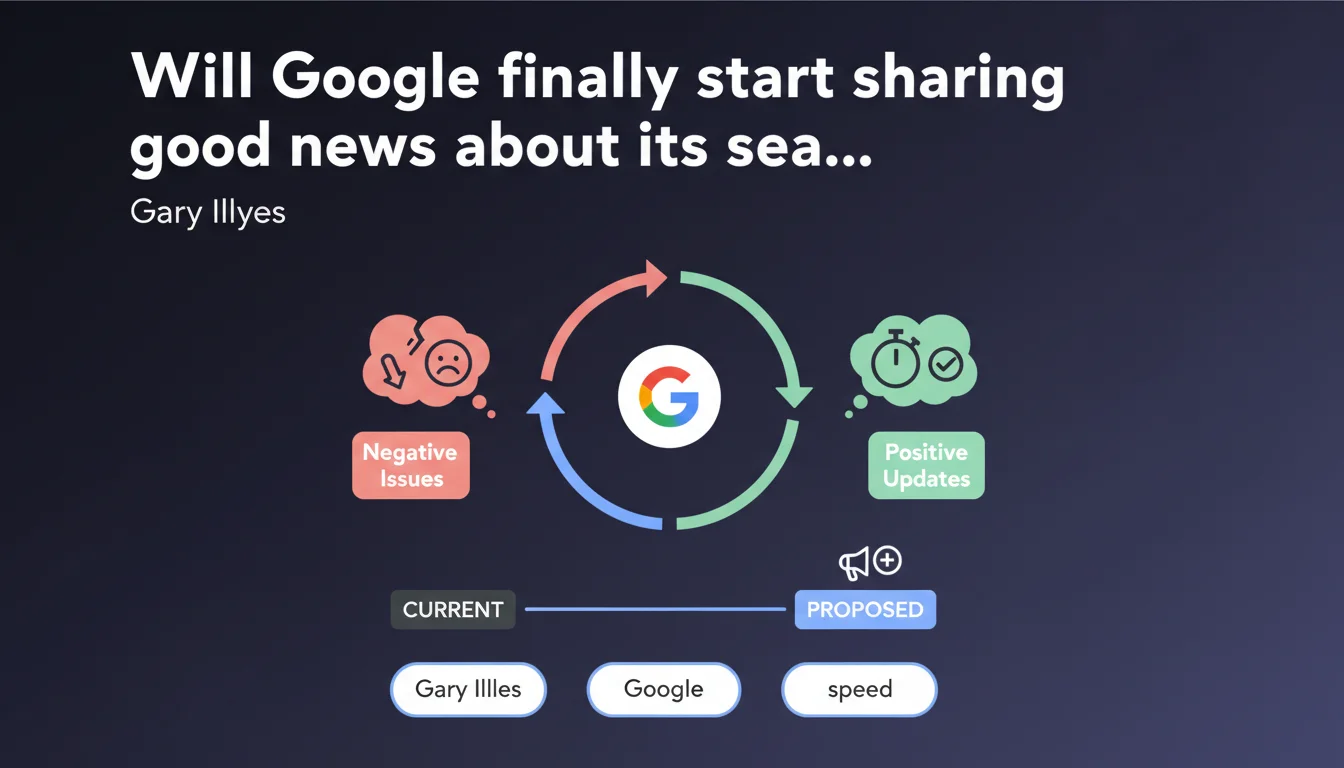
Gary Illyes announces that Google is considering using its status dashboard to share positive updates — indexing improvements, speed gains — and not only incidents. Currently, communication remains heavily problem-focused. This shift could be a game-changer for SEO practitioners who lack visibility into Google's ongoing optimizations.
What you need to understand
This statement marks a turning point in Google's communication strategy. Until now, the Search Status Dashboard primarily served to signal malfunctions: indexing bugs, crawl problems, occasional technical incidents.
Gary Illyes suggests expanding this tool to include positive announcements. Concretely? Notifications when Google improves its indexing capacity, speeds up processing for new pages, or rolls out infrastructure optimizations beneficial to websites.
Why this shift now?
Google is facing growing pressure from SEO practitioners, who denounce the lack of proactive transparency. Current communication relies on a reactive model: you only learn about a problem after observing its effects on your traffic.
By broadening positive information sharing, Google is attempting to rebalance perception. Rather than appearing only as a firefighter, the engine wants to show it is continuously improving its service — even when nobody directly notices it.
What does this change for SEO professionals?
If this initiative materializes, practitioners will have an early signal on certain internal evolutions. For example: knowing that an indexing improvement wave has been deployed allows you to better contextualize a sudden increase in indexed pages — without panicking or searching for an explanation on your site's end.
It remains declarative. Google won't detail algorithms, but the information can help diagnose movement faster in Search Console observations.
- The status dashboard will potentially include positive informational updates, not just bugs.
- Stated objective: make communication more balanced and less focused on incidents.
- No precise timeline communicated — this is an intention, not a formal commitment.
- Envisioned types of information include: indexing improvements, processing speed gains, infrastructure optimizations.
SEO Expert opinion
Is this statement consistent with observed practices?
Let's be honest: Google has always favored minimal communication. The current dashboard itself arrived only after years of requests. Its usage remains sporadic, often to confirm incidents the community had already identified on Twitter.
The idea of adding positive information is appealing on paper. The problem? [To be verified] We don't yet know how frequently these announcements will occur, or their level of detail. If Google merely sends generic messages like "we've improved overall indexing," the practical value will be limited.
What nuances should we add?
Gary Illyes speaks of "indexing improvements" or "speed increases." These formulations remain extremely vague. For an SEO practitioner, indexing covers vastly different realities: crawl budget, JavaScript handling, large site processing, URL canonicalization prioritization…
Without clarity on the scope concerned, it's hard to leverage the information. And that's where it gets sticky: if Google announces "global 15% improvement in page processing," what does that mean for my specific site? Nothing, as it stands.
Another point: this initiative looks a lot like a public relations operation. Communicating more about "good news" allows diluting the impact of negative announcements. It's a classic image management strategy — not necessarily a revolution for practitioners.
When will this evolution truly be useful?
If — and it's a big if — Google details the technical segments affected by each improvement, then yes, it becomes interesting. Concrete example: "Improved processing for e-commerce sites with complex pagination" would provide an actionable signal.
But Google's track record invites skepticism. Core Updates announcements remain generic. "Helpful content updates" have never provided precise criteria. Why would this time be different?
Practical impact and recommendations
What should you do concretely right now?
First step: integrate the status dashboard into your monitoring routine. If Google keeps its word, this channel will become a complementary information source — not absolute truth, but an additional indicator.
Second point: don't change anything about your monitoring practices. Google's announcements, even positive ones, remain declarative and general. Your own data — crawl logs, indexing evolution via Search Console, server response times — remain the foundation of any serious diagnosis.
What mistakes should you avoid in interpreting these future announcements?
Classic mistake: over-interpreting a generic message. If Google announces "overall indexing improvement," don't automatically conclude that your site benefits from it. Infrastructure improvements rarely affect all segments uniformly.
Another trap: easing monitoring pressure because "Google said everything is better." Localized bugs, problems specific to certain content types, configuration errors on your site side… all that continues to exist, regardless of official announcements.
How to leverage this information to guide your strategy?
Use positive announcements as interpretation context, not as action signals. Example: you notice a sudden spike in indexed pages. At the same time, Google announces an improvement in large site processing. You can then hypothesize that this spike stems from an external factor — rather than searching for an internal cause.
That saves diagnostic time, nothing more. SEO action remains guided by your own objectives and your site's data.
- Subscribe to notifications from Google's Search status dashboard (if you haven't already).
- Continue monitoring your own indexation metrics via Search Console and server logs.
- Don't modify your SEO strategy based solely on a generic announcement — always validate with your data.
- Document correlations between official announcements and variations observed on your sites — this helps refine future interpretation.
- Stay critical: increased communication doesn't necessarily mean increased transparency on technical details.
❓ Frequently Asked Questions
Le tableau de bord d'état de Google est-il déjà utilisé pour communiquer des informations positives ?
Ces annonces positives remplaceront-elles les communications sur les bugs ?
Dois-je modifier ma stratégie SEO en anticipation de ces annonces ?
Ces informations positives concerneront-elles tous les types de sites ?
Comment savoir si une amélioration annoncée par Google affecte concrètement mon site ?
🎥 From the same video 9
Other SEO insights extracted from this same Google Search Central video · published on 06/06/2024
🎥 Watch the full video on YouTube →
💬 Comments (0)
Be the first to comment.