
Official statement
Other statements from this video 9 ▾
- □ Pourquoi Google supprime-t-il 7% de son index vidéo et comment éviter d'en faire partie ?
- □ Pourquoi les incidents d'indexation paralysent-ils autant les sites d'actualités ?
- □ Pourquoi Google laisse-t-il des incidents 'ouverts' sur son tableau de bord même après résolution ?
- □ Faut-il s'inquiéter des incidents techniques mineurs chez Google ?
- □ Comment Google décide-t-il de communiquer publiquement sur un incident technique ?
- □ Pourquoi Google ne crawle-t-il pas votre site aussi souvent que vous le souhaitez ?
- □ Pourquoi Google utilise-t-il des messages pré-approuvés lors d'incidents techniques ?
- □ Pourquoi votre contenu n'apparaît-il pas dans les SERP malgré la résolution de votre incident d'indexation ?
- □ Google va-t-il enfin communiquer sur les bonnes nouvelles de son moteur ?
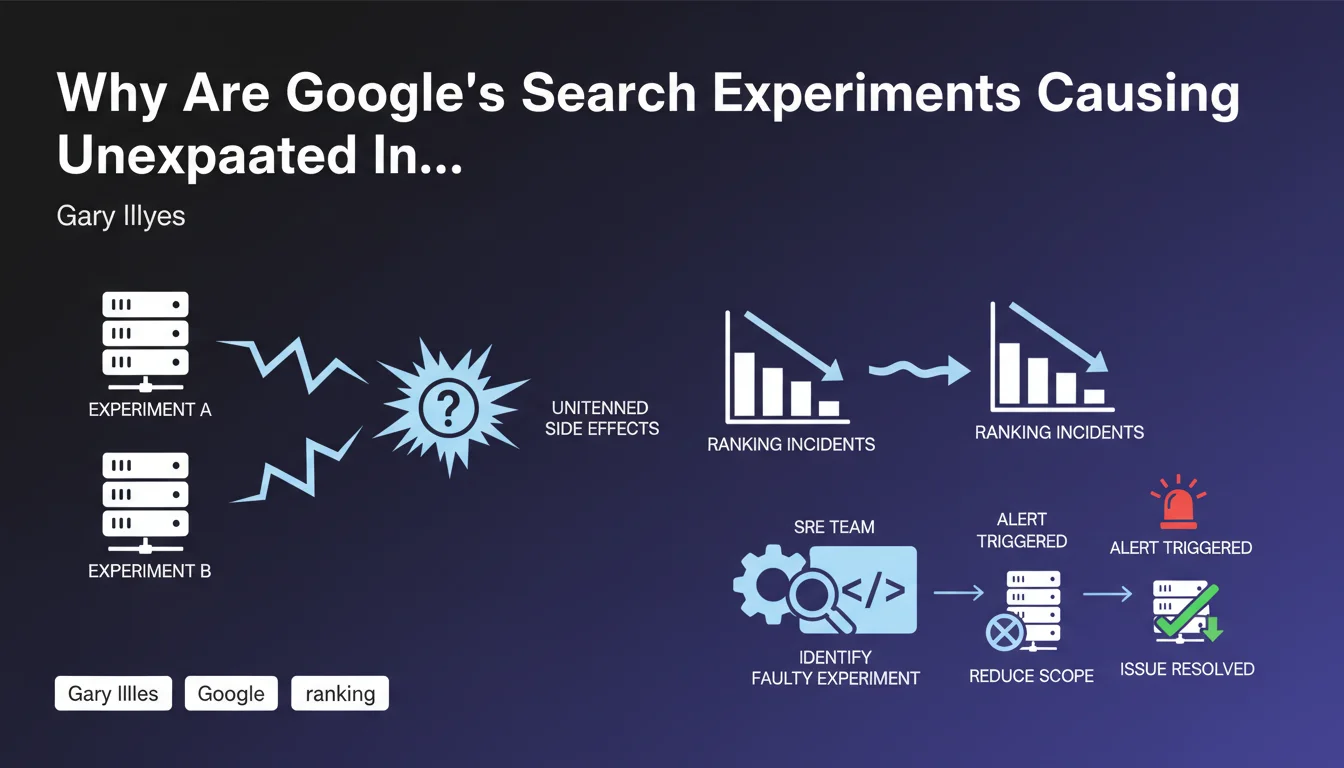
Google admits that its own tests and experiments on the search engine can interact in unexpected ways and cause incidents. When an alert triggers, the SRE team can identify the faulty experiment and disable it or reduce its scope. This revelation confirms that some SERP fluctuations aren't related to your site, but to internal bugs at Google.
What you need to understand
What Does Google Mean by "Experiments" in Its Search Engine?
Google constantly tests algorithmic modifications on samples of users before rolling them out widely. These tests — called experiments — can involve ranking, search results display, SERP features, or even crawling adjustments.
The problem? These experiments run simultaneously, sometimes dozens at a time. When two tests interact poorly, they can create unintended side effects: unexplained traffic drops, temporary page disappearances, erratic ranking fluctuations.
How Does Google Detect and Manage These Incidents?
The SRE (Site Reliability Engineering) team continuously monitors system alerts. As soon as an incident is detected, they can isolate the faulty experiment and either disable it completely or reduce its scope (decrease the percentage of exposed users).
This approach reveals two things: Google is aware that its tests can cause collateral damage, and it has a rapid response system in place. But it says nothing about the delay between bug occurrence and detection.
What Are the Implications for Affected Sites?
If your site suffers a sudden traffic drop with no apparent reason — no penalty, no technical changes, no announced update — you may be the victim of a poorly calibrated experiment. Recovery can be just as sudden.
Let's be honest: you'll never know if a given incident comes from a Google experiment bug or another factor. But this statement legitimizes the hypothesis that some fluctuations are completely outside your control.
- Google constantly tests algorithmic and technical modifications on user samples
- These experiments can interact unexpectedly and create bugs affecting search results
- The SRE team can disable or reduce the scope of a faulty experiment after detecting an incident
- Some traffic or ranking fluctuations may be caused by Google tests, not by your site
SEO Expert opinion
Is This Revelation Consistent with Real-World Observations?
Absolutely. For years, SEO practitioners have reported unexplained fluctuations: sites losing 50% of traffic overnight, then recovering completely 48 hours later. No trace of a penalty, no official announcement, no technical changes.
This statement from Illyes confirms what many suspected: Google sometimes breaks its own search engine with its tests. The problem is that it's impossible to distinguish an experiment bug from a real algorithmic devaluation — until it returns to normal, if it does.
What Transparency Does Google Really Offer About These Incidents?
Close to zero. Google never publishes communications like "sorry, an experiment caused an incident yesterday." At best, you'll see John Mueller or Gary Illyes respond to an isolated case on Twitter confirming a bug — after the fact, and informally.
For affected sites, this means hours of useless investigation, panicked clients, decisions made on false assumptions. [To verify]: Google claims SRE alerts enable fast resolution, but no public data confirms average detection and correction timeframes.
Should You React Differently to Sudden Traffic Drops?
Yes. Before panicking and massively modifying your site, wait 48-72 hours. If the drop comes from a faulty Google experiment, it will resolve itself once the SRE team has identified and disabled the problematic test.
Concretely? First verify the basics: no technical issues (crawl, indexing, Core Web Vitals), no manual penalty in Search Console, no announced algorithmic update. If everything is clean and the drop is sudden and unexplained, wait before taking action.
Practical impact and recommendations
How Do You Distinguish a Google Bug From a Real SEO Problem on Your Site?
That's the million-dollar question. Here's a pragmatic method: if your traffic drops suddenly and uniformly across all your pages, with no correlation to your actions, a Google bug is a credible hypothesis. If the drop is gradual or targeted at specific page types, it's probably an algorithmic signal.
Another indicator: check if other sites in your sector are experiencing the same thing at the same time. Monitoring tools like SEMrush or Sistrix let you compare visibility curves. A drop isolated to your domain alone is less likely to be a Google experiment bug.
What Should You Do Concretely in Case of Unexplained Fluctuation?
First instinct: don't touch anything for 72 hours. Document the situation (screenshots, Analytics exports, rankings), but make no major technical or editorial modifications. If it's a Google bug, the issue will resolve itself.
In parallel, verify the fundamentals: HTTP status codes, server logs, crawl budget, indexation in Search Console. If everything is stable on your end, the experiment bug hypothesis strengthens.
- Wait 48-72 hours before reacting to a sudden, unexplained traffic drop
- Verify that your technical fundamentals are stable (crawl, indexation, Core Web Vitals)
- Compare your visibility curve with that of direct competitors to isolate a potential Google bug
- Document the situation precisely (dates, scale, affected pages) for later analysis
- Don't massively modify your site under the pretext of a fluctuation — you risk making things worse
- Monitor official Google channels (Search Central Blog, Google Search Twitter account) for any announcements
❓ Frequently Asked Questions
Google informe-t-il publiquement lorsqu'une expérience cause un incident ?
Combien de temps faut-il pour que Google détecte et corrige un bug d'expérience ?
Peut-on savoir si son site est affecté par une expérience Google spécifique ?
Faut-il contacter Google si on soupçonne un bug d'expérience sur son site ?
Les expériences Google peuvent-elles affecter l'indexation ou seulement le classement ?
🎥 From the same video 9
Other SEO insights extracted from this same Google Search Central video · published on 06/06/2024
🎥 Watch the full video on YouTube →
💬 Comments (0)
Be the first to comment.