
Official statement
What you need to understand
What exactly is the SRE team and what role does it play in communication?
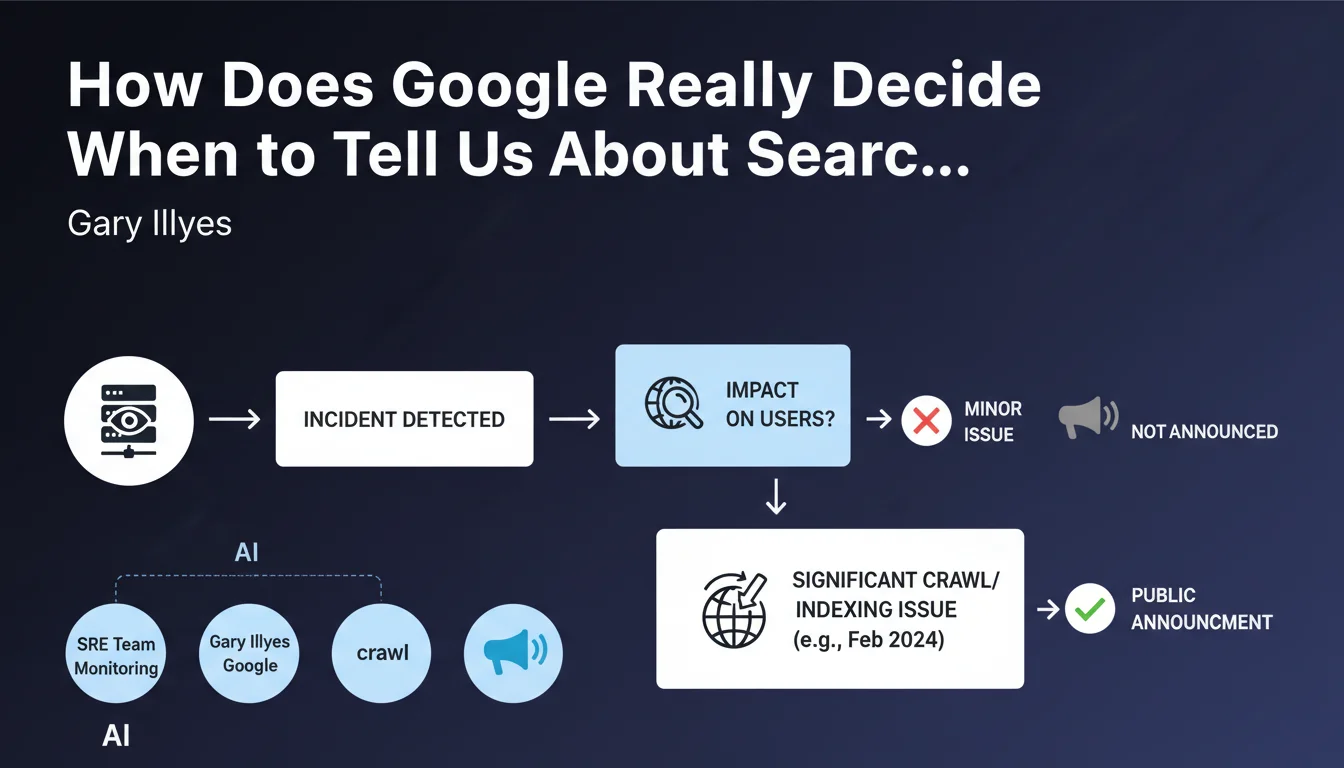
The SRE (Site Reliability Engineering) team at Google is responsible for monitoring critical search engine systems. It detects incidents affecting crawl and indexing and assesses their severity.
This team decides whether an incident warrants public communication or remains internal. The main criterion is the impact on end users, not just on webmasters.
Which types of incidents does Google actually communicate publicly?
Google essentially communicates about incidents having a visible impact on users of the search engine. The cited example is the indexing problem from February 2024 that disrupted search results.
Minor incidents that only affect a limited portion of sites or that are quickly resolved generally do not result in official announcements. This policy aims to avoid overwhelming webmasters with irrelevant technical communications.
Why do certain indexing problems go unnoticed?
Google's communication is user-centered rather than webmaster-centered. An incident that affects your site specifically may never be communicated if it doesn't massively impact search results.
- Incidents are evaluated according to their impact on the overall user experience
- Public communication is reserved for problems affecting a large portion of the index
- Minor problems or those quick to resolve typically remain undocumented
- The editorial comment highlights that there are probably major uncommunicated incidents
- Webmasters must develop their own monitoring tools to detect anomalies
SEO Expert opinion
Does this communication policy align with what we actually observe in practice?
Yes, this statement corresponds perfectly to the reality in the field. Over 15 years, I've observed numerous indexing problems reported by clients that never resulted in official communication.
Google clearly has a very restrictive definition of what deserves communication. A site losing 50% of its indexed pages may not generate an announcement if the phenomenon remains isolated. This approach protects Google from criticism but complicates diagnosis for SEO professionals.
What are the unspoken implications of this statement?
The editorial comment touches on a crucial point: some major incidents remain confidential. This means Google can experience significant outages without ever publicly acknowledging them if the user impact remains acceptable.
For SEO practitioners, this implies that we can never rely solely on official communications to diagnose a problem. We must cross-reference with other sources: forums, communities, third-party monitoring tools.
How does this limited transparency actually affect our work?
This policy creates an information asymmetry between Google and webmasters. We must constantly distinguish between a Google-side problem and a problem on our site, without having all the data.
This reinforces the importance of independent monitoring tools and professional networks. The SEO community often becomes more responsive than Google itself in reporting anomalies. It's frustrating but it's the reality of the profession.
Practical impact and recommendations
How can you detect a Google incident without official communication?
Implement a multi-layered monitoring system. Never rely solely on Google's announcements to identify an indexing or crawl problem.
Use Google Search Console daily, but supplement with third-party tools like Screaming Frog, OnCrawl or Botify to detect crawl anomalies. Monitor your performance indicators in Analytics in parallel.
- Check the number of indexed pages in Search Console daily
- Monitor coverage errors and abnormal spikes in reports
- Set up automatic alerts for organic traffic drops (-20% or more)
- Follow SEO communities (Twitter, specialized forums) to detect collective reports
- Compare your data with multiple sites in your portfolio to identify a Google pattern vs local issue
- Systematically document anomalies with screenshots and data exports
What strategy should you adopt when facing a suspected incident?
Apply a structured diagnostic protocol as soon as an anomaly is detected. Never assume it's necessarily a Google problem, even if other sites seem affected.
Start by checking your fundamentals: robots.txt, XML sitemap, redirects, page speed. Only then, if everything is normal on your end, look to correlate with a potential Google incident.
Should you adapt your communication with clients?
Yes, educate your clients about this reality. Explain to them that Google's lack of communication doesn't mean there's no problem on the search engine side.
Prepare reports that clearly distinguish hypotheses between internal technical problems and suspicions of Google incidents. This protects you professionally and helps with decision-making.
💬 Comments (0)
Be the first to comment.