
Official statement
What you need to understand
What Exactly Does Google Hold Against White Label Coupon Sites?
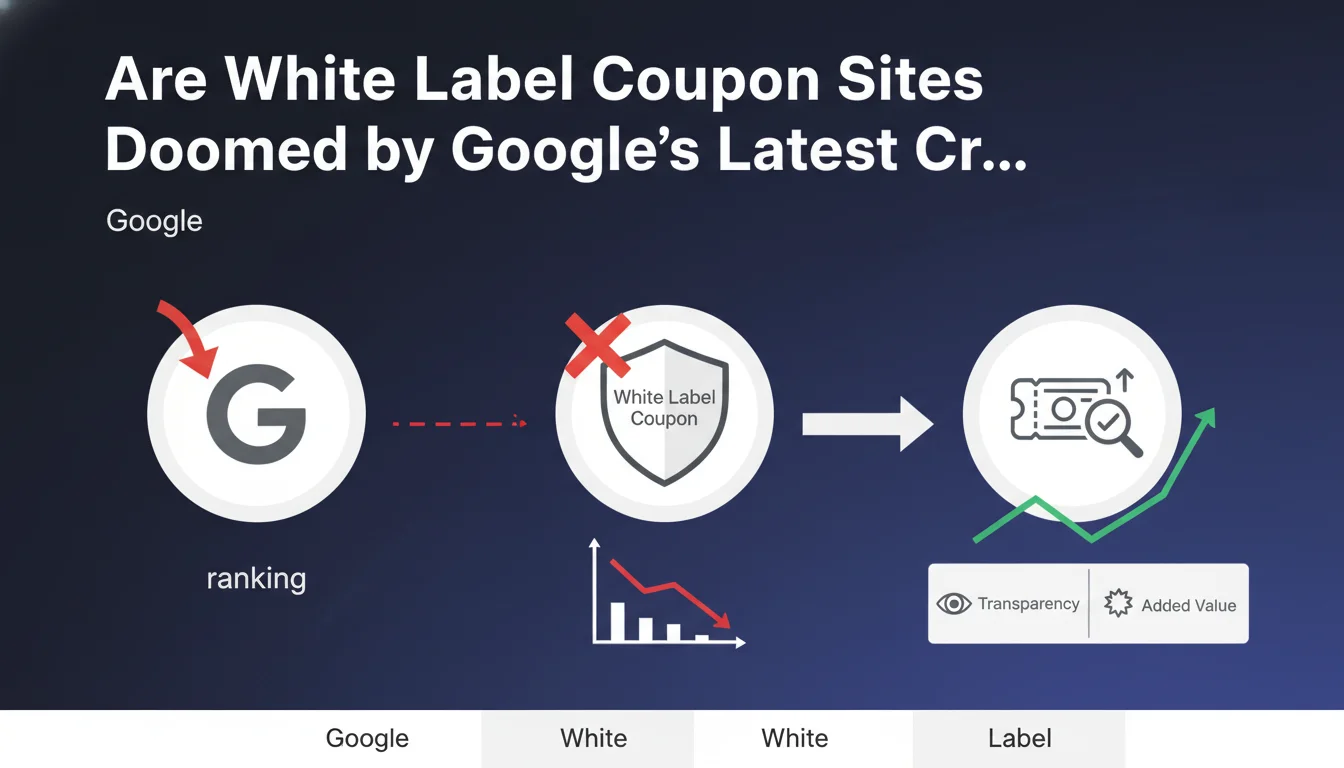
Google specifically targets white label coupon sites created solely to manipulate search rankings. These sites typically exploit the reputation of an established domain to promote third-party content without real added value.
The notion of site reputation abuse is central: it involves entire sections of a site entrusted to third parties to benefit from the authority of the main domain. This practice has been sanctioned by manual actions since May 2024.
Which Coupon Sites Are Not Affected by This Penalty?
Sites that demonstrate transparency about the origin of coupons and provide genuine added value to their users escape sanctions. Google distinguishes between manipulation and legitimate service.
A legitimate site must clearly indicate where coupons come from, offer original editorial content, and provide a quality user experience. Simple automatic aggregation of promo codes without context or validation is considered abusive.
Why Is This Official Documentation Update Happening Now?
This official clarification follows the manual actions deployed since May 6, 2024. Google is formalizing in its documentation a repressive practice already underway in the field.
- White label sites created to manipulate SERPs are now explicitly targeted
- Transparency and added value are the two discriminating criteria
- Manual actions are prioritized for this type of abuse
- This policy is part of the broader fight against site reputation abuse
SEO Expert opinion
Does This Statement Align with Practices Observed in the Field?
Absolutely. Since May 2024, we have indeed observed a wave of manual actions targeting suspicious coupon sites. This formalization was expected and corresponds to the signals sent by Google for several months.
The notion of reputation abuse is gradually expanding: after sponsored sections of authority sites, Google is tackling purely SEO white label models. The consistency is complete with the stated intention to favor authentic content.
What Important Nuances Should Be Applied to This Rule?
The boundary between legitimate site and abuse remains subjective and depends on human evaluation during manual action. The criteria of "transparency" and "added value" are not precisely quantified by Google.
A site can offer white label coupons while being compliant, provided it contextualizes the offers, clearly indicates partnerships, and provides original editorial content. The problem is not the business model but the manipulative intent.
What Types of Coupon Sites Are Most at Risk of Being Penalized?
The sites most at risk are those that use automated promo code feeds without curation, that don't test coupons, and that provide no editorial context. Expired domains purchased for their authority and transformed into coupon farms are also targeted.
Affiliate site networks created en masse with duplicated or automatically generated content are particularly vulnerable. Google easily detects patterns of cloned sites with only minor variations.
Practical impact and recommendations
What Should You Concretely Do If You Manage a Coupon Site?
Start with a transparency audit: each coupon must clearly indicate its source, validation date, and terms of use. Add explicit mentions about your commercial partnerships.
Develop original editorial content around offers: buying guides, comparisons, product tests, usage tips. The added value must be obvious to the user, not just a showcase for affiliate links.
If your site operates as white label, regain editorial control. A model where you don't control the content published under your domain is now high-risk. Consider migrating to a more integrated model.
How Can You Verify That Your Site Isn't at Risk of a Penalty?
- Check Search Console: any manual action appears there immediately
- Audit transparency: origin of coupons, dates, conditions clearly displayed
- Evaluate the original content / syndicated content ratio: aim for at least 60% proprietary content
- Actually test promo codes and remove expired ones
- Add clear legal notices about partnerships and affiliations
- Verify that each page provides unique value beyond the simple promo code
- Analyze your engagement metrics: time on page, bounce rate, page views
What Mistakes Should You Absolutely Avoid in This Context?
Don't attempt to hide the white label nature of your site: Google has technical indicators to detect these configurations. Concealment worsens the situation during a manual review.
Avoid automatically generated content or AI content without strict editorial supervision. "Template" pages with only the brand name changing are immediately identifiable.
Don't rely on quantity at the expense of quality: better to have 100 excellent pages than 10,000 mediocre pages. The pure volume strategy has become counterproductive with recent updates.
In summary: Google is significantly hardening its position on white label coupon sites without added value. Transparency and authenticity are becoming survival criteria, not just optimization factors.
Legitimate sites have nothing to fear if they prioritize user experience and editorial quality. For others, a deep overhaul of the model is urgently needed.
These transformations often require advanced expertise in modern SEO and guideline compliance. For complex or high-traffic sites, support from a specialized SEO agency can prove valuable to navigate these changes without compromising your revenue during the transition.
💬 Comments (0)
Be the first to comment.