
Official statement
Other statements from this video 9 ▾
- □ Is Google really deleting 7% of its video index and how can you avoid being part of it?
- □ Why does Google keep incidents 'open' on its status dashboard even after they're resolved?
- □ Should you worry about Google's minor technical incidents?
- □ Does Google Really Only Announce Technical Incidents When Enough Sites Are Impacted?
- □ Why isn't Google crawling your site as frequently as you'd like?
- □ Why does Google rely on pre-approved message templates during technical incidents?
- □ Why isn't your content appearing in search results even after you've fixed your indexing issue?
- □ Why Are Google's Search Experiments Causing Unexpected Incidents in Your Rankings?
- □ Will Google finally start sharing good news about its search engine?
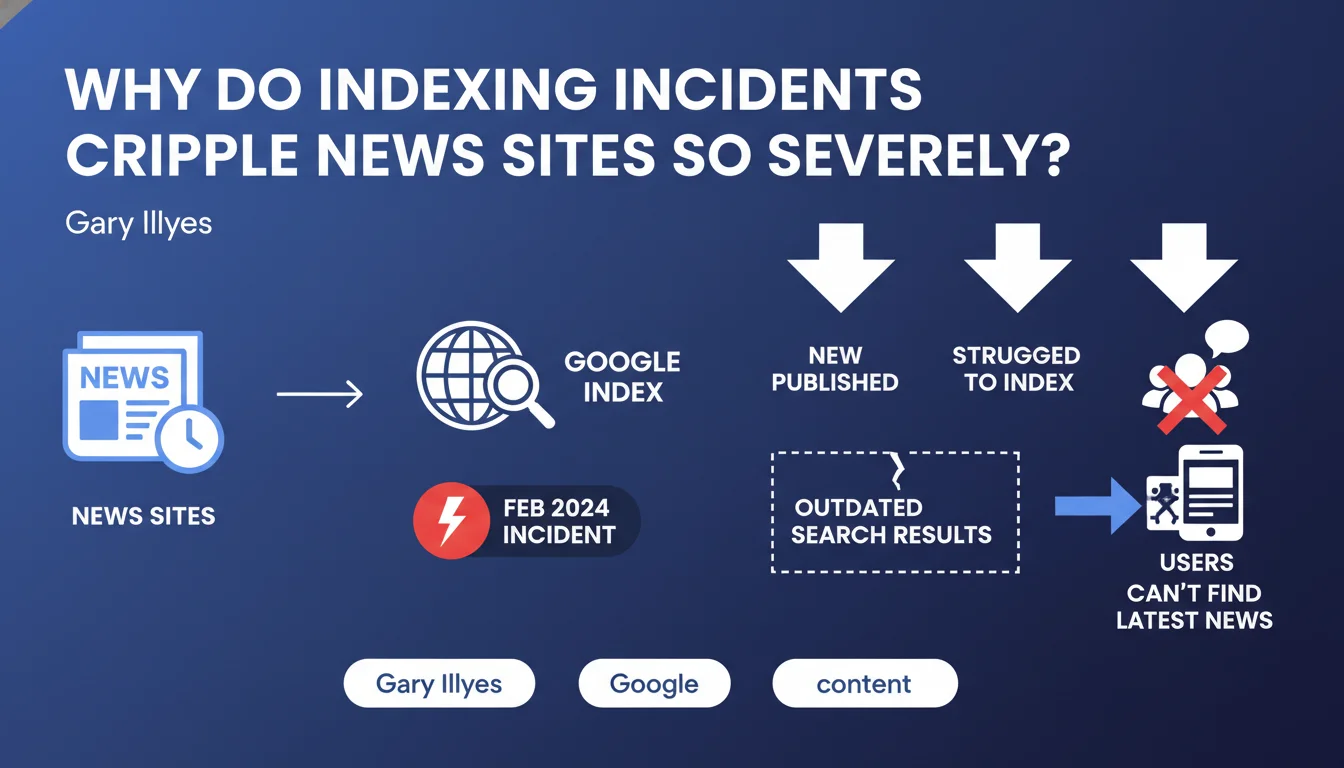
Google confirms that a major indexing incident prevented the search engine from processing new content for several days. News sites were hit hardest, losing visibility precisely when their articles were most relevant. The admission reveals the fragility of the indexing pipeline and its direct impact on real-time discoverability.
What you need to understand
What actually happened during this incident?
Google experienced an indexing outage that blocked the integration of new content into the index. In practical terms: the bot continued crawling, but pages didn't appear in search results. SERPs displayed stale content while new publications remained invisible.
This type of incident reveals that indexing isn't a binary process — a page can be crawled without being indexed, or indexed with significant delays. For news sites, this delay kills editorial value.
Why are news portals so vulnerable to this type of outage?
News sites live on content freshness. An article about a same-day event only has value for a few hours, maybe a few days at most. If indexing takes 48 hours instead of 10 minutes, the article arrives dead on arrival.
By contrast, an e-commerce or corporate site can tolerate an indexing delay of several days without catastrophe. A how-to guide or product sheet maintains its relevance over time.
What lessons should we draw about Google dependency?
This incident highlights an uncomfortable reality: publishers depend entirely on Google's ability to process their content quickly. No amount of technical optimization on the website side can compensate for an outage at Google.
Gary Illyes' statement implicitly acknowledges this asymmetry. Site owners suffer direct business impact, but have no leverage to diagnose or resolve the problem themselves.
- Indexing can fail even when crawling functions normally
- News sites are most exposed to temporary indexing incidents
- No on-page optimization can force Google to index during an infrastructure outage
- Dependence on a single distribution channel (Google Search) creates major business risk
SEO Expert opinion
Does this public acknowledgment change anything for SEOs?
Let's be honest: Google rarely communicates about its indexing outages. When a site suddenly loses visibility, the instinct is to hunt for a penalty, a technical bug on the site side, or an algorithm update. But sometimes — and that's what's insidious — the problem originates from Google's infrastructure itself.
This statement validates what we observe in the field: indexing incidents exist, they can last several days, and Google doesn't always notify about them. The problem? There's no official tool to distinguish a Google-side indexing slowdown from a site-side problem.
How do you tell the difference between a Google outage and a site-side issue?
Practically speaking, it's very difficult. If your site suddenly loses the ability to get new content indexed, you'll first check: robots.txt, crawl budget, server errors, duplicate content, manual penalties. That takes time.
And if after 48 hours Google reindexes normally without you changing anything? You'll never know if it was an incident on their end or some magical resolution of an invisible problem. [Needs verification]: Google offers no public dashboard indicating the health status of its indexing pipeline by vertical or region.
Should you diversify acquisition channels to anticipate this risk?
Short answer: yes. A site that gets 80% of its traffic from Google Search takes an extreme concentration risk. If an indexing incident occurs during a critical commercial period, the impact can be devastating.
Media companies understand this: newsletters, social media, aggregators, Apple News, Google Discover — all these channels serve as a safety net. SEO remains central, but should never be your only distribution lever.
Practical impact and recommendations
What should you do when you suspect a widespread indexing problem?
First step: verify whether the problem affects only your site or the entire market. Check SEO forums, Twitter, community reports. If multiple players in the same sector report similar symptoms at the same time, it's probably a Google incident.
In parallel, use the URL inspection tool in Search Console to force indexing of a few critical pages. If Google consistently returns vague errors or unusually long delays, that's a signal.
How do you protect a news site against these incidents?
You can't prevent a Google outage, but you can reduce your dependence on instant indexing. Push critical content through alternative channels: RSS feeds, Google News, push notifications, social media.
On the technical side, ensure your crawl budget is optimized. If Google normally takes 2 days to crawl a new page, an incident will amplify that delay. The fewer technical friction points you have, the faster you'll recover when infrastructure stabilizes.
What indicators should you monitor to detect these incidents faster?
Set up strict monitoring of your daily indexation rate. How many new pages get indexed each day? If that number drops sharply without changes to your editorial output, that's a red flag.
Also monitor the delay between publication and first appearance in SERPs. A gap that jumps from 10 minutes to 6 hours with no apparent reason may indicate a slowdown in the indexing pipeline.
- Check forums and community channels to confirm a widespread incident
- Use URL inspection to manually test indexing of critical pages
- Diversify distribution channels (newsletter, RSS feeds, social media)
- Optimize crawl budget to minimize indexing delays under normal conditions
- Set up monitoring of daily indexation rate and publication-to-indexing delays
- Maintain editorial presence on Google Discover and Google News as backup channels
❓ Frequently Asked Questions
Combien de temps a duré l'incident d'indexation évoqué par Gary Illyes ?
Est-ce que Google prévient les éditeurs quand un incident d'indexation est en cours ?
Un incident d'indexation peut-il affecter uniquement certaines catégories de sites ?
La Search Console indique-t-elle clairement un incident d'indexation côté Google ?
Faut-il soumettre manuellement ses pages via l'inspection d'URL pendant un incident ?
🎥 From the same video 9
Other SEO insights extracted from this same Google Search Central video · published on 06/06/2024
🎥 Watch the full video on YouTube →
💬 Comments (0)
Be the first to comment.