
Official statement
Other statements from this video 8 ▾
- □ Why does Google deliberately choose not to aim for 100% reliability in Search?
- □ Is Google really checking user experience beyond HTTP status codes?
- □ How is Google detecting incidents before you even know they exist?
- □ Does Google really deprioritize certain traffic during extreme peaks without affecting your SEO?
- □ Why does Google treat some search queries as less expensive than others?
- □ How does Google anticipate and pre-provision server resources for major traffic spikes?
- □ Does Google really steal indexing resources to stabilize its search engine during outages?
- □ Why does Google suddenly shut down data centers when something goes wrong?
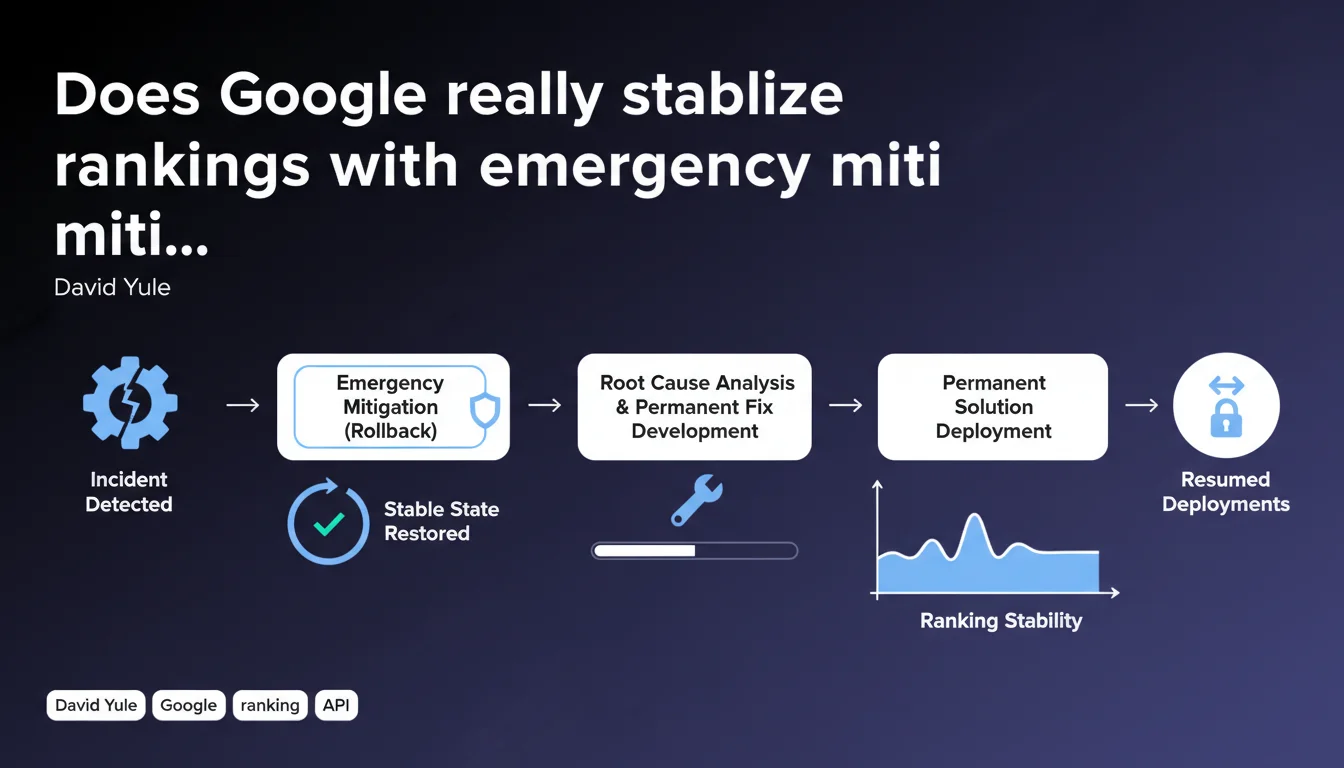
Google formally distinguishes mitigations (urgent actions to stop an incident, such as rollbacks) from permanent fixes. When a deployment causes a ranking problem, the team first intervenes to restore a stable state, then analyzes the root cause before redeploying. This two-step approach explains why certain SERP fluctuations correct quickly, then reappear after a few days.
What you need to understand
Why does Google separate mitigation from permanent fixes?
The distinction is purely operational. A mitigation aims to stop the bleeding: if an algorithmic deployment causes aberrant results or massive instability, the team rolls back to restore a functional state.
The permanent fix, on the other hand, takes time: root cause analysis, testing, validation. Google cannot leave the SERPs in an unstable state during this investigation phase. Hence this sequential mitigation-fix approach.
What does a mitigation look like in practice?
The most common case: a rollback. Google reverts to the previous version of the algorithm or system in question. It's fast, testable, and predictable.
But a mitigation can also be a temporary parametric adjustment — for example, drastically reducing the weight of a signal causing anomalies. The goal remains the same: stabilize, not solve.
What are the implications for SEO professionals?
This approach explains why certain SERP fluctuations correct sharply within 24-48 hours, then reappear a few days later. The first movement is often a mitigation (rollback), the second is the permanent fix deployment.
It also means that a return to normal after an update isn't necessarily a signal of lasting stability. If it's a mitigation, the problem will return in a corrected form — or worse, a different one.
- Google prioritizes immediate stability over permanent resolution initially
- Rollbacks are the primary mitigation tool, but not the only one
- A rapid return to normal after an update may be temporary if it's a mitigation
- Permanent fixes require root cause analysis, which takes time
- This approach explains double SERP movements: rapid correction followed by readjustment a few days later
SEO Expert opinion
Is this transparency a first for Google?
Yes and no. Google has always practiced rollbacks — we saw this with certain Core Updates whose effects were partially reversed in a few days. But explicitly naming the mitigation/fix distinction is new.
It's interesting because it validates a reality that SEO professionals have observed for years: SERPs don't move linearly. They oscillate, correct, re-correct. Knowing there's operational logic behind these movements helps interpret them without falling into paranoia.
Can you anticipate when a mitigation will be followed by a fix?
[To verify] Google doesn't publish a public timeline. In the field, we typically observe a 3 to 10-day delay between a visible mitigation (rollback) and the permanent fix deployment.
But nothing guarantees this timing. Some complex incidents can drag on for weeks. Conversely, fixes can be deployed without visible mitigation if the initial impact was limited.
Should you react differently depending on whether it's a mitigation or a fix?
In theory, yes. If you identify that a SERP movement is probably a mitigation (sharp fluctuation, rapid corrections, discussions in the SEO community reporting a bug), avoid overreacting.
Modifying your site urgently to compensate for a mitigation risks under-optimizing when the permanent fix arrives. Better to wait 7-10 days to confirm whether the fluctuation stabilizes or a second movement occurs.
Practical impact and recommendations
What to do when a suspicious SERP fluctuation appears?
First, observe without panicking. If the movement is sharp and affects many sites simultaneously, it's probably a Google-side incident, not a degradation in your SEO.
Check forums (Reddit, Twitter/X, SEO communities) to see if others report anomalies. If so, wait 48-72 hours before drawing conclusions. A mitigation can correct course quickly.
How do you distinguish a mitigation from a permanent fix?
No foolproof method, but a few clues:
- A mitigation often causes a return to a known previous state — you find rankings similar to those from a few days ago
- A permanent fix generally creates a new equilibrium, different from before and after the incident
- Mitigations are fast (24-48 hours max), fixes take longer to stabilize (several days)
- If Google officially communicates about a bug, it's probably a mitigation in progress
What strategy to adopt when faced with these double movements?
Patience and rigorous documentation. Note dates, fluctuations, and patterns. This will help you distinguish Google incidents from real SEO degradations.
Only modify your site urgently if the fluctuation confirms itself after 10 days. Many SEO professionals have burned themselves by over-optimizing in reaction to a mitigation, only to have to fix everything again when the permanent fix arrived.
Google's two-step incident management (mitigation then fix) demands a cautious approach: wait for stabilization before acting. Monitor, document, analyze — but don't succumb to urgency when a suspicious SERP movement appears.
These algorithmic oscillations make signal interpretation increasingly complex. If you lack visibility or time to track these movements daily, support from a specialized SEO agency can help you distinguish noise from signal and make the right decisions at the right time.
❓ Frequently Asked Questions
Un rollback Google efface-t-il définitivement les changements d'une mise à jour ?
Combien de temps entre une mitigation et le déploiement du correctif définitif ?
Peut-on identifier une mitigation en cours sans confirmation Google ?
Faut-il modifier son site en réaction à une mitigation ?
Les mitigations concernent-elles uniquement les Core Updates ?
🎥 From the same video 8
Other SEO insights extracted from this same Google Search Central video · published on 03/10/2024
🎥 Watch the full video on YouTube →
💬 Comments (0)
Be the first to comment.