
Official statement
Other statements from this video 7 ▾
- □ Pourquoi Google a-t-il vraiment créé les XML Sitemaps ?
- □ Pourquoi Google a-t-il voulu faire des XML Sitemaps un standard web partagé entre moteurs ?
- □ Pourquoi Google a-t-il vraiment lancé Search Console à l'origine ?
- □ Comment réduire de 80% vos emails de support grâce à une documentation SEO-friendly ?
- □ Pourquoi Google cache-t-il certaines informations SEO aux webmasters ?
- □ Pourquoi Google a-t-il ciblé les SEO en priorité avec ses premiers outils pour webmasters ?
- □ Sous-domaines vs sous-répertoires : pourquoi Google refuse-t-il de trancher ?
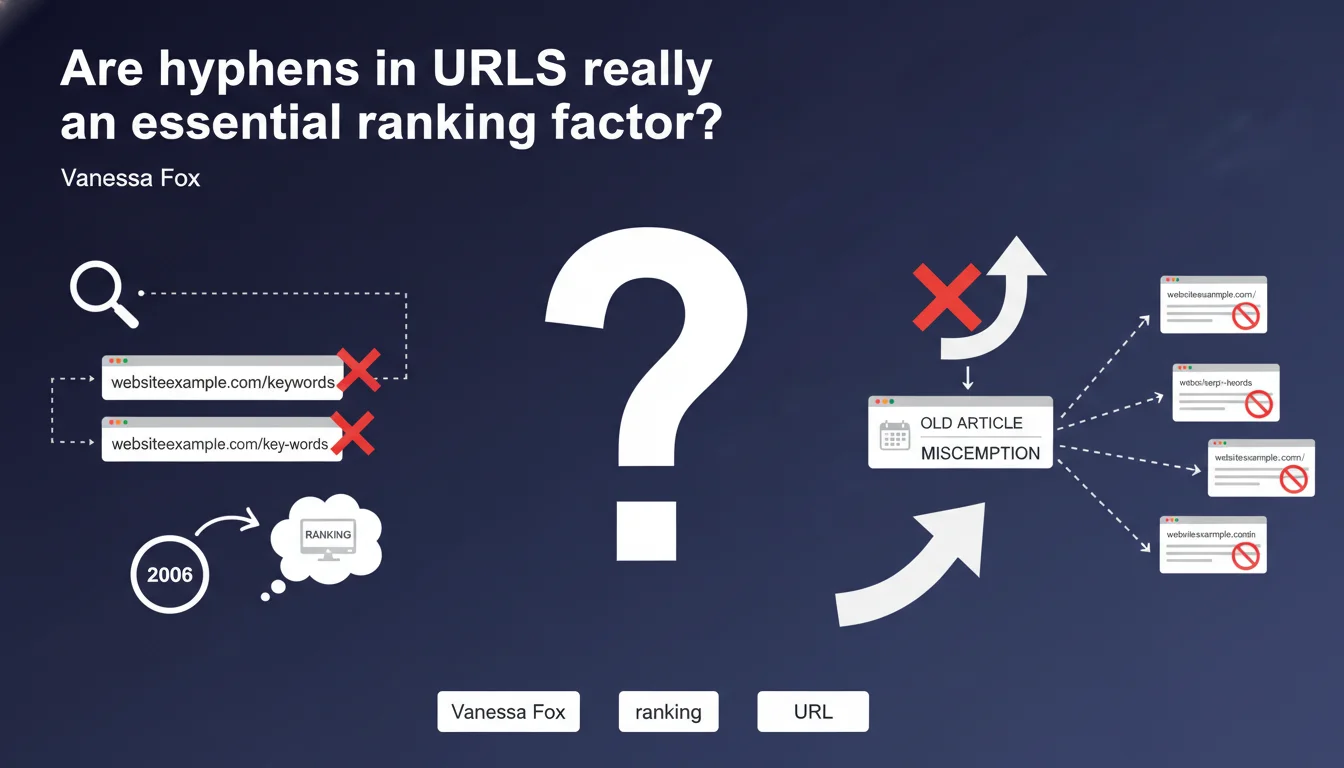
Google clarifies that a 2006 article about using hyphens in URLs continues to cause unnecessary migrations. Websites are still completely restructuring their URLs to add hyphens today, believing it's an essential best practice, when it's not actually a decisive ranking factor. Let's be honest: it's an oversold optimization that generates more risks than benefits.
What you need to understand
Why has this confusion persisted since 2006?
An old article created a stubborn belief: hyphens in URLs would be indispensable for good rankings. This recommendation, taken out of context, has been recycled for years by SEO blogs and unscrupulous agencies.
The problem is that this practice was elevated to the status of SEO dogma, even though it was never presented by Google as a major ranking factor. Result: entire websites are being redesigned just to transform "example.com/categorieproduit" into "example.com/categorie-produit".
What is Google's actual position on hyphens?
Google does recommend using hyphens to separate words in a URL, but only for readability and comprehension—not as a ranking signal. Underscores, for example, don't separate words the same way in indexing, but the impact on rankings is negligible in 99% of cases.
Concretely? If your URL is "product_red", Google might interpret it as a single term "productred". With "product-red", the two words are clearly distinct. But if your content, your tags, and your internal linking are solid, this nuance weighs very little in the balance.
Do you really need to rebuild everything to add hyphens?
No. And that's precisely what Google is denouncing here. A poorly managed URL migration can generate 404 errors, break backlinks, dilute internal PageRank, and cause a temporary drop in traffic. The game is rarely worth the candle.
If your site is already working correctly with URLs without hyphens or with underscores, touching that without strategic reason is taking an unnecessary risk. Time and resources would be better invested in content optimization, internal linking, or technical improvements.
- Hyphens improve URL readability, but don't guarantee better rankings
- A URL migration solely to add hyphens carries significant technical risks
- Google has never said hyphens are an essential ranking factor
- Focus your efforts on optimizations with measurable impact: content, links, Core Web Vitals
SEO Expert opinion
Is this statement consistent with what we observe in the field?
Absolutely. I've seen dozens of sites lose 20 to 40% of traffic after poorly planned URL migrations—often for cosmetic reasons like adding hyphens. 301 redirects don't transfer 100% of juice, external backlinks aren't always updated, and re-crawl time can be lengthy.
The most ironic part? In the vast majority of cases, no ranking improvement is observed after migration. Because Google doesn't care, as long as the URL remains consistent with the content and isn't a string of incomprehensible parameters.
When can hyphens really make a difference?
There are two cases where it might matter—marginally. First, if you're targeting very long-tail queries with multiple keywords in the URL. In that case, having "best-electric-water-heater-2023" rather than "bestelectricwaterheater2023" helps Google understand each term.
Second, in certain multilingual contexts or with exotic CMS systems, underscores can actually cause indexing problems. But that's rare, and it's quickly verified with Search Console.
Why does this belief refuse to die?
Because it's simple to understand and to sell. It's a visible, technical optimization that gives the impression of doing something. Incompetent agencies love it: it justifies quotes, impresses the client, and avoids tackling real problems—mediocre content, chaotic internal linking, disastrous loading times.
SEO still suffers from these recycled myths dating from when Google was much more rudimentary. In 2006, maybe hyphens had weight. But today, with BERT, MUM, and semantic algorithms, Google understands the context of a page perfectly without relying on a pixel-perfect formatted URL.
Practical impact and recommendations
What should you do if your site already uses underscores or no separators?
Don't touch anything unless you have a solid strategic reason. First check if your URLs actually pose an indexing or comprehension problem in Search Console. If everything is indexed correctly and your pages rank, there's no need to disrupt the architecture.
On the other hand, if you're launching a new site or a new section, you might as well adopt hyphens directly. It's a basic best practice, just like having short and descriptive URLs. But not an emergency that justifies a redesign.
How to manage a migration if it's really necessary?
If you absolutely must migrate your URLs—for a global redesign, CMS change, or a real technical reason—then do it properly. Map each old URL, create a 301 redirect for each one, test in pre-production, and monitor Search Console like a hawk for at least 3 months.
Also notify your most strategic backlinks by contacting the sites linking to you. And document everything: number of URLs migrated, residual 404 errors, traffic evolution. Without that, you'll never know if the migration was a success or a disaster.
- Check in Search Console if your current URLs pose an indexing problem
- Don't migrate just to add hyphens—identify a solid strategic reason
- If migrating, create a 301 redirect for each modified URL
- Test redirects in pre-production before going live
- Monitor Search Console and Analytics for at least 3 months post-migration
- Update your strategic backlinks manually if possible
- Document everything to analyze the real impact of the migration
❓ Frequently Asked Questions
Les tirets sont-ils obligatoires pour que Google indexe correctement mes URLs ?
Si je migre toutes mes URLs pour ajouter des tirets, est-ce que je vais gagner en ranking ?
Quelle est la différence entre tirets et underscores pour Google ?
Faut-il absolument utiliser des tirets pour un nouveau site ?
Quels sont les vrais risques d'une migration d'URLs uniquement pour ajouter des tirets ?
🎥 From the same video 7
Other SEO insights extracted from this same Google Search Central video · published on 22/09/2022
🎥 Watch the full video on YouTube →
💬 Comments (0)
Be the first to comment.