
Official statement
What you need to understand
What really determines similarity between two sites in Google's eyes?
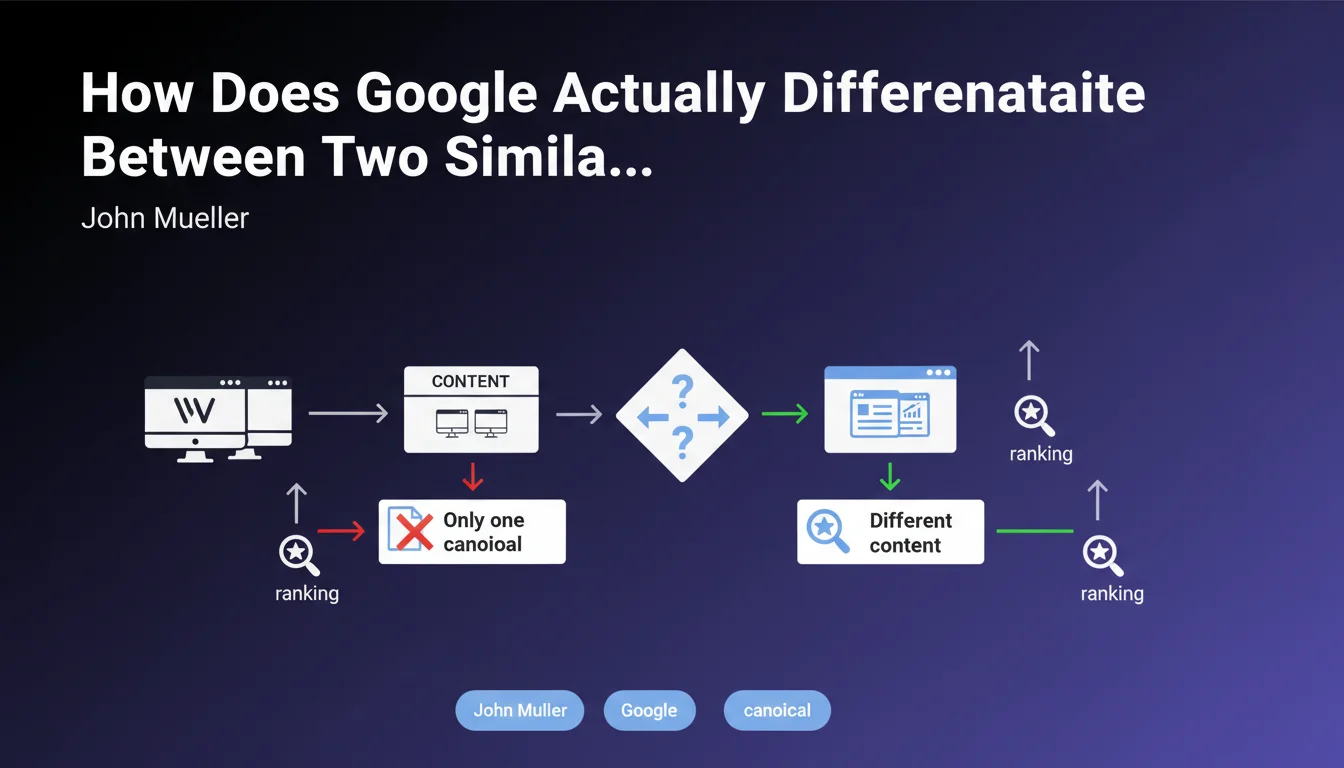
Contrary to popular belief, Google doesn't base its evaluation on visual appearance when judging similarity between two sites. The visual design, colors, or layout don't influence this assessment.
It's exclusively the editorial content that matters in this analysis. Google compares the text, information, and semantic structure of pages to determine whether two sites are identical or not.
How does Google handle two pages with identical content on different sites?
When two pages present the same editorial content, Google applies its duplicate content management logic. Only one of the two pages will be considered canonical and will gain visibility in search results.
The other page will be deindexed or simply won't be displayed in the SERPs. Google typically chooses the version it considers most relevant based on various criteria such as domain authority, publication date, or technical signals.
What happens if the content differs between two similar sites?
If the editorial contents are distinct, even with identical visual appearance, both pages will be indexed normally. Each one will be able to rank for its own keywords based on its relevance and quality.
- Content differentiation is the only determining criterion for Google
- Two sites with the same design but unique content will be treated as two separate entities
- Duplicate content results in canonicalization of only one version
- Editorial originality guarantees indexing and potential visibility
SEO Expert opinion
Is this statement consistent with practices observed in the field?
Absolutely. John Mueller's explanation perfectly aligns with empirical observations made over the years. Many sites use identical or very similar templates without impacting their SEO.
What truly causes problems are satellite site networks with duplicated or lightly spun content. These practices are systematically penalized because Google easily detects editorial duplicate content, regardless of graphic presentation.
What important nuances should be added to this rule?
The notion of "identical content" is more complex than it appears. Google uses semantic similarity algorithms that go beyond simple textual comparison. Rephrased content expressing exactly the same information can be considered duplicate.
Furthermore, the context of the site as a whole also matters. Two isolated pages with similar content will have less negative impact than two entire sites built on the same editorial corpus.
In what cases might this rule have exceptions?
Syndicated content with authorization constitutes a special case. Google may accept duplicate content if clear signals indicate a legitimate syndication relationship, particularly through canonical tags.
International sites with literal translations can also create ambiguous situations. If two language versions are too semantically similar, Google might consider them duplicate despite different languages.
Practical impact and recommendations
What should you concretely do to avoid canonicalization issues?
The absolute priority is to create unique editorial content for each site or each important page. Even if you use the same CMS or template as a competitor, your content must be original.
For multi-brand sites, develop differentiated editorial strategies: distinct angles of approach, specific expertise, targeted geographic areas. Each site must provide unique value to the user.
- Systematically audit your content with duplicate content detection tools (Copyscape, Siteliner, Screaming Frog)
- Properly implement canonical tags to indicate your canonicalization preferences to Google
- Absolutely avoid spinning or automatic content rephrasing
- Create original content of at least 300-500 words per strategic page
- Differentiate product descriptions if you manage multiple e-commerce stores
How can you verify that your sites aren't competing internally?
Use Search Console to identify indexed pages and detect any messages concerning duplicate content. Google sometimes directly signals canonicalization issues.
Perform searches on specific content excerpts in quotes to see which version Google displays as priority. If your pages don't appear, they've probably been deindexed in favor of a canonical version.
What critical mistakes should you absolutely avoid?
Never create a satellite site network with identical or near-identical content hoping to multiply your visibility. This technique has been obsolete and counterproductive for years.
Also avoid copying supplier product descriptions without enriching them. Thousands of e-commerce sites use the same descriptions: you absolutely must personalize and enrich this content.
💬 Comments (0)
Be the first to comment.