
Official statement
What you need to understand
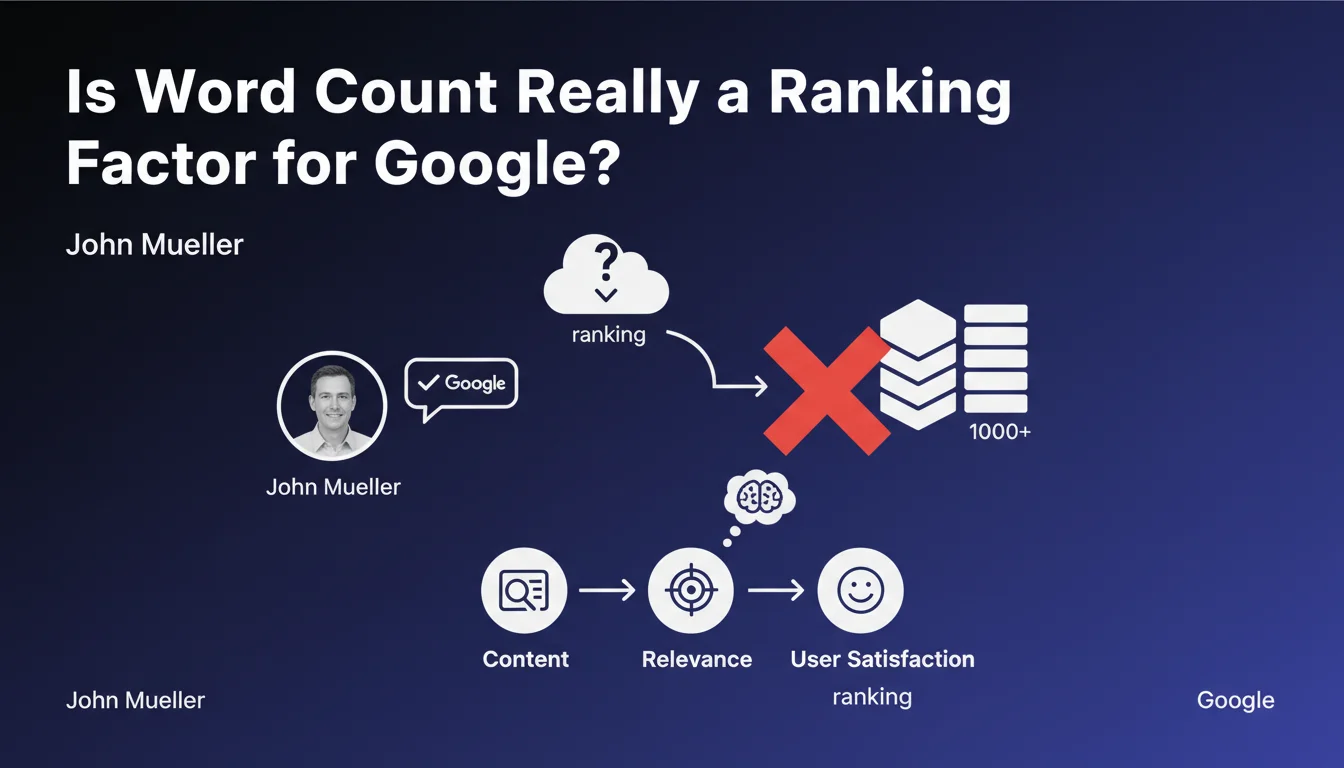
John Mueller clarified a persistent misconception in the SEO world: word count itself is not a ranking factor for Google. This means that a 3000-word page is not automatically ranked higher than a 500-word page.
This statement aims to deconstruct the purely quantitative approach to content. Google seeks to evaluate quality and relevance rather than count words. Long content that is repetitive or off-topic will provide no advantage.
However, there is an important indirect correlation to understand. More developed content generally allows you to:
- Cover the topic comprehensively and respond to search intent
- Develop a rich semantic field with relevant lexical variations
- Address related questions that users have
- Increase time spent on the page and reduce bounce rate
- Obtain more backlinks thanks to reference content
The nuance is therefore crucial: it's not the volume that counts, but what you do with that volume. Long, quality text will almost always outperform short text of equal quality.
SEO Expert opinion
This statement is perfectly consistent with what we observe in the field. The pages that rank at the top of results are not necessarily the longest, but they are those that best respond to search intent.
Nevertheless, analysis of millions of pages shows a correlation between length and positioning in many sectors. Why? Because in-depth content naturally satisfies several criteria that Google values: semantic richness, complete answers, topical authority. A well-structured 2500-word article can naturally cover more long-tail queries than a 300-word text.
In certain specific cases, concise content can indeed outperform: simple definitional queries, direct transactional searches, or technical pages. The essential thing remains to adapt the volume to the page's objective and user expectations.
Practical impact and recommendations
Following this clarification, here are the concrete actions to implement in your content strategy:
- Analyze search intent before defining the target length of your content
- Study competing content that ranks well to identify the expected level of depth
- Prioritize completeness: cover all angles of the topic rather than targeting an arbitrary word count
- Eliminate filler: every sentence should provide value, remove unnecessary repetitions
- Enrich your semantic field naturally by developing relevant sub-themes
- Structure with Hn headings to facilitate reading and indexing of different sections
- Measure user engagement (time on page, bounce rate) rather than counting words
- Test different lengths according to page types: blog articles, product pages, category pages
- Update your existing content by adding depth where relevant, not everywhere systematically
In summary: Focus on satisfying user intent rather than a word count goal. Excellent 800-word content is better than mediocre 2000-word content.
Implementing this qualitative approach requires careful analysis of your sector, your competitors, and the specific expectations of your audience. These optimizations require time, analytical skills, and a deep understanding of Google's relevance mechanisms. To effectively structure this approach and maximize your results, support from a specialized SEO agency can prove valuable, particularly for defining the content strategy adapted to each page type on your site.
💬 Comments (0)
Be the first to comment.