
Official statement
What you need to understand
What exactly does Google say about word count as a ranking criterion?
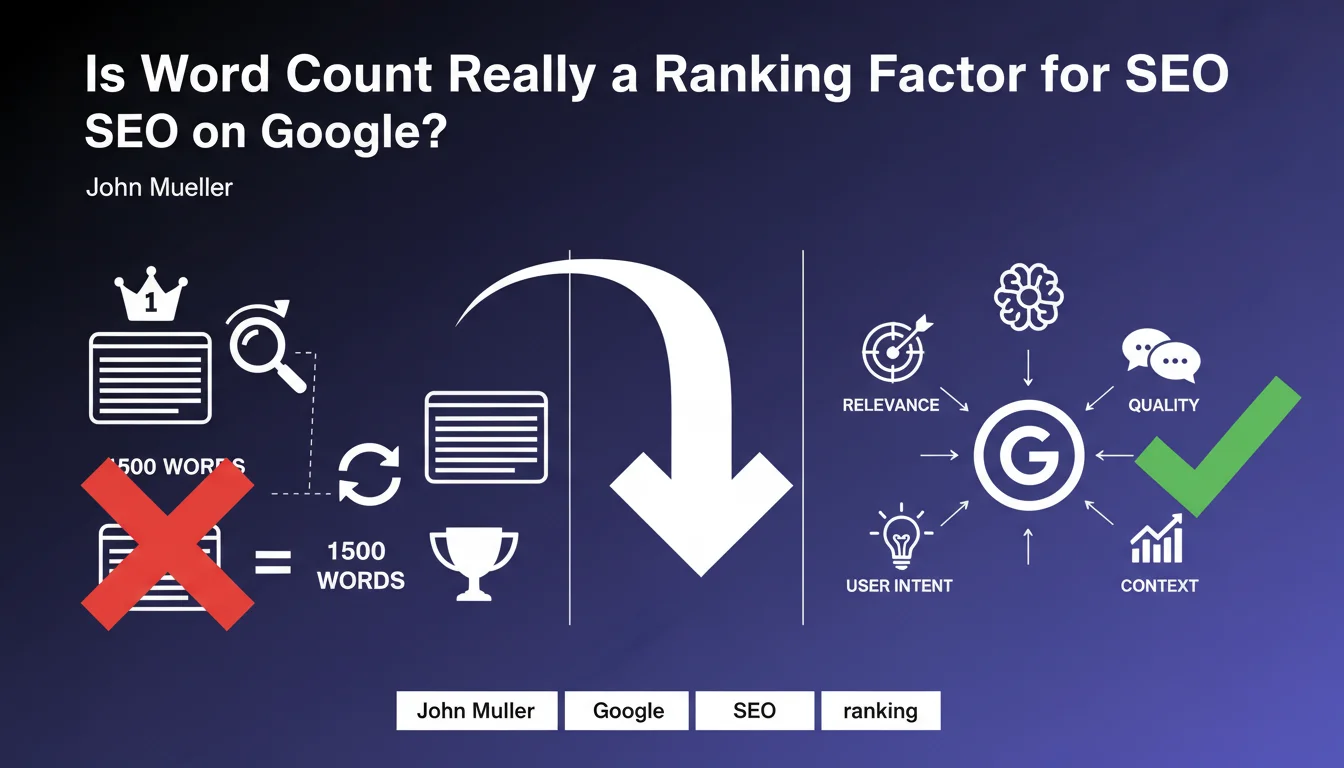
Google clearly states that word count on a page is not a direct relevance or ranking criterion. Reproducing the same content volume as a well-positioned competitor page therefore in no way guarantees good SEO performance.
This statement contradicts a very widespread misconception in the SEO community: the one that involves analyzing the length of content in first position to determine the "optimal" number of words to produce.
Why does this confusion persist within the SEO community?
Many SEO tools display the average word count of pages ranked on the first page as an important metric. This has created a misleading correlation in the minds of many practitioners.
In reality, if long content often ranks well, it's not because of its length per se, but because it has more opportunities to develop a rich semantic field and fully answer the search intent.
How does Google actually evaluate content quality?
Google's algorithm analyzes semantic relevance, depth of subject treatment, and the content's ability to satisfy the user's search intent. Word count is merely a potential byproduct of these factors.
- Word count is not a direct ranking criterion in Google's algorithm
- Long content is not automatically better than short content
- Semantic richness and answering search intent are the true determining factors
- Copying competitors' length is an ineffective strategy
SEO Expert opinion
Does this statement align with field observations from SEO practitioners?
Yes, absolutely. In 15 years of practice, I've observed that concise and relevant content regularly outperforms long but diluted content. The observed correlation between length and ranking actually hides a different causal relationship.
Well-positioned long content ranks well because it treats its subject exhaustively, covers secondary questions, and develops a rich semantic universe. Length is a consequence, not a cause.
What essential nuances should be added to this statement?
Warning: this doesn't mean that 150-word content will outperform a 2,000-word competitor on a complex query. Word count remains an indirect indicator of the ability to treat a subject in depth.
For complex informational queries, it's mathematically difficult to provide a complete answer in 300 words. Conversely, for simple or transactional queries, 5,000-word content can be counterproductive.
In which cases does content length remain a factor to consider?
Length remains relevant as an exploratory metric during competitive analysis. It indicates the level of depth expected by Google for a given query, without constituting a target to reach.
For technical subjects or practical guides, a certain length is inevitable to cover all aspects. But it's the completeness of treatment that matters, not the word counter.
Practical impact and recommendations
What editorial strategy should you concretely adopt for your content?
Definitively abandon the "target word count" approach. Instead, start from search intent and the questions your audience actually asks. List all aspects of the subject to cover before starting to write.
Analyze competitor content not to count their words, but to identify the angles covered, the questions addressed, and potential gaps you could fill. It's this qualitative approach that will make the difference.
What critical mistakes must you absolutely avoid?
Never artificially dilute content to reach a predefined word count. Google detects inflated content with repetitions, unnecessary digressions, or generic filler.
Also avoid the opposite mistake: systematically producing minimalist content on the grounds that "length doesn't matter." Content that's too superficial won't answer search intent for complex queries.
How should you audit and optimize existing content according to this principle?
Analyze your pages by asking yourself this question: does this content answer completely and clearly the search intent? If yes, its length is appropriate. If no, identify semantic gaps, not a word deficit.
Use Search Console data to identify pages with high impression rates but low CTR or average position. These pages may suffer from incomplete subject treatment, regardless of their current length.
- Analyze search intent before defining content structure
- List all aspects and questions to cover for comprehensive subject treatment
- Write naturally until the subject is exhausted, without length constraints
- Enrich the semantic field with relevant related terms and concepts
- Ruthlessly remove all filler or repetitive content
- Verify that each paragraph provides real informational value
- Test readability and clarity: dense content isn't necessarily indigestible content
- Measure performance through engagement metrics (time on page, bounce rate)
Word count is not a Google ranking criterion, but a natural byproduct of thorough subject treatment. Focus on completely satisfying search intent and developing a rich semantic field rather than reaching a word quota.
This qualitative content approach requires sharp editorial and SEO expertise to finely analyze search intents, optimally structure information, and balance comprehensiveness with readability. If transforming your content strategy seems complex to orchestrate internally, support from a specialized SEO agency can prove valuable for developing a customized methodology and training your teams in best practices.
💬 Comments (0)
Be the first to comment.